

TL;DR:
- Most industrial property owners treat due diligence as a compliance check, which leaves significant risk unaddressed. Commercial due diligence validates the investment thesis by analyzing market, tenant, and competitive dynamics specific to GTA industrial assets. A thorough process involves cross-disciplinary teams and rigorous analysis to protect long-term value amid the region's fast-changing market conditions.
Most industrial property owners treat due diligence as a compliance exercise. They check the title, review the lease abstracts, confirm zoning, and call it done. But that approach leaves enormous risk on the table, and in the GTA's fast-moving industrial market, it can cost you millions. Commercial due diligence is fundamentally about validating the investment thesis, not just confirming paperwork. This guide breaks down what commercial due diligence truly means for GTA industrial real estate, what you must examine, and how to apply it practically whether you are acquiring, disposing of, or leasing industrial assets across Toronto, Mississauga, Brampton, Vaughan, or the broader GTA region.
Table of Contents
- Defining commercial due diligence in industrial real estate
- Core elements you must review during commercial due diligence
- How to analyse market dynamics and competition for GTA industrial assets
- Growth, margin, and tenant dynamics: Connecting due diligence to long-term value
- Best practices and GTA-specific tips for commercial due diligence success
- A hard truth: Why most commercial due diligence fails to protect GTA property value
- Need help? Connect with GTA industrial real estate experts
- Frequently asked questions
Key Takeaways
| Point | Details |
|---|---|
| Goes beyond compliance | Commercial due diligence uncovers risks and opportunities that basic compliance checks miss. |
| Market and tenant focus | Reviewing market trends and tenant quality is essential for GTA industrial property success. |
| Process is multi-layered | True diligence involves analysing competition, demand, property fundamentals, and margins. |
| Expert help matters | Using local professionals can boost the depth and accuracy of your due diligence work. |
Defining commercial due diligence in industrial real estate
Commercial due diligence is often confused with its legal and financial counterparts, and that confusion is costly. When most people say "due diligence," they picture lawyers reviewing title documents or accountants auditing financial statements. Those are important, but they are not commercial due diligence.
"Commercial due diligence is essentially about validating the transaction thesis, not just confirming compliance or balance-sheet accuracy."
Commercial due diligence asks a fundamentally different question. Instead of asking "Is everything in order?", it asks "Does this deal actually make sense given market realities, competitive dynamics, and future demand?" For a GTA industrial property, that means examining whether the asset can sustain or grow its income, whether the tenants occupying it are creditworthy and expanding, and whether the submarket supports the rental rates and absorption assumptions baked into the purchase price.
The distinction between the three types of due diligence matters enormously in practice:
- Commercial due diligence validates the business case, market position, and growth assumptions
- Financial due diligence verifies income statements, operating expenses, and cash flow accuracy
- Legal due diligence confirms title, zoning, environmental compliance, and lease enforceability
In the GTA industrial market, where vacancy rates have remained historically tight and rental rates have climbed sharply over recent years, the commercial layer is where the real risk and opportunity lives. A property might show clean financials and clear title but still represent a poor investment if the tenant is contracting, the submarket is oversupplying, or the building specifications are becoming obsolete relative to modern logistics requirements.
Understanding due diligence in GTA leasing is the foundation for making sound decisions in one of Canada's most competitive industrial corridors. Getting this definition right before you begin any transaction is not optional. It is the difference between a deal that performs and one that disappoints.
Core elements you must review during commercial due diligence
Once you understand what commercial due diligence means, you need to know exactly what to examine to make sound decisions. The scope is broader than most buyers and tenants expect, and each element connects directly to the property's future performance.
Here is a numbered breakdown of the essential domains to investigate:
- Market analysis — Vacancy rates, net asking rents, absorption trends, and supply pipeline for the specific GTA submarket where the asset sits
- Property fundamentals — Clear height, truck court depth, column spacing, power supply, and dock/grade door ratios relative to current tenant requirements
- Tenant and covenant review — Credit strength of existing tenants, lease expiry profile, renewal options, and expansion or contraction clauses
- Competitive landscape — Proximity to competing industrial parks, new speculative developments, and alternative sites that tenants could relocate to
- Customer and demand analysis — Understanding the end-user demand driving tenant activity, including e-commerce growth, logistics consolidation, and manufacturing reshoring trends
- Regulatory and environmental review — Phase I and Phase II environmental assessments, municipal zoning permissions, and any outstanding orders or compliance issues
Each of these domains feeds directly into the investment thesis. Missing even one can create a blind spot that undermines your entire valuation model.
| Type of due diligence | Primary focus | Key outputs |
|---|---|---|
| Commercial | Market, competition, tenant demand, growth drivers | Investment thesis validation, risk flags, opportunity mapping |
| Financial | Income, expenses, cash flow, capital expenditure | Verified NOI, adjusted EBITDA, financial risk exposure |
| Legal | Title, zoning, leases, environmental compliance | Clean title confirmation, lease enforceability, regulatory standing |
When analysing leaseback deals or any complex industrial transaction, this three-layer framework helps ensure nothing falls through the cracks. Each type of review informs the others, but commercial due diligence sets the strategic context that makes the financial and legal findings meaningful.
Pro Tip: Start your commercial due diligence before you engage lawyers and accountants. If the market analysis reveals fundamental problems with the investment thesis, you save significant professional fees by identifying deal-breakers early.
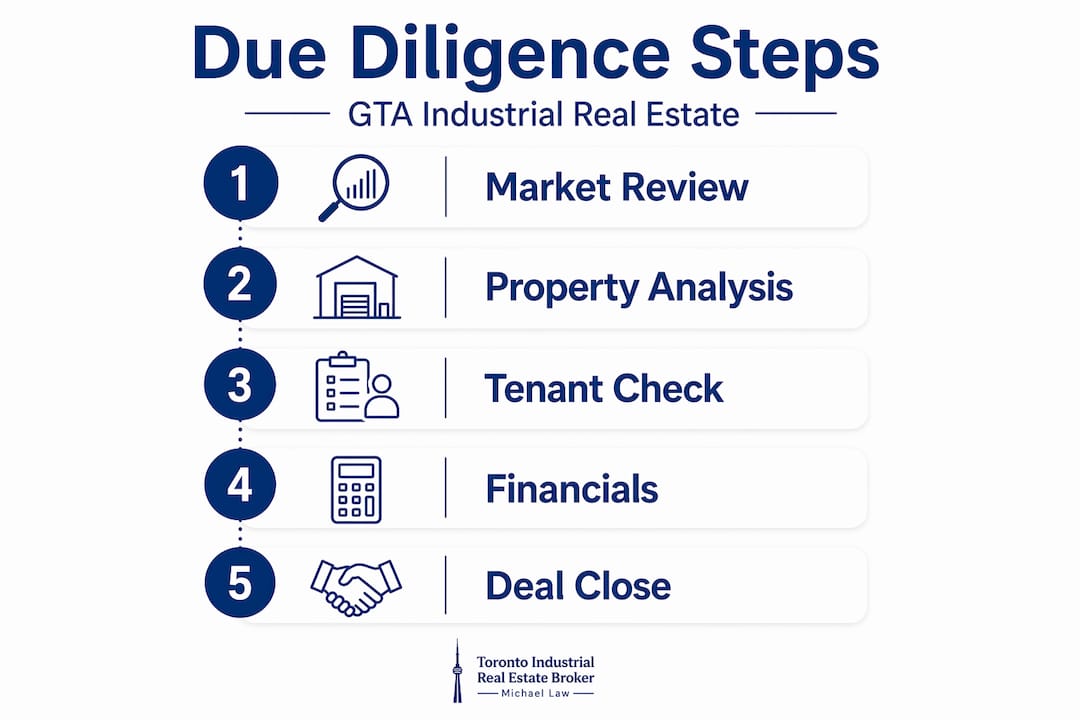
A standard commercial due diligence process for a GTA industrial acquisition typically follows this sequence. First, you define the investment thesis and the assumptions it relies on. Second, you gather market data and competitive intelligence for the specific submarket. Third, you review tenant covenants and lease structures in detail. Fourth, you assess the property's physical specifications against current and future tenant requirements. Fifth, you synthesise findings into a risk-adjusted view of value that informs your offer price and negotiation strategy.
How to analyse market dynamics and competition for GTA industrial assets
With the checklist of elements in hand, the next step is to effectively analyse the broader GTA market and competitive landscape. This is where many buyers and tenants underinvest their time, relying on general market commentary rather than submarket-specific intelligence.
The GTA industrial market is not monolithic. Conditions in Mississauga's Airport Corridor differ meaningfully from those in Brampton's Highway 410 node, which differ again from Markham's Highway 407 corridor or Oshawa's emerging industrial parks. Each submarket has its own vacancy profile, rent trajectory, supply pipeline, and tenant demand drivers.
Key market indicators to track for any GTA industrial asset include:
- Vacancy rate for the specific submarket, not just the GTA overall
- Net asking rent and net effective rent trends over the past 12 to 24 months
- New supply under construction or planned within a 5-kilometre radius
- Recent lease transactions of comparable size and specification in the area
- Absorption trends indicating whether demand is outpacing or lagging supply
- Infrastructure changes such as highway expansions, transit investments, or port capacity shifts that affect logistics demand
The table below illustrates how to frame a market benchmarking exercise using illustrative GTA data:
| Market indicator | Healthy benchmark | Illustrative GTA context (2025/2026) |
|---|---|---|
| Submarket vacancy rate | Below 4% signals strong demand | Many GTA nodes remain below 3% despite recent supply additions |
| Net asking rent growth | 3 to 5% annual growth is sustainable | Select submarkets saw 15 to 20% growth in prior cycle peaks |
| New supply pipeline | Balanced when below 2% of existing stock | Brampton and Milton have seen elevated speculative construction |
| Lease transaction velocity | Stable or rising absorption confirms demand | Large-bay logistics demand has moderated; mid-bay remains active |
Understanding market analysis for investment decisions requires going beyond headline statistics. The real insight comes from understanding why those numbers are moving. Is vacancy rising because of new supply, or because tenants are contracting? Is rent growth slowing because demand is softening, or because landlords are offering more incentives to attract quality covenants?
Competitive analysis adds another critical layer. For an industrial acquisition or lease negotiation, you need to map the competing properties that your tenants could realistically move to. This means identifying buildings of similar size, clear height, and specification within a reasonable logistics radius. If a tenant has three or four credible alternatives at lower rents, their negotiating position is strong and your income assumptions need to reflect that reality.
GTA real estate strategies that work consistently are built on this kind of granular competitive intelligence. Accessing industrial real estate market reports that break down submarket performance by building size, age, and specification gives you the benchmarking data needed to position your asset accurately and negotiate from a position of knowledge.
Growth, margin, and tenant dynamics: Connecting due diligence to long-term value
Beyond understanding markets and competition, focus on the property-level analysis that shapes future performance and value. This is where commercial due diligence moves from market observation to investment conviction, examining the specific drivers that will determine whether the asset grows in value or stagnates.
Growth drivers are the forces that will expand demand for the property over time. In GTA industrial real estate, the most significant growth drivers right now include:
- E-commerce logistics requirements driving demand for last-mile and mid-bay distribution facilities close to population centres
- Manufacturing reshoring as Canadian and North American companies bring production closer to home markets, increasing demand for flex and manufacturing space
- Infrastructure investment such as Highway 413, transit expansions, and port improvements that reshape logistics geography
- Tenant expansion plans where existing occupants have contractual or operational reasons to grow within the same facility or campus
Margin drivers determine how much of the property's revenue actually flows through to the owner as net income. In industrial real estate, the most important margin factors are:
- Lease structure and whether the property operates on a net, gross, or modified gross basis
- Expense recovery provisions and how effectively operating costs are passed through to tenants
- Capital expenditure requirements including roof life, HVAC condition, dock leveller maintenance, and pavement condition
- Operating efficiency of the building's systems relative to modern energy and sustainability standards
Pro Tip: When reviewing a GTA industrial acquisition, model three scenarios for each major lease rollover: the tenant renews at market rent, the tenant vacates and you re-lease within six months, and the tenant vacates and the space sits vacant for 12 months. The gap between these scenarios reveals your true risk exposure.
Tenant review is arguably the most critical component of property-level due diligence. A lease is only as strong as the covenant behind it. For each significant tenant, you want to understand their financial health, their industry trajectory, their operational dependency on the specific location, and their lease expiry and option profile.

Monitoring real estate trends at the tenant industry level is equally important. A logistics company whose primary customer is a retailer facing structural decline represents a different risk profile than a pharmaceutical distributor with long-term government contracts. Understanding the tenant's business, not just their lease, is what separates thorough commercial due diligence from a superficial document review.
The property acquisition process in the GTA requires integrating all of these property-level findings into a coherent view of risk-adjusted value. Data-driven decisions in GTA industrial real estate consistently outperform decisions made on intuition or incomplete information, particularly when market conditions shift quickly.
Best practices and GTA-specific tips for commercial due diligence success
Now that you know what to analyse, it is time to ensure due diligence is executed consistently and effectively using local experts and practical tools. The difference between due diligence that protects your investment and due diligence that gives you false confidence often comes down to process discipline and team quality.
Assembling the right team is the first step. A robust commercial due diligence team for a GTA industrial transaction typically includes:
- An industrial real estate broker with deep submarket knowledge and access to comparable transaction data
- A market analyst or research specialist who can interpret vacancy, rent, and absorption trends at the submarket level
- A commercial lawyer experienced in industrial leases, environmental liability, and Ontario real estate law
- A qualified building inspector with specific industrial experience, not a residential inspector working outside their expertise
- An accountant or financial analyst to verify income statements and model cash flow scenarios
- An environmental consultant for Phase I and, where warranted, Phase II assessments
Common mistakes GTA industrial owners make during due diligence include:
- Relying on the vendor's rent roll without independently verifying lease terms and tenant payment history
- Accepting market rent assumptions based on headline asking rents rather than net effective rents after incentives
- Skipping competitive analysis because the current vacancy is low, missing the risk of new supply entering the market during the hold period
- Underestimating capital expenditure requirements by focusing only on current condition rather than projected maintenance over a 5 to 10 year hold
- Failing to investigate tenant business health beyond the lease document itself
Key documents and tools to gather and review during a GTA industrial due diligence process include the current rent roll and all lease agreements, operating cost statements for the past three years, property tax assessments and any outstanding appeals, environmental reports and records of site use history, building condition reports, zoning certificates and any outstanding municipal orders, and recent comparable lease and sale transactions in the submarket.
Broker value in leasing and acquisition transactions extends well beyond negotiating the deal. An experienced GTA industrial broker brings access to off-market transaction data, submarket relationships, and pattern recognition from dozens of similar deals. That institutional knowledge accelerates your due diligence and surfaces risks that a checklist alone would never catch.
Pro Tip: Set a firm due diligence timeline at the outset and assign clear ownership for each workstream. Open-ended timelines lead to scope creep, missed deadlines, and decisions made under pressure. A well-managed 30-day due diligence period with clear milestones is more effective than a 60-day process with no structure.
The GTA industrial market moves quickly. Properties that generate strong interest can see competing offers emerge during a due diligence period, creating pressure to compress the process or overlook concerns. Resist that pressure. A disciplined due diligence process is your primary protection against overpaying or inheriting problems that erode returns for years.
A hard truth: Why most commercial due diligence fails to protect GTA property value
Here is something that does not get said often enough in this industry: most commercial due diligence processes, even when they look thorough on paper, fail to genuinely protect the buyer or lessee. They produce reports, they check boxes, and they satisfy lenders and boards. But they do not actually challenge the investment thesis.
The reason is structural. Most due diligence teams are assembled after the decision to pursue a deal has already been made emotionally or strategically. The brief they receive, implicitly or explicitly, is to confirm the deal rather than to stress-test it. Lawyers look for legal problems. Accountants verify the numbers. Brokers confirm market rents. But nobody is explicitly tasked with asking the harder question: "Should we actually do this deal at this price?"
We have seen this play out in the GTA market more than once. A buyer acquires a well-located industrial property with a strong-looking rent roll, only to discover two years later that the anchor tenant's core business was already in structural decline at the time of purchase. The lease had four years remaining. The financials looked clean. But a genuine commercial due diligence process, one that examined the tenant's industry, their customer concentration, and their operational trajectory, would have flagged the risk clearly.
The institutional investment strategies that consistently outperform in the GTA industrial market share a common characteristic. They treat commercial due diligence as an adversarial process, not a confirmatory one. They assign someone the explicit role of finding reasons not to do the deal and require that those concerns be addressed before proceeding.
The investment thesis validation framework is not just about market and competition analysis. It is about intellectual honesty. It requires acknowledging what you do not know, modelling the downside scenarios with the same rigour as the upside, and being willing to walk away from a deal that looks attractive on the surface but cannot withstand scrutiny.
In a market like the GTA, where industrial assets have appreciated dramatically and competition for quality product is fierce, the temptation to compress due diligence and move quickly is real. The investors and corporate occupiers who build lasting value are the ones who resist that temptation consistently.
Need help? Connect with GTA industrial real estate experts
Navigating commercial due diligence in the GTA industrial market requires more than a checklist. It requires local expertise, submarket intelligence, and the professional relationships to access data that is not publicly available.
Michael Law Real Estate provides advisory services across all major GTA industrial corridors, from Mississauga and Brampton in the west to Markham and Durham Region in the east. Whether you are acquiring an investment property, negotiating a lease, or evaluating a sale, the due diligence process benefits enormously from a broker who knows the specific submarket, the competing properties, and the tenant demand drivers at a granular level. If you are exploring industrial real estate in Caledon or any other GTA node, connecting with an experienced industrial specialist early in the process is the single highest-value step you can take to protect your investment and improve your negotiating position.
Frequently asked questions
How long does commercial due diligence usually take for GTA industrial assets?
Most GTA industrial property due diligence processes require 3 to 6 weeks, depending on deal complexity and issues uncovered. Larger or more complex assets with multiple tenants or environmental considerations may require additional time.
What is the main risk if due diligence is superficial?
Poor due diligence can lead to overpaying, missed tenant risks, or expensive surprises post-acquisition. As the ICAEW notes, the real purpose is validating the investment thesis, and skipping that step leaves your core assumptions unverified.
Is commercial due diligence required by law for industrial real estate?
No, but skipping it significantly increases risk for purchasers and corporate decision-makers. Lenders and institutional partners increasingly expect evidence of thorough commercial due diligence before committing capital.
What type of professionals should be on a due diligence team?
Teams often include property brokers, market analysts, lawyers, building inspectors, and accountants. For GTA industrial assets, adding an environmental consultant and a tenant credit analyst is strongly advisable.
Does commercial due diligence differ for a lease versus a purchase?
Yes. Leased assets focus more on tenant covenant, operational fit, and lease flexibility, while purchases require deeper title, financial, and market-level assessments to validate long-term income and capital value assumptions.