
TL;DR:
- Thorough due diligence in GTA industrial leasing is essential to uncover environmental, zoning, and repair liabilities.
- Skipping or rushing due diligence can lead to costly legal and operational issues throughout the lease term.
- Engaging an industrial real estate expert enhances risk management and negotiation leverage in a competitive market.
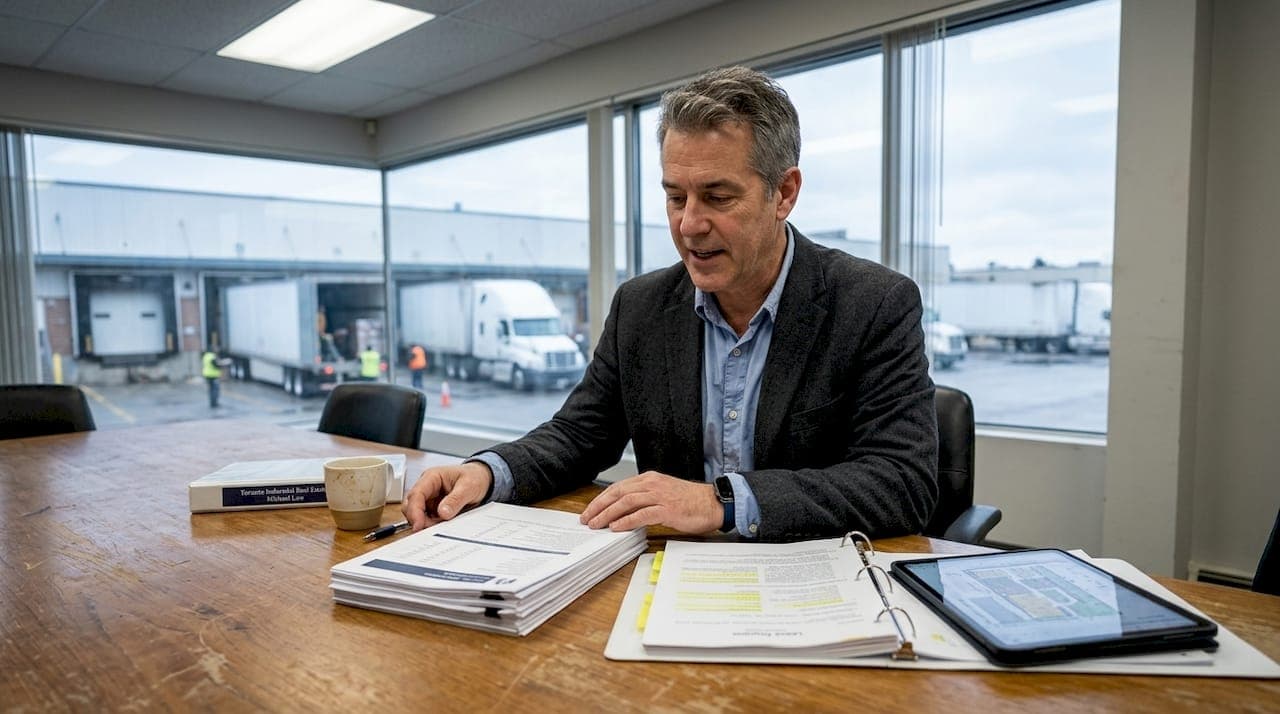
Signing an industrial lease in the GTA feels straightforward until the surprises start arriving. Most businesses focus on the rent figure and the square footage, assuming everything else is manageable detail. It rarely is. Environmental liabilities, hidden repair obligations, zoning restrictions, and poorly drafted operating cost clauses can quietly turn a sound business decision into an expensive problem. Thorough due diligence is not a formality you rush through before moving in. It is the process that separates businesses that thrive in their space from those that spend years fighting costly obligations they never anticipated.
Table of Contents
- What due diligence means in industrial leasing
- The core components of industrial leasing due diligence
- Special due diligence issues for GTA logistics, manufacturing, and warehousing
- Timeline, red flags, and real-world risks
- The uncomfortable truth most businesses miss about industrial lease due diligence
- Connect with GTA industrial leasing expertise
- Frequently asked questions
Key Takeaways
| Point | Details |
|---|---|
| Hidden risks abound | Skipping due diligence can expose your business to liabilities tied to the property and lease, not just the other party. |
| Checklists protect you | A thorough process prevents missed items like environmental contamination or excessive repair costs. |
| GTA market is unique | Local zoning, industrial use patterns, and building features demand special attention in the Greater Toronto Area. |
| Leverage expert insight | Real estate specialists can help you spot issues that generic reviews often miss, especially in competitive or changing markets. |
What due diligence means in industrial leasing
To understand how to manage these risks, it's crucial to know what due diligence actually involves and why it's different in an industrial setting.
Due diligence in industrial leasing is the formal process of investigating every material fact about a property, a lease, and a landlord before you commit. In a residential rental, you look around the unit and sign. In an industrial context, the stakes are fundamentally different. You may be responsible for returning a property in a specific condition, absorbing costs for repairs you didn't cause, or facing restrictions that make your operation legally non-compliant from day one.
The GTA industrial market moves fast. Vacancy rates have tightened across major nodes including Mississauga, Brampton, and Vaughan over the past several years, creating pressure on tenants to make quick decisions. That urgency is exactly where costly mistakes are made. A business that accepts a lease without scrutinising every clause because another tenant was circling the property is a business that may spend years absorbing costs it never budgeted for.
Working with an industrial real estate expert who knows the GTA market gives you the analytical distance to slow down, ask the right questions, and protect yourself appropriately.
Here is what due diligence is designed to uncover:
- Undisclosed environmental contamination from prior industrial uses
- Operating cost clauses that shift capital repair obligations to the tenant
- Zoning designations that restrict your specific type of operation
- Outstanding work orders or municipal violations attached to the property
- Existing side agreements between the landlord and prior tenants
- Restrictions on assignment or subletting that limit your future flexibility
One of the most significant legal realities every GTA tenant should understand is this: leases run with the land under Ontario's Commercial Tenancies Act, meaning your obligations bind you and potentially future parties regardless of ownership changes. A poorly reviewed lease does not become harmless when the building sells. It travels with the property and remains your problem.
"Due diligence in industrial leasing is critical to avoid unforeseen liabilities as leases run with the land under Ontario's Commercial Tenancies Act."
The GTA's industrial legacy adds another layer. Many sites in Toronto, Etobicoke, and older parts of Mississauga have decades of manufacturing history, meaning environmental exposure is a genuine and common risk, not a remote possibility.
The core components of industrial leasing due diligence
Now that we know what due diligence is, let's dig into the specific steps every GTA business should take when considering an industrial lease.
Due diligence is not a single task. It is a structured process with distinct components, each targeting a different type of risk. Skipping even one can leave you exposed in ways that are expensive and sometimes irreversible.
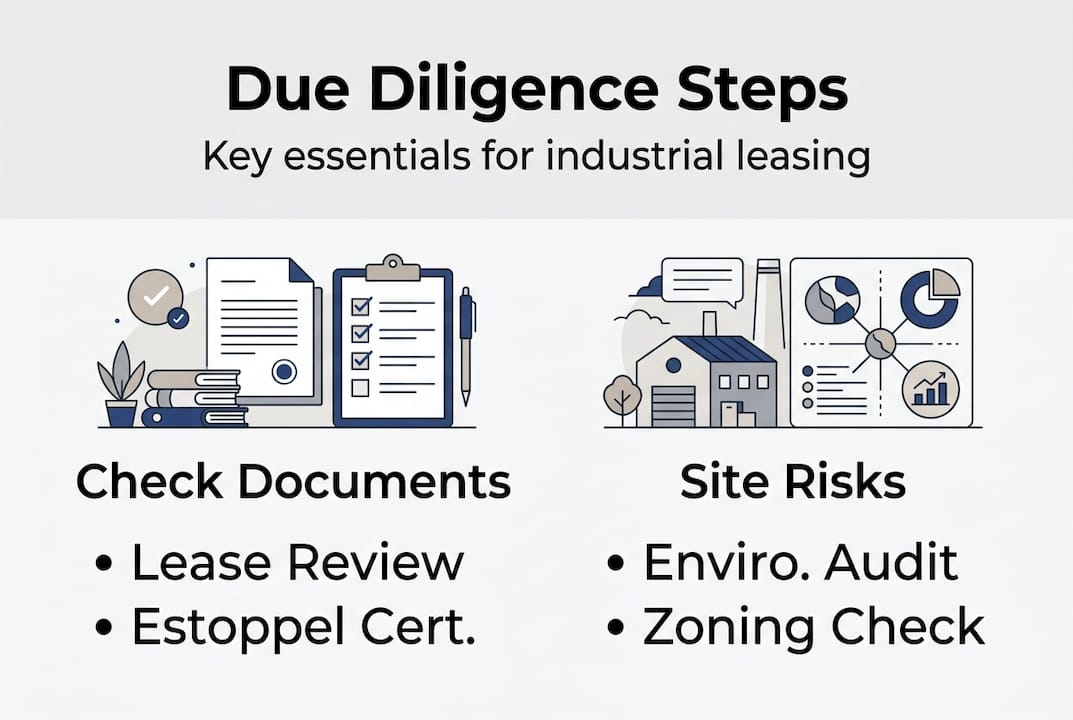
Key mechanics include verifying lease basics, obtaining estoppel certificates, reviewing operating costs, and completing a physical inspection of the property. Here is what each component involves and why it matters:
| Due diligence component | Purpose | Common pitfall |
|---|---|---|
| Full lease review | Identifies obligations, restrictions, and cost responsibilities | Buried repair and HVAC clauses |
| Estoppel certificate | Confirms landlord's representations about lease status | Undisclosed amendments or arrears |
| Operating cost audit | Validates what costs are passed to tenants | Management fees, capital replacements |
| Title and survey review | Confirms ownership and any encumbrances | Easements affecting your access |
| Physical building inspection | Assesses structural, mechanical, and electrical condition | Deferred maintenance passed to tenant |
| Zoning and permit verification | Ensures your use is legally permitted | Use restrictions, truck access limits |
An estoppel certificate is a written declaration from the landlord confirming the current status of the lease including rent amounts, any outstanding disputes, and the existence of side agreements. For tenants, it is a critical safeguard because it creates a legal record the landlord cannot easily contradict later.
Knowing the range of industrial property types in the GTA also matters here. A flex unit, a freestanding distribution centre, and a multi-tenant warehouse each carry different risk profiles and require different inspection priorities.
Here is a recommended sequence for your due diligence process:
- Obtain and review the full lease document and all schedules
- Request an estoppel certificate from the landlord
- Commission an operating cost audit covering the past two to three years
- Engage a commercial building inspector for a physical assessment
- Verify zoning compliance for your specific operation with the municipality
- Confirm title, ownership, and any registered charges
- Assess assignment and subletting provisions for future flexibility
Pro Tip: Align your due diligence checklist with 2026 lease trends in the GTA, particularly around operating cost escalations and capital expenditure responsibilities, which have become increasingly contentious in recent lease negotiations.
Special due diligence issues for GTA logistics, manufacturing, and warehousing
Beyond the basics, the realities in Toronto's industrial sector call for extra attention in several areas.
Environmental due diligence is non-negotiable in the GTA. A Phase I Environmental Site Assessment (ESA) is a desktop review of historical site use, and it is the starting point for almost every industrial transaction. If Phase I flags a concern, a Phase II ESA involves actual soil and groundwater testing. In 2026, a Phase I ESA costs between $3,500 and $6,000 CAD for most GTA properties, with Phase II investigations ranging considerably higher depending on site complexity.
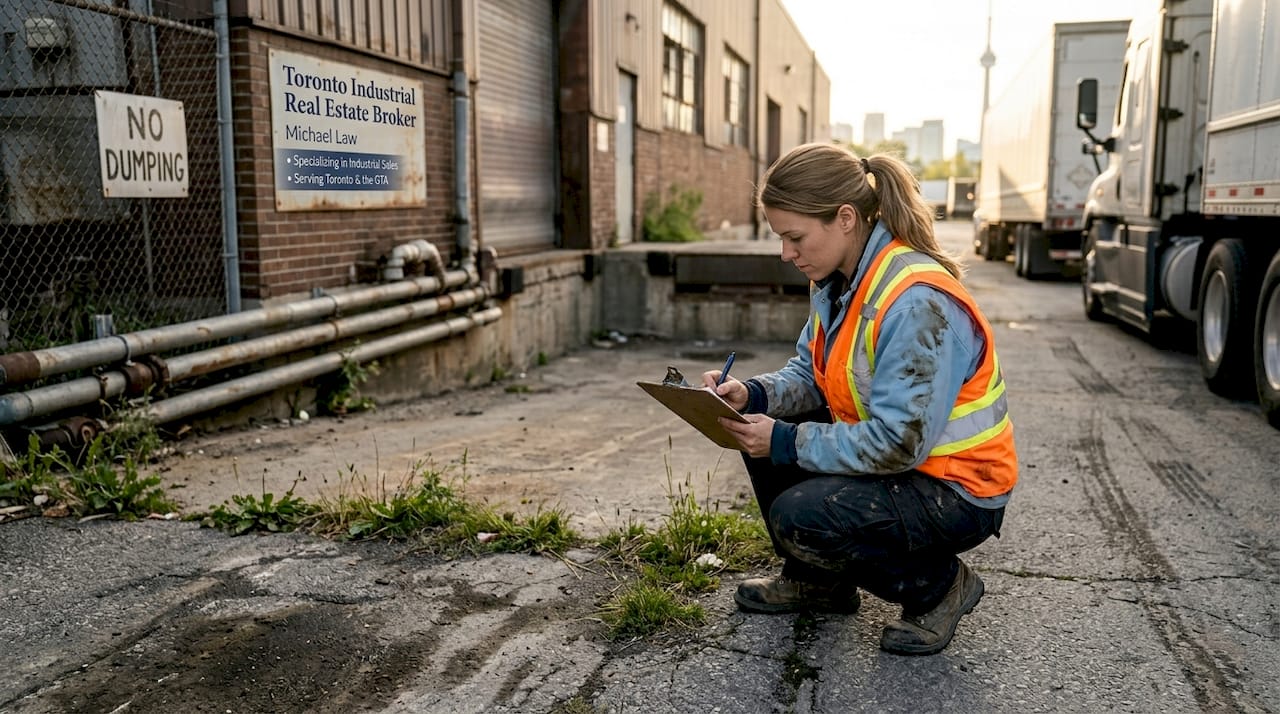
Zoning is the other major GTA-specific risk. Many Toronto and inner-suburb sites are subject to Employment Area designations that sound permissive but contain operational restrictions affecting truck access routes, operating hours, or the type of goods you can store. Never assume your intended use fits simply because the building looks like a warehouse.
The benefits of Toronto industrial space are well established, but realising those benefits depends on choosing a property where your operation is fully permitted from day one.
Understanding the lease structure is equally important. The two primary formats are:
| Lease type | Who pays operating costs | Key risk for tenants |
|---|---|---|
| Triple net (NNN) | Tenant pays taxes, insurance, maintenance | Surprise capital repair costs |
| Gross lease | Landlord covers most costs | Higher base rent, less transparency |
Triple net leases dominate the GTA industrial market. That means you carry the risk of property tax increases, insurance adjustments, and maintenance costs for the duration of the term.
For logistics and warehousing businesses, physical building specifications are just as important as lease terms. Here are the critical specs to assess:
- Clear height (a minimum of 28 to 32 feet for modern logistics)
- Number and configuration of truck-level and drive-in loading doors
- Available electrical capacity and transformer amperage
- Column spacing and floor load rating
- Trailer parking and truck court depth
- Sprinkler system type and coverage
Missing a single specification mismatch can require costly tenant improvements or, worse, make the space operationally unworkable for your business.
Timeline, red flags, and real-world risks
Timing and real-world experience can make or break an industrial lease. Here is what a GTA due diligence timeline really involves.
A typical due diligence window runs 30 to 75 days from the date of an accepted offer, depending on complexity. Here is how a well-managed process typically unfolds:
- Days 1 to 7: Obtain all lease documents, engage legal counsel, order title search
- Days 7 to 21: Commission ESA, complete building inspection, request estoppel
- Days 21 to 45: Review operating cost history, confirm zoning compliance
- Days 45 to 60: Negotiate any identified issues with the landlord
- Days 60 to 75: Final legal review and sign-off before conditions are waived
Front-loading the critical tasks into the first three weeks is essential. Environmental reports and municipal zoning confirmations take time, and discovering a problem on day 60 of a 75-day window leaves almost no room to negotiate or exit.
Real Ontario case law illustrates exactly how serious these risks are. The Sandhu v Paterson case established that wilful blindness during due diligence provides no legal protection. If a risk was discoverable and you chose not to look, courts have been unsympathetic. That precedent should focus every GTA tenant's attention on doing the work properly.
"Wilful blindness during due diligence offers no legal protection. If a risk was discoverable and you chose not to investigate, Ontario courts have consistently held the discovering party responsible."
Common red flags to watch for during your review include:
- Landlords who resist providing operating cost statements
- Unexplained gaps in the lease amendment history
- Prior environmental reports that are several years old and have not been updated
- Repair and maintenance clauses that assign HVAC and roof responsibility to the tenant
Pro Tip: Always request copies of every side agreement, amendment, and inducement letter in writing. Post-offer changes to deal terms that are not documented in the formal lease can create serious disputes later.
A single missed due diligence step can cost a GTA business hundreds of thousands of dollars over a lease term, whether through inherited environmental liability, capital repairs, or inflexible assignment clauses that trap you in a space your business has outgrown. Reviewing industrial subleasing essentials before signing also ensures you have an exit path if your operational needs shift.
The uncomfortable truth most businesses miss about industrial lease due diligence
With all these risks in mind, here is why conventional wisdom on due diligence often falls short.
Most GTA businesses that conduct due diligence still get caught. Not because they are careless, but because they treat due diligence as a checklist exercise rather than a negotiation tool. They verify the facts, identify the risks, and then file the findings away instead of using them to shift the lease terms.
The real gap is strategic. A tenant who discovers that HVAC units are aging has information. What they do with that information is what separates a good outcome from a costly one. You can negotiate a capital repair cap, a landlord repair covenant, or a rent abatement provision. Most tenants do not, because they are too focused on completing the process and moving forward.
There is also the problem of overconfidence in hot markets. When GTA industrial vacancy was extremely tight, businesses accepted unfavourable terms because they feared losing the space. As disclosure schedules show, what sellers and landlords choose not to volunteer is as important as what they disclose. Thorough due diligence forces disclosure; poor due diligence lets landlords stay silent.
The businesses that consistently secure better industrial leases are those that hire an industrial expert who can read between the lines, challenge landlord representations, and convert findings into leverage. That is not just checking boxes. That is negotiating from a position of actual knowledge.
Connect with GTA industrial leasing expertise
Navigating industrial lease due diligence in the GTA is genuinely complex, and the cost of missing a critical step is real and often permanent. Whether you are leasing your first warehouse, relocating a manufacturing operation, or expanding your logistics footprint across Durham Region or Mississauga, getting the due diligence process right from the start protects your business and your bottom line.
The GTA industrial real estate experts at Michael Law Real Estate provide hands-on advisory services that go well beyond document review. From strategic site selection and lease negotiation to environmental risk assessment and operating cost analysis, the team delivers institutional-grade due diligence for businesses of every size. Explore current industrial property listings across the GTA and connect with an advisor who specialises in protecting tenants through every stage of the leasing process.
Frequently asked questions
What documents are essential for due diligence in industrial leasing?
You need the full lease, estoppel certificate, title and survey, Environmental Site Assessment, and at least two years of operating cost statements. Verifying these essentials is the foundation of any credible review.
How much does environmental due diligence typically cost in the GTA?
A Phase I ESA ranges from $3,500 to $6,000 CAD, with commercial building assessments costing $2,500 to $6,000 for mid-size properties.
How long should the due diligence period be for industrial leases in Toronto?
Expect a 30 to 75 day window post-offer, with environmental reports and zoning confirmations front-loaded into the first three weeks.
What are the most common hidden risks in GTA industrial leases?
Environmental contamination, zoning non-compliance, repair obligations, and undisclosed side agreements are the risks most frequently missed. Cases like Sandhu v Paterson confirm these risks carry real legal consequences.