

Many property owners and tenants assume industrial real estate transactions are straightforward, but the reality is far more nuanced. Between environmental assessments, zoning complexities, lease structures, and the Greater Toronto Area's competitive market dynamics, even seasoned investors can overlook critical details that impact value and risk. Hiring an industrial real estate expert ensures you navigate these challenges with confidence, protecting your interests whilst maximising returns. This article explains exactly why professional guidance matters and how it transforms outcomes for GTA industrial property stakeholders.
Table of Contents
- Key takeaways
- Understanding the complexities of industrial real estate transactions
- How GTA market conditions affect industrial real estate transactions
- Navigating lease structures and tenant considerations with expert guidance
- Applying expert advice for your GTA industrial real estate success
- Expert industrial real estate services in the GTA
- Frequently asked questions
Key Takeaways
| Point | Details |
|---|---|
| Comprehensive due diligence | Industrial deals demand environmental, zoning, and financial scrutiny to protect value. |
| Environmental site assessments early | Phase I and Phase II assessments identify liabilities before signing, preventing costly remediation. |
| Zoning verification critical | Experts confirm permitted uses and required permits to avoid costly retrofits and expansion limits. |
| GTA market timing strategy | Hiring experts helps time transactions with demand cycles to maximise price and speed. |
Understanding the complexities of industrial real estate transactions
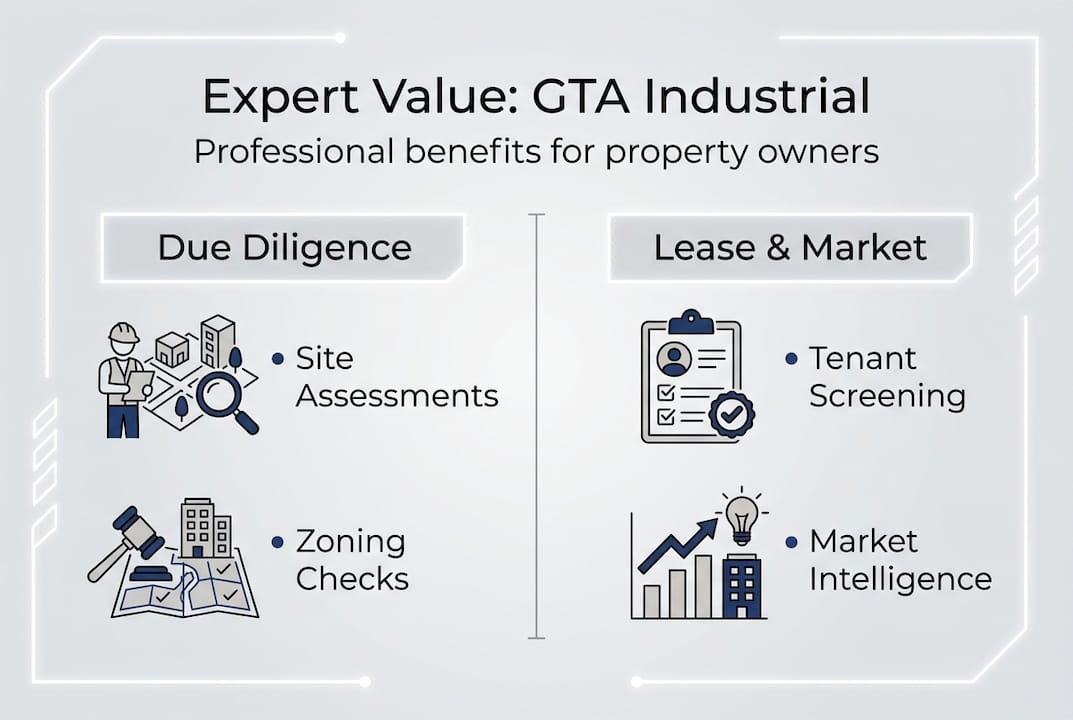
Industrial property deals demand far more scrutiny than many realise. Unlike residential transactions, industrial real estate requires specialised due diligence including environmental assessments, zoning verification, and financial analysis to protect your investment. Without expert oversight, you risk inheriting environmental liabilities, zoning violations, or structural deficiencies that erode value and trigger legal headaches.
Environmental site assessments represent a critical first step. Phase I ESAs identify potential contamination from previous industrial uses, whilst Phase II testing confirms soil and groundwater quality. Industrial transactions involve environmental risk that can derail deals or saddle buyers with remediation costs reaching hundreds of thousands of dollars. Experts coordinate these assessments early, ensuring you understand liabilities before signing agreements.
Zoning laws add another layer of complexity. The GTA's municipalities enforce specific regulations governing industrial use, building heights, parking ratios, and setbacks. An expert verifies that your intended use aligns with current zoning, identifies required permits, and flags any non-conforming aspects that could limit future expansion or resale value. Overlooking zoning details can force costly retrofits or restrict operational flexibility.
Financial analysis rounds out comprehensive due diligence. Professionals evaluate property valuations against comparable sales, assess financing options, and stress-test projected returns under various market scenarios. They identify red flags in seller disclosures, scrutinise operating expense histories, and ensure asking prices reflect true market conditions. This rigour prevents overpayment and structures deals that align with your investment objectives.
Pro Tip: Engage your commercial real estate expertise partner before making offers. Early involvement allows thorough due diligence without rushed timelines, uncovering issues whilst you still have negotiating leverage.
Key due diligence elements experts manage include:
- Environmental site assessments to identify contamination and remediation requirements
- Zoning compliance verification ensuring permitted uses match your operational needs
- Financial analysis validating property valuations and investment returns
- Title searches revealing liens, easements, or encumbrances affecting ownership
- Building condition assessments flagging structural, mechanical, or electrical deficiencies
How GTA market conditions affect industrial real estate transactions
The Greater Toronto Area's industrial market presents unique challenges that demand expert navigation. Vacancy rates remain below 5%, signalling a landlord-favourable environment where quality space commands premium pricing. For tenants, this scarcity means fierce competition and limited negotiating power without professional representation. For property owners, it creates opportunities to maximise lease rates and sale prices, provided you time transactions strategically.
Rising absorption reflects strong demand despite limited new supply. Net absorption in recent quarters has outpaced new construction, tightening available inventory and pushing asking rents to record levels. Asking rents currently average $16.56 per square foot, whilst sales prices hover around $350 per square foot for quality industrial assets. These metrics underscore the importance of data-driven decision-making when entering or exiting positions.

Experts leverage market intelligence to time transactions optimally. They monitor absorption trends, track new development pipelines, and analyse submarket variations across Mississauga, Brampton, Vaughan, and other GTA industrial nodes. This granular understanding allows them to advise when to lock in favourable lease terms, when to hold for appreciation, or when market peaks justify selling.
| Quarter | Vacancy rate | Net absorption | Average asking rent |
|---|---|---|---|
| Q1 2025 | 4.5% | 1.2M sq ft | $16.20/sq ft |
| Q2 2025 | 4.3% | 1.4M sq ft | $16.40/sq ft |
| Q3 2025 | 4.4% | 1.1M sq ft | $16.56/sq ft |
| Q4 2025 | 4.3% | 1.3M sq ft | $16.56/sq ft |
Market conditions also influence negotiation strategies. In tight markets, landlords can impose stricter lease terms, higher deposits, and reduced tenant improvement allowances. Tenants without expert advocates often accept unfavourable conditions simply to secure space. Conversely, knowledgeable brokers identify pockets of opportunity where motivated landlords or upcoming vacancies create negotiating leverage even in competitive environments.
"Understanding micro-market dynamics within the GTA separates successful transactions from costly missteps. Vacancy rates vary significantly between industrial corridors, and timing your move to align with market cycles can save or earn hundreds of thousands of dollars."
Experts also anticipate future shifts. They track employment trends, e-commerce growth, and infrastructure investments like highway expansions that signal where demand will concentrate. This forward-looking perspective helps you position assets to capture emerging value rather than chasing yesterday's hotspots.
Navigating lease structures and tenant considerations with expert guidance
Lease agreements in industrial real estate carry complexities that demand professional interpretation. Triple net leases shift property expenses like taxes, insurance, and maintenance to tenants, but poorly negotiated covenants can expose landlords to unexpected costs or tenants to unfair burdens. Experts ensure lease structures align with your financial model whilst protecting against common pitfalls.
Triple net (NNN) leases dominate the industrial sector, appealing to landlords seeking predictable income without operational responsibilities. However, lease nuances require strong covenants defining exactly which expenses tenants cover and how increases are calculated. Ambiguous language around roof repairs, structural maintenance, or capital improvements can trigger disputes. Specialists draft or review terms that clearly delineate responsibilities, preventing conflicts and preserving relationships.
Tenant vetting represents another critical expertise area. Experts handle tenant vetting by scrutinising financial statements, business plans, and operational histories to assess reliability. They verify creditworthiness, evaluate business models for sustainability, and confirm that tenant operations align with property capabilities. A manufacturing tenant requiring heavy power loads needs different infrastructure than a logistics operator prioritising dock doors and truck access.
Location analysis further refines tenant-property matching. Industrial tenants prioritise proximity to major highways, airports, and rail connections for efficient supply chain operations. Experts evaluate how a property's location serves tenant logistics needs, considering factors like truck routing restrictions, highway access points, and proximity to customer bases. Properties near Highways 401, 407, or 427 command premiums precisely because they reduce transportation costs and delivery times.
| Lease type | Landlord responsibilities | Tenant responsibilities | Best for |
|---|---|---|---|
| Triple net (NNN) | Structural repairs, roof | Taxes, insurance, maintenance, utilities | Long-term, credit tenants |
| Modified gross | Some operating expenses | Base rent plus specified costs | Multi-tenant buildings |
| Full service gross | All operating expenses | Base rent only | Short-term or flexible arrangements |
Pro Tip: Request detailed tenant financial disclosures beyond basic credit checks. Cash flow statements and accounts receivable ageing reports reveal financial health that credit scores miss, helping you avoid tenants who may default mid-lease.
Experts also negotiate lease renewal options, expansion rights, and early termination clauses that provide flexibility as business needs evolve. They structure rent escalations tied to market indices or fixed percentages, ensuring landlords capture appreciation whilst tenants maintain budget predictability. These nuanced negotiations require deep knowledge of industrial lease complexities and local market standards.
Key tenant considerations experts evaluate include:
- Financial stability through audited statements and credit analysis
- Operational fit with property infrastructure like power capacity and ceiling heights
- Business clarity ensuring sustainable demand for industrial space
- Location alignment with logistics networks and customer proximity
- Expansion potential matching tenant growth projections
Applying expert advice for your GTA industrial real estate success
Transforming expert knowledge into actionable results requires a systematic approach tailored to your specific objectives. Whether acquiring property, negotiating leases, or optimising existing assets, following structured steps with professional guidance maximises outcomes whilst minimising risk exposure.
-
Engage specialists early in your planning process. Before viewing properties or drafting offers, consult with commercial real estate expertise professionals who understand GTA industrial markets. Early engagement allows time for thorough market analysis, due diligence planning, and strategy development without rushed decisions. Experts help you define investment criteria, identify target submarkets, and establish realistic timelines that align with market cycles.
-
Conduct comprehensive market analysis tailored to your property type. Experts analyse comparable sales, lease rates, and absorption trends specific to your asset class, whether distribution centres, manufacturing facilities, or flex industrial spaces. They identify which GTA submarkets offer the best risk-adjusted returns for your investment horizon, considering factors like infrastructure development, tenant demand patterns, and competitive supply pipelines.
-
Execute rigorous due diligence across all transaction dimensions. Professionals coordinate environmental assessments, zoning reviews, building inspections, and financial audits simultaneously, ensuring nothing falls through the cracks. They manage timelines, follow up on outstanding items, and negotiate extensions when discoveries warrant additional investigation. This disciplined approach prevents surprises at closing and strengthens your negotiating position.
-
Leverage data-driven insights for optimal transaction timing. Experts resolve market uncertainties by analysing vacancy trends, absorption rates, and economic indicators to advise when conditions favour buyers, sellers, or tenants. They help you recognise when to act aggressively on opportunities or when patience will yield better terms as market dynamics shift.
-
Structure agreements that protect your interests long-term. Beyond negotiating price, experts craft lease terms, purchase agreements, and financing structures that provide flexibility and downside protection. They anticipate future scenarios like tenant defaults, market downturns, or expansion needs, building contractual provisions that preserve your options without excessive cost.
-
Maintain ongoing market reviews to stay competitive. Regular consultations with your expert help you monitor how your assets perform relative to market benchmarks. They identify when lease renewals should be renegotiated, when property improvements will yield highest returns, and when market peaks create opportune exit windows.
Pro Tip: Schedule quarterly market reviews with your industrial real estate specialist. Regular check-ins help you anticipate market shifts, adjust strategies proactively, and maintain your competitive edge as GTA industrial dynamics evolve.
"Successful industrial real estate investors don't react to market changes, they anticipate them. Working with experts who track leading indicators like employment trends, construction permits, and transportation infrastructure investments allows you to position assets ahead of demand curves rather than chasing them."
Applying expert guidance transforms industrial real estate from a reactive, transactional activity into a strategic, value-creating discipline. You gain confidence that decisions rest on solid data, thorough analysis, and proven market knowledge rather than guesswork or incomplete information. This professional foundation protects your capital whilst positioning you to capitalise on the GTA's robust industrial market opportunities.
Expert industrial real estate services in the GTA
Navigating the Greater Toronto Area's competitive industrial market demands more than general real estate knowledge. It requires specialised expertise in market dynamics, property types, and transaction structures unique to industrial assets. Michael Law brings dedicated focus to GTA industrial real estate, helping property owners and tenants achieve optimal outcomes through every phase of acquisition, leasing, and asset management.

Whether you're evaluating industrial property listings for investment, negotiating complex lease renewals, or seeking strategic guidance on portfolio optimisation, professional representation ensures you benefit from deep market intelligence and proven negotiation strategies. Services span property acquisition support, tenant vetting and placement, lease structure analysis, and ongoing market monitoring that keeps your assets competitive. Clients gain access to proprietary market data, transaction insights, and industrial real estate services designed specifically for the GTA's unique industrial landscape. Partnering with proven commercial real estate expertise streamlines complex transactions, protects your investment, and positions you to capture value as market conditions evolve. Taking this next step transforms uncertainty into strategic advantage.
Frequently asked questions
What does an industrial real estate expert do?
Industrial real estate experts manage comprehensive due diligence including environmental site assessments, zoning verification, and financial analysis to protect client interests. They negotiate lease terms, vet tenants, analyse market conditions, and structure transactions that maximise value whilst minimising risk. Their specialised knowledge of industrial property types, market dynamics, and regulatory requirements ensures clients avoid costly oversights and capitalise on opportunities.
Why is due diligence particularly important in industrial real estate transactions?
Industrial properties often carry environmental contamination risks from previous manufacturing or storage uses that can trigger expensive remediation obligations. Thorough due diligence uncovers these liabilities before purchase or lease commitments, allowing informed decisions and proper risk allocation. Experts also verify zoning compliance and financial viability, preventing unforeseen restrictions or valuation surprises that could derail your investment objectives.
How do market conditions in the GTA affect industrial property decisions?
The GTA's industrial market scarcity, with vacancy rates consistently below 5%, creates intense competition for quality space and drives premium pricing. This tight supply makes negotiation timing and strategy crucial for securing favourable terms. Experts apply data-driven insights on absorption trends, submarket variations, and upcoming supply to help clients capitalise on market dynamics, whether acquiring assets, negotiating leases, or timing dispositions for maximum returns.
What should tenants and property owners look for in an industrial real estate expert?
Seek professionals with proven knowledge of GTA zoning regulations, lease structures like triple net arrangements, and current market trends across industrial submarkets. Strong negotiation skills, thorough tenant vetting practices, and established relationships with landlords, tenants, and service providers are essential qualities. Look for specialists who demonstrate deep industrial sector focus rather than generalists, ensuring they bring relevant expertise to your specific transaction challenges and opportunities.