

TL;DR:
- Off-market industrial properties in Toronto are available through broker relationships, private networks, and data signals.
- Building trust and consistency with brokers is essential for gaining early access to exclusive deals.
- Monitoring public records and focusing on high-growth submarkets can reveal motivated sellers and valuable opportunities.
By the time most GTA industrial properties appear on public listing platforms, experienced buyers have already competed away the pricing advantage. Fierce bidding wars, compressed timelines, and inflated asking prices are the norm on the open market. The real edge belongs to those who access deals before they're public, through broker relationships, private networks, and data-driven prospecting. This guide gives you a concrete, step-by-step playbook for identifying off-market industrial opportunities across the Greater Toronto Area, so you can negotiate from a position of strength and secure assets that never appear on MLS.
Table of Contents
- Understand off-market deal dynamics in the GTA
- Build relationships with key players and networks
- Use public records and data signals for early lead discovery
- Target high-growth submarkets and zoning plays
- Verify value and mitigate risks before closing
- Why real off-market access is an insider's game (and how to break in)
- Get first access to exclusive industrial opportunities
- Frequently asked questions
Key Takeaways
| Point | Details |
|---|---|
| Broker connections matter | The most attractive off-market industrial deals in GTA rely on private broker networks and relationships, not public listings. |
| Leverage public records | Public data like building permits or liens can reveal motivated sellers before other buyers spot them. |
| Focus on growth submarkets | Regions like Brampton, Vaughan, and East GTA (Whitby, Durham) offer the best potential for off-market appreciation. |
| Do strict due diligence | Make sure to validate zoning, environmental, and title issues unique to off-market GTA properties before purchase. |
| Persistence breaks barriers | With consistent effort and relationship-building, even new investors can gain access to exclusive industrial opportunities. |
Understand off-market deal dynamics in the GTA
Before you can find off-market industrial properties, you need to understand why they exist and what makes them so different from standard listings. "Off-market" simply means a property is available for acquisition or lease but has not been listed on any public platform, including MLS, LoopNet, or CoStar. The owner, often through a broker, is quietly gauging interest within a select group of qualified parties.
Why do sellers and owners choose this route? The reasons vary, but common motivations include privacy (some owners don't want competitors knowing a facility is for sale), avoiding the disruption of public showings, reducing carrying costs from prolonged exposure, and wanting a faster, cleaner transaction. Estate sales, corporate dispositions, and portfolio rebalancing by REITs often produce off-market industrial deals for exactly these reasons.
The primary method to identify off-market industrial properties in the GTA is building relationships with specialised brokers and agents who share pocket listings exclusively within trusted networks, deliberately avoiding public MLS to prevent bidding wars. This is not accidental. It is a structural feature of how serious GTA industrial deals get done.
Understanding the contrast between on-market and off-market transactions matters deeply for your strategy.
| Feature | On-market | Off-market |
|---|---|---|
| Competition level | High, open bidding | Low, curated buyers only |
| Pricing | Market or above-market | Often below replacement cost |
| Timeline | Extended, public process | Faster, private process |
| Negotiating leverage | Minimal | Significant |
| Information available | Public data | Requires relationship access |
| Due diligence window | Compressed by competition | Usually more flexible |
Key differences you should internalise before starting your search:
- Off-market deals reward preparation. You need financing ready and criteria clearly defined before a deal surfaces.
- Broker networks govern access. The best deals never hit MLS; contrast public listings (high competition) against private channels (leverage, early access).
- Early access changes the negotiation entirely. You're often the only buyer at the table, which gives you time to conduct proper due diligence without pressure.
- Information asymmetry is your friend. Off-market sellers sometimes don't know current market rents or replacement values, which creates real pricing advantages for informed buyers.
"The GTA industrial market moves fast. By the time a quality asset goes public, the smart money has already been in private conversations for weeks."
The GTA locations overview shows how dramatically market conditions differ across submarkets, from the Airport Corridor in Mississauga to Durham Region in the east. Each zone has its own off-market deal dynamics, and understanding those nuances gives you a distinct edge. Knowing, for example, which industrial property types trade most frequently off-market in each submarket allows you to focus your energy where the opportunities are densest.
Once you understand the unique dynamics of the off-market landscape, you can prepare to access these exclusive opportunities.
Build relationships with key players and networks
Relationships are the currency of the GTA off-market industrial market. No amount of data analysis or public record research replaces being known, trusted, and top-of-mind with the right people. Here is how to build those relationships systematically.

Step 1: Identify who controls the deal flow. The GTA industrial brokerage community is concentrated. A relatively small group of senior brokers at major firms handle the majority of significant industrial transactions. Firms like Colliers, Cushman and Wakefield, CBRE, and JLL all have dedicated industrial teams covering specific corridors. You should know the names and territories of the senior players in your target areas.
Step 2: Join industry events and forums. NAIOP (the Commercial Real Estate Development Association) hosts regular events where GTA industrial brokers, investors, and developers gather. BOMA Canada and the Urban Land Institute also provide access to the professional circles where private deals get discussed. These are not casual networking events. Come prepared with a clear acquisition mandate, proof of financial capability, and specific questions about the submarkets you're targeting.
Step 3: Engage major brokerage houses directly. Firms like Colliers and Cushman and Wakefield offer curated selections and leverage their relationships for off-market access in tight markets like GTA West and East. Walking into these firms and asking for "off-market listings" will get you nowhere. Instead, schedule a proper meeting, bring your acquisition criteria in writing, demonstrate financial readiness, and ask who their top industrial brokers are covering your target nodes.
Step 4: Make communication consistent and valuable. After your initial meetings, follow up regularly. Send brief notes when you see relevant market news. Share your updated criteria when your budget or requirements shift. Brokers prioritise buyers who communicate clearly and don't waste their time.
Step 5: Prove you can execute. The fastest way to get on a broker's private deal list is to close a deal with them, or close one they hear about. A track record of execution signals reliability. Off-market deals are shared among curated groups of trusted professionals for smoother negotiations, better due diligence, and less competition, creating wealth before a property goes public.
Confidentiality is critical at every stage. When a broker shares a pocket listing, treat that information as proprietary. Don't discuss the deal with parties outside your immediate team. Breaching this trust once can remove you from a broker's private network permanently.
Pro Tip: Offer specific, written feedback every time a broker sends you a deal you pass on. Explain exactly why it didn't meet your criteria. This takes two minutes and signals that you're a serious, thoughtful buyer. Brokers remember the people who give them useful information, and they'll keep sending you deals because they trust you'll engage constructively.
You can find industrial real estate experts who already maintain these private networks, which is often the most efficient way to plug into off-market deal flow immediately. Once you've established relationships, supplement them with data-driven scout work for the best results.
Use public records and data signals for early lead discovery
Relationships get you access to deals that brokers already know about. But the sharpest investors find deals before anyone else does, by reading signals in publicly available data. This requires patience and process, but it produces leads with zero competition.
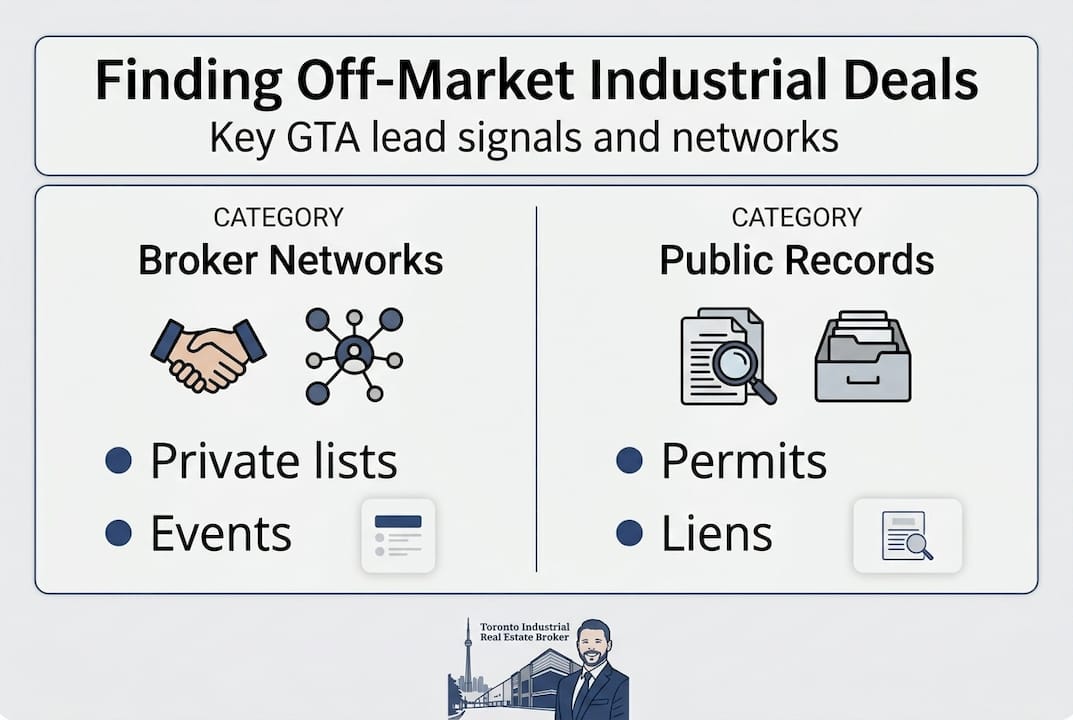
Public records you should monitor regularly include:
-
Toronto building permit data. The City of Toronto publishes permit applications and withdrawals online. A permit withdrawal on an industrial property can signal financial stress, operational changes, or a pending sale. Cross-reference withdrawn permits against property ownership records to identify potential motivated sellers.
-
Ontario land registry records. Mortgage registrations, discharges, and transfers are all recorded at ServiceOntario. A pattern of refinancing followed by stalled construction or permit activity can indicate an owner under pressure to sell.
-
Lien notices. Construction liens registered against an industrial property suggest cash flow problems or contractor disputes. These are public records and often precede a distressed sale.
-
Utility connection changes. Changes in hydro or natural gas account status can signal a facility going dark or changing operational use. This data is harder to access directly, but proptech platforms sometimes aggregate it.
-
Municipal tax arrears. Properties with outstanding tax obligations are often owned by motivated sellers. Tax arrear lists are periodically published or can be requested through freedom of information requests in Ontario.
The approach works well when systematised. Using public records and data signals like withdrawn permits, liens, or utility changes identifies motivated sellers before they list. In the GTA, monitoring Toronto building permit data and provincial property records gives you a consistent pipeline of early-stage leads.
| Signal type | Where to find it | What it may indicate |
|---|---|---|
| Withdrawn building permit | City of Toronto open data portal | Stalled project, financial strain |
| Construction lien | Ontario land registry | Contractor dispute, cash flow issue |
| Tax arrears | Municipal tax office, FOI request | Motivated seller, distressed asset |
| Mortgage discharge after long hold | ServiceOntario land registry | Estate sale or portfolio disposition |
| Zoning change application withdrawal | Municipal planning department | Abandoned development plan |
Data-driven prospecting through public records complements broker networks. Proptech firms now automate much of this signal tracking, producing high signal-to-noise leads that save significant research time.
Pro Tip: Set a calendar reminder to review Toronto's open data portal monthly. The permit activity datasets are updated regularly and are searchable by address, ward, or permit type. A simple filter for industrial zones and withdrawn applications takes less than 30 minutes and can surface genuine off-market leads that no broker has acted on yet.
After building your lead list, connect it back to the GTA industrial real estate trends affecting each submarket. Understanding whether a specific node is experiencing rent growth or declining absorption helps you prioritise which leads are worth pursuing. Reviewing industrial vacancy case studies across the GTA also clarifies which property conditions create the most negotiating room.
Armed with verified leads, knowing where to focus geographically will boost your odds of finding high-value, high-appreciation properties.
Target high-growth submarkets and zoning plays
Not all GTA submarkets offer equal off-market opportunity. The most successful industrial investors concentrate on nodes where vacancy is structurally low, rent growth is consistent, and zoning changes or infrastructure investments are creating future value. Here is where to focus your attention.
Brampton remains one of the tightest markets in the GTA. With vacancy near 2.8% and average rents around $18.75 per square foot, Brampton's logistics-heavy infrastructure and proximity to Pearson Airport make it a perennial target for occupiers and investors alike. Off-market deals here tend to surface through long-term owner retirements and family business successions.
Mississauga sits at roughly 3.1% vacancy with rents averaging $19.25 per square foot. The Airport Corporate Centre and surrounding industrial nodes continue to attract e-commerce and cold chain operators. Pocket listings in Mississauga are typically controlled by a small cluster of brokers who specialise in the airport submarket.
Vaughan is particularly interesting, with vacancy around 2.9% and rents touching $20 per square foot in prime nodes. The York Region growth plan continues to drive industrial demand from manufacturers and distributors seeking north GTA locations. Vaughan also benefits from Highway 400 and 407 access, making it attractive for regional distribution.
Caledon represents a more strategic play. Industrial land here carries Prestige Industrial zoning designations in areas identified in the Region of Peel's Official Plan for long-term growth. Buying agricultural or edge land in Caledon and holding for rezoning can produce 3 to 5 times appreciation post-rezoning, particularly as servicing extends further north.
Durham Region (Whitby, Oshawa, Pickering, Ajax) is where low vacancy in the range of 1.2% to 4.4% creates scarcity. East GTA offers lower entry costs than core markets, making it ideal for logistics operators and investors pricing out of Mississauga or Brampton. Infrastructure investments along Highway 407 East extension are accelerating demand.
Key factors when evaluating off-market opportunities in any GTA submarket:
- Vacancy rate below 3% signals strong rental growth potential and limited tenant alternatives.
- Planned infrastructure nearby (transit, highway expansion, servicing) is a value catalyst.
- Prestige Industrial or Employment Area designations in Official Plans signal long-term protection from rezoning to non-industrial uses.
- Proximity to intermodal facilities or ports of entry drives tenant demand from logistics and e-commerce users.
- Existing tenant with NNN lease (a net-net-net lease where tenants pay most operating costs) provides income stability during hold periods.
Pro Tip: Download the latest market reports from CBRE, Colliers, and JLL every quarter. Cross-reference their submarket vacancy and rent data against your target property list. If a specific node shows rising rents alongside falling vacancy, any off-market deal in that corridor is worth accelerating. The market data gives you credibility in negotiation and confirms your investment thesis.
You can also explore ESG impact on GTA markets to understand how sustainability designations and energy efficiency are starting to influence industrial asset pricing across the region. The GTA investment sales guide provides additional context on how to structure acquisitions once you've identified your target.
After executing your search and shortlisting promising properties, verify what success and return on effort look like for off-market industrial moves.
Verify value and mitigate risks before closing
Off-market deals offer real advantages, but they carry unique risks that on-market transactions don't. When a property hasn't been publicly listed, there's often less information in the market about its condition, history, and title. Skipping or rushing due diligence in pursuit of a faster close is the single biggest mistake buyers make in off-market industrial transactions.
Your due diligence checklist for GTA industrial acquisitions should cover:
-
Zoning and official plan conformity. Confirm the current zoning allows your intended use. Check whether any zoning variances, conditional approvals, or outstanding municipal orders affect the site. Due diligence on zoning, environmental issues, and NNN leases is critical, particularly when acquiring land for banking before infrastructure extension.
-
Environmental assessment (Phase I and Phase II). This is non-negotiable for older GTA industrial sites. Properties near former rail corridors, gas stations, dry cleaners, or manufacturing operations frequently carry contamination risk. A Phase I Environmental Site Assessment reviews historical records. Phase II involves physical testing. Never waive this step.
-
Title search and encumbrances. Off-market deals sometimes surface properties with complex title histories. Engage a commercial real estate lawyer to review ownership chains, registered liens, easements, and rights-of-way.
-
Survey review. Confirm actual lot dimensions, building setbacks, and any encroachments. Discrepancies between survey and seller representations are more common in older industrial properties.
-
Existing lease and tenant agreements. If the property is tenanted, review the full lease, rent rolls, operating cost reconciliations, and any side agreements or lease modifications. Understand the rent structure, renewal options, and any landlord obligations outstanding.
-
Building condition assessment. Roof, HVAC, electrical, structural. Industrial properties often have deferred maintenance that sellers don't disclose in off-market contexts. Budget for what you find.
On the market side, context matters for your negotiation. GTA industrial vacancy sat at 4.4% in Q4 2025, with average rents at $16.56 per square foot, down approximately 4.1% year over year. However, during the peak tightness of late 2024, GTA vacancy had reached as low as 1.2% according to CBRE data, pushing demand aggressively toward East GTA markets like Whitby. Understanding this trajectory tells you that while off-market premiums exist, the overall market is slightly more balanced now than it was, which gives buyers a bit more room to negotiate.
"Low supply and premium off-market positioning create urgency in the GTA, but urgency without rigorous review is how sophisticated buyers make expensive mistakes. Take the time to verify everything, even when a broker tells you the window is closing."
Tracking industrial lease trends in your target submarket also helps you assess whether current rents reflect market conditions or whether a property is under-leased, which represents a value-add opportunity post-acquisition.
With this process, you can confidently approach the off-market hunt equipped with proven tools, relationships, and data.
Why real off-market access is an insider's game (and how to break in)
Here is the uncomfortable truth about GTA off-market industrial deals: the market is not a meritocracy. The best opportunities don't go to the most sophisticated financial model or the highest offer submitted through a public portal. They go to the person the broker trusts most at the moment the deal becomes available.
This is not cynical. It's structural. Brokers have fiduciary obligations to their clients, but they also have reputational stakes in every transaction they facilitate. They want clean closings, cooperative buyers, and deals that don't fall apart in due diligence. That means they consistently bring their best off-market opportunities to buyers they have already tested through smaller or earlier transactions.
Most investors who struggle to access GTA off-market deals make one of two mistakes. Either they rely entirely on public data signals and proptech alerts without ever building the relationship infrastructure to convert those leads, or they expect relationships to build themselves through passive networking. Neither approach works in a market this competitive.
The investors who consistently access exclusive types of industrial properties before they're publicly listed share a common behaviour. They give more than they receive, early on. They share market observations with brokers. They respond promptly. They close what they commit to. They become the buyer that every senior industrial broker in their target corridor thinks of first.
Breaking into this network as an outsider takes 12 to 24 months of deliberate, consistent effort. There is no shortcut. But there is a legitimate accelerator: aligning yourself with an experienced advisor who already has established relationships within the private deal network. That access transfers. It is one of the most underrated reasons to engage a specialised industrial real estate advisor from day one of your GTA market entry.
Get first access to exclusive industrial opportunities
If you're serious about accessing off-market GTA industrial properties before they reach the broader market, the fastest path is working with an advisor who already has the network, the market intelligence, and the trusted broker relationships in place.
Michael Law Real Estate offers private deal flow and curated industrial property access across Caledon, Milton, Markham, Vaughan, Mississauga, and throughout the GTA. As part of Lennard Commercial Realty, the practice brings institutional-grade market knowledge and a deep professional network to every client engagement. Whether you're acquiring for investment, owner-user purposes, or land banking, experienced representation is your most reliable shortcut to deals that never appear on public platforms. Explore available industrial listings currently on the market, or reach out directly to discuss discrete off-market opportunities, including Caledon industrial market properties with significant rezoning upside.
Frequently asked questions
What counts as an off-market industrial property in the GTA?
An off-market industrial property in the GTA is one not listed publicly, shared only within trusted professional circles or via private broker channels. These pocket listings deliberately avoid MLS to prevent bidding wars and attract only serious, pre-qualified buyers.
How do I get on a broker's private pocket listing list?
Establish rapport by being decisive, responsive, and transparent about your buying criteria and financial readiness. Trusted brokers prioritise reliable buyers for their best off-market deals because smooth transactions protect their professional reputation with sellers.
Which public records are best for sourcing off-market leads in Toronto?
Monitor Toronto building permit data, withdrawn permit applications, property registry records, liens, and utility changes for early signals of potential sales. These public data sources reveal motivated sellers before they engage a broker or list a property publicly.
What is the biggest risk with off-market industrial deals in the GTA?
Inadequate due diligence, especially regarding zoning or environmental contamination, can lead to costly surprises or failed transactions. Zoning and environmental review are especially critical for older industrial sites near former rail lands or legacy manufacturing operations.
Why are East GTA markets like Durham and Whitby now considered hot spots?
Lower costs, rezoning potential, and infrastructure investments make East GTA submarkets prime for off-market industrial investments. Low vacancy across East GTA combined with the 407 East extension is driving sustained demand from logistics and distribution users priced out of core GTA markets.