

TL;DR:
- Market conditions in GTA industrial real estate are softening, with rents declining and vacancies rising.
- Ongoing market analysis helps investors identify early signals and adjust strategies proactively.
- Timely, localized data and expert interpretation are critical for capitalizing on emerging opportunities and mitigating risks.
Most industrial property investors in the Greater Toronto Area operate with a quiet conviction: values go up, rents follow, and the market rewards patience. That assumption is being tested right now. Net rents in the GTA averaged $16 to $19 per square foot in recent years, but fell 6% year-over-year to $16.57 in Q4 2025, a shift that caught many investors off guard. If your investment thesis depends on a market that always climbs, you are carrying more risk than you realise. Structured market analysis is what separates reactive guessing from deliberate, profitable strategy.
Table of Contents
- Why market analysis is critical in GTA industrial property investment
- Core steps of effective market analysis for property investment
- Reading market signals: rents, vacancies, and investor implications
- Turning market analysis into actionable investment strategy
- The real advantage: seeing beyond data points
- Level up your property investment strategy
- Frequently asked questions
Key Takeaways
| Point | Details |
|---|---|
| Market analysis is essential | Without thorough analysis, investors risk costly mistakes when market cycles shift. |
| Watch key metrics | Prioritise rents, vacancies, and supply-demand data to spot trends early. |
| Turn insights into action | Use market signals to drive decisive strategy, not just reports. |
| Local nuance matters | Understanding the GTA’s unique industrial landscape unlocks better investments. |
Why market analysis is critical in GTA industrial property investment
Market analysis, in the context of property investment, means systematically gathering and interpreting data on rents, vacancies, absorption, supply pipelines, and comparable transactions to inform decisions. It is not a one-time exercise. It is an ongoing discipline that shapes how you price acquisitions, structure leases, time dispositions, and allocate capital across your portfolio.
Skipping or skimming market analysis carries real consequences:
- Overpaying on acquisitions because you relied on peak-cycle comparables instead of current trend data
- Holding underperforming assets longer than necessary because vacancy signals were ignored
- Locking into unfavourable lease structures without understanding where rents are heading
- Missing re-entry opportunities in softening submarkets where values are quietly correcting
- Misjudging exit timing, leaving capital gains on the table or selling into further decline
The GTA is a useful case study in why all of this matters. The post-2022 supply surge flooded several submarkets with new inventory precisely when demand was moderating after the pandemic-driven logistics boom. The result was rising vacancy and declining rents in markets that many investors had assumed were structurally immune to softening.
"Understanding GTA market intelligence strategies is no longer optional for serious industrial investors. The penalty for being uninformed has moved from theoretical to tangible."
The ability to read and respond to these shifts is what separates investors who protect returns from those who watch them erode. Monitoring real estate trends also boosts investor confidence when it comes to communicating with lenders, partners, and boards, because you can back every position with data.
Core steps of effective market analysis for property investment
Effective market analysis follows a repeatable process. Here is a practical framework built specifically for GTA industrial investors:
- Define your objectives. Are you evaluating an acquisition, benchmarking a lease renewal, or stress-testing your existing portfolio? Clarity on purpose determines which data matters most.
- Gather current market reports. Use market reports for decision-making from credible sources: brokerage houses, CBRE, Colliers, and local specialists. Look at submarket-level data, not just GTA-wide averages.
- Benchmark rents by asset class. Do not treat all industrial product as interchangeable. In 2025, class-A asking rents averaged $17 per square foot versus $15 for class-B, a meaningful gap that affects both pricing and tenant quality.
- Forecast supply and demand. Review construction pipelines, planned completions, and pre-leasing rates. High supply with low pre-leasing is a red flag in any submarket.
- Identify risk signals early. Rising vacancy alongside stagnant or falling rents is a classic early-warning indicator. Act before those signals reach the headlines.
| Metric | Class-A (2025) | Class-B (2025) | Trend |
|---|---|---|---|
| Asking net rent ($/sq ft) | $17.00 | $15.00 | Softening |
| Vacancy rate | Lower | Higher | Rising |
| Tenant quality | Institutional | Mixed | Varies |
| Lease term preference | Long-term | Flexible | Mixed |
Pro Tip: The biggest analytical trap is waiting until you have perfect data before acting. Markets move faster than report cycles. Build your analysis on directional trends, not decimal-point precision, and revisit your conclusions quarterly.
Analysis done well also feeds proven strategies for maximising returns in GTA industrial property. The discipline of revisiting your assumptions regularly is what keeps your strategy aligned with where the market actually is, not where it was six months ago.
Reading market signals: rents, vacancies, and investor implications
Data points mean nothing without interpretation. Here is how to translate the three most important signals into investment logic.
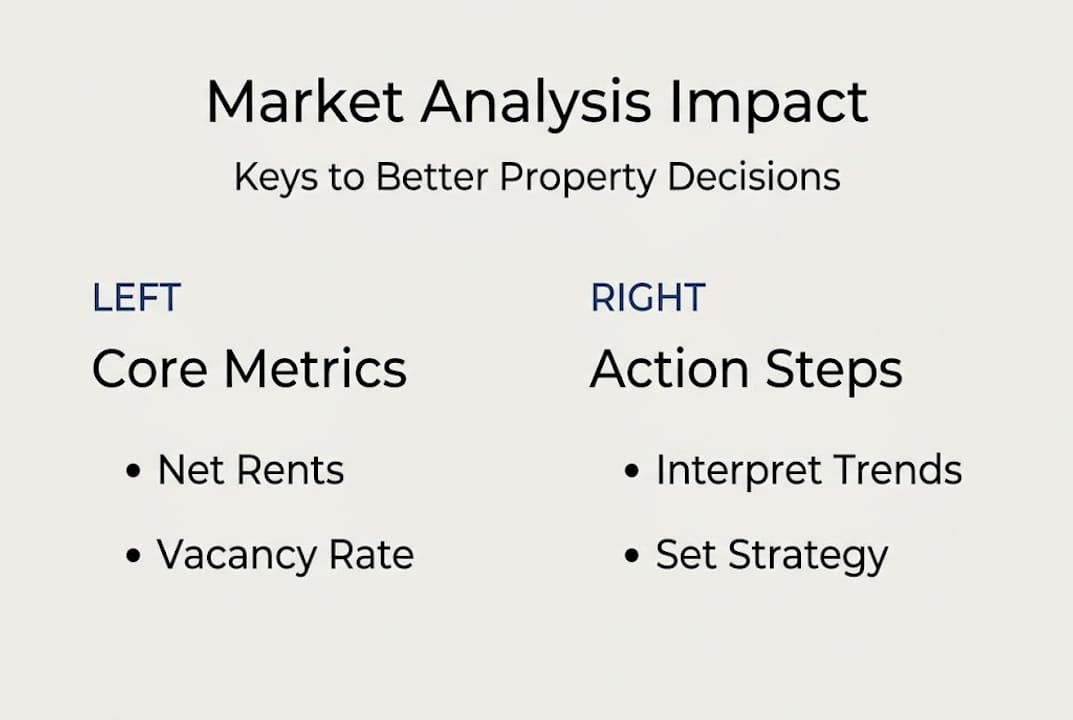
Rent trends tell you where landlord leverage sits. When rents climb steadily, demand is outpacing supply and landlords hold the cards. When rents soften, as they have in the GTA recently, tenants gain negotiating power and investors must reassess underwriting assumptions. GTA net rents fell 6% year-over-year to $16.57 per square foot, with a leasing pipeline of 20 million square feet active in 2025. That combination signals a market in transition.

Vacancy rates signal absorption health. A vacancy rate climbing from 1% to 4% sounds modest in percentage terms, but it represents a quadrupling of available space, and that changes negotiating dynamics entirely.
Absorption figures tell you whether the market is digesting new supply efficiently. Positive absorption means tenants are taking up space faster than it is being delivered. Negative absorption is a warning sign.
| Indicator | 2022 peak | 2025 current | Signal |
|---|---|---|---|
| Net rent ($/sq ft) | $18.50+ | $16.57 | Softening |
| Vacancy rate | Sub-1% | Rising (3-5%) | Supply overhang |
| Annual absorption | High positive | Moderating | Demand stabilising |
| New supply delivered | Surging | Elevated | Correction phase |
Given these signals, investors should consider:
- Pausing acquisitions in oversupplied submarkets until vacancy stabilises
- Renegotiating leases proactively where tenants hold softening-market leverage
- Rotating capital toward well-located, low-vacancy nodes like Mississauga Airport or Vaughan
- Understanding net lease structures to properly model occupancy cost shifts under changing market conditions
Understanding why industrial property trends matter for your specific holdings is essential context. The GTA is not a monolithic market. Different corridors move at different speeds, and submarket intelligence is the real edge. Tracking 2026 industrial trends for the GTA will be particularly important as new supply completions and demand from e-commerce and logistics users reshape the landscape through the year.
Turning market analysis into actionable investment strategy
Gathering data is only useful if it changes what you do next. Here is how to convert analysis findings into real strategic moves.
- Renegotiate leases where market softening gives you leverage. If comparable rents in your submarket have dropped, your renewal is a negotiating opportunity, not just an administrative task.
- Reallocate acquisition capital toward undersupplied nodes. Markets like Burlington, Hamilton, and Oshawa are showing stronger relative fundamentals in early 2026 compared to some oversupplied west-end corridors.
- Pause or restructure planned developments if your pro-forma assumed 2022-era rents. Reassessing underwriting with current rates protects you from building into a soft market.
- Stress-test your portfolio using current vacancy and rent scenarios, not optimistic projections. Know your breakeven occupancy before you need to.
- Build a market review cadence. Set a quarterly rhythm for reviewing key metrics. Markets shift faster than annual reporting cycles.
Pro Tip: When presenting market analysis findings to a board or executive team, lead with the risk scenario, not the upside. Decision-makers who understand downside exposure first make faster, more committed approvals when you recommend action.
The good news for GTA industrial investors is that resilience is expected as new supply slows and demand gradually absorbs available space. The current cycle is a correction, not a collapse. The investors who use market intelligence for strategy now will be positioned well when the next upswing arrives.
The real advantage: seeing beyond data points
Here is the uncomfortable truth about market analysis: most investors are looking at the same reports. The data is not the edge. What separates top performers from the rest is the ability to act decisively on signals before the broader market reaches consensus.
Consider a composite scenario we have seen play out across the GTA. An investor holding a multi-unit industrial portfolio in Brampton noticed vacancy creeping upward in their submarket in early 2024. Instead of waiting for the next quarterly report, they initiated lease renewals with existing tenants at still-favourable rates, locking in occupancy before competitors flooded the leasing market. By mid-2025, that discipline had protected net operating income while neighbouring assets scrambled to fill empty bays.
That outcome was not the result of better data. It was the result of reading directional signals earlier and having the confidence to act without waiting for certainty. Understanding broker advantages in 2026 means recognising that local expertise accelerates that interpretation. A spreadsheet tells you what happened. A specialist who operates in a specific corridor every day tells you what it means.
Agility beats perfection in every market cycle.
Level up your property investment strategy
Navigating a shifting GTA industrial market requires more than good instincts. It requires current data, submarket-level expertise, and a clear strategy that moves with the market rather than behind it.

At Michael Law Real Estate, we provide institutional-grade market intelligence and hands-on advisory for investors and corporate occupiers across the GTA, from Mississauga and Brampton to Markham, Vaughan, and the Durham Region. Whether you are evaluating an acquisition, renegotiating a lease, or repositioning a portfolio, we bring the analysis and the relationships to get the right outcome. Browse featured GTA industrial properties or speak with an expert to discuss your specific investment objectives today.
Frequently asked questions
What market data should GTA industrial investors focus on?
Track net rents, vacancy rates, new supply, and absorption, as these reflect real-time market conditions and emerging risks. Net rents and leasing pipeline are among the most critical metrics in the GTA context.
How often should market analysis be conducted for property investments?
Review core market statistics at least quarterly, since supply or demand shifts can move faster than annual reporting. Net rent shifts and vacancy are tracked on a quarterly basis in GTA market reports.
Can market analysis really reduce investment risk?
Yes, systematic market analysis surfaces risks early enough to adjust strategy before losses accumulate. Market analysis shapes response to softening rents and rising vacancies more effectively than reactive decision-making.
How do GTA industrial property trends in 2026 compare to previous years?
Recent years brought softening rents and higher vacancies, but the underlying demand base remains solid as the supply pipeline nears absorption. GTA net rents declined 6% YoY in Q4 2025, with new supply gradually being absorbed through 2026.