

TL;DR:
- Institutional investors control billions in GTA industrial assets, influencing market dynamics and land values.
- They prefer large, modern industrial assets with long leases, strong tenants, and logistics access.
- Smaller investors can follow institutional trends using REITs and targeted acquisitions for diversification and growth.
Most investors assume the GTA industrial market is shaped by individual buyers and local developers. It is not. Pension funds, insurance companies, and real estate investment trusts (REITs) collectively control billions in Canadian industrial assets, and their decisions ripple through every submarket from Mississauga to Oshawa. When an institution acquires a logistics park in Brampton or exits a warehouse portfolio in Vaughan, it shifts vacancy rates, lease benchmarks, and land values for everyone else. Understanding how institutional capital moves, and why, gives you a genuine edge in one of Canada's most competitive property sectors.
Table of Contents
- Defining institutional real estate investment
- Types of industrial assets institutions prefer
- Core strategies and portfolio approaches
- Key factors and trends shaping institutional strategies
- What most miss about institutional real estate in the GTA
- Discover GTA properties with institutional potential
- Frequently asked questions
Key Takeaways
| Point | Details |
|---|---|
| Institutions set market standards | Institutional investment influences what properties are built, bought, and leased in the GTA industrial real estate market. |
| REITs add portfolio flexibility | Real estate investment trusts provide investors with liquidity and diversification unavailable in private-only portfolios. |
| GTA focus drives industrial demand | Strong tenant demand and logistics growth make GTA industrial assets particularly attractive to institutional capital. |
| ESG and data drive decisions | Institutions prioritise ESG factors and advanced analytics when selecting and managing properties. |
Defining institutional real estate investment
Institutional investors are organisations that pool large amounts of capital to invest on behalf of beneficiaries or shareholders. In real estate, this group includes pension funds (like OMERS and CPP Investments), life insurance companies, sovereign wealth funds, private equity firms, and publicly traded REITs. They are distinct from private or individual investors in three important ways: scale, regulatory oversight, and time horizon.
A private investor might acquire a single 20,000-square-foot warehouse in Ajax. An institution might acquire a portfolio of ten such buildings across the GTA in a single transaction. That scale creates a fundamentally different relationship with the market. Institutions can absorb risk across multiple assets, negotiate favourable financing terms, and hold properties through downturns without the pressure to sell.
Key characteristics that separate institutional from private investing include:
- Scale: Transactions typically start at $20 million and routinely exceed $100 million in the GTA industrial sector
- Regulatory oversight: REITs and pension funds operate under strict governance frameworks, requiring transparent reporting and risk management
- Long-term focus: Institutions typically hold assets for 7 to 15 years, prioritising stable income over short-term gains
- Data-driven decisions: Acquisitions are supported by proprietary analytics, third-party appraisals, and detailed market modelling
- ESG integration: ESG principles in GTA real estate are now a standard filter in institutional due diligence, not an optional add-on
Institutional activity also shapes local market liquidity. When institutions are active buyers, transaction volume rises, pricing benchmarks are set at higher levels, and smaller investors gain clearer comparables. REITs provide liquidity and diversification, often outperforming private real estate alone, which is why they have become a dominant force in the GTA industrial corridor.
The 2026 industrial real estate trends show institutions increasingly prioritising assets with green certifications, modern building specifications, and long-weighted average lease expiry (WALE) profiles.
Pro Tip: When researching a submarket, check whether institutional owners are present. High institutional ownership in an area like Mississauga's Airport Corridor or Vaughan's Highway 400 node is a reliable signal of pricing stability and tenant quality.
With a working definition in mind, let's examine what types of real estate assets institutions favour, particularly in Toronto's industrial market.
Types of industrial assets institutions prefer
Not every industrial building qualifies for institutional ownership. Institutions are selective, and their preferences have become more refined as the GTA industrial market has matured. The asset types that attract the most institutional capital share common traits: large footprints, modern specifications, strong tenant covenants, and locations with excellent logistics access.

The most sought-after industrial asset classes in Toronto include:
| Asset type | Typical size | Lease length | Risk profile | Major tenants |
|---|---|---|---|---|
| Distribution centre | 200,000+ sq ft | 7 to 15 years | Low to medium | Amazon, Loblaw, Purolator |
| Cold storage facility | 50,000 to 150,000 sq ft | 5 to 10 years | Medium | Grocery chains, pharma |
| Bulk warehouse | 100,000 to 500,000 sq ft | 5 to 12 years | Low | 3PL providers, retailers |
| Specialised manufacturing | 30,000 to 100,000 sq ft | 7 to 20 years | Medium to high | Automotive, aerospace |
Distribution and logistics assets have seen the sharpest institutional demand since 2020. E-commerce growth accelerated the need for last-mile and regional fulfilment facilities, and the GTA's position as Canada's largest consumer market made it ground zero for that expansion. Institutions often allocate to distribution, logistics, and specialised manufacturing spaces for higher yields and growth potential.
What makes an asset truly "institutional grade" goes beyond size alone. Look for:
- Clear height of 32 feet or greater
- ESFR sprinkler systems and modern dock configurations
- Trailer parking ratios that support large fleet operations
- Proximity to Highway 400, 401, 407, or 410 corridors
- Tenants with investment-grade credit ratings or national brand recognition
- Lease structures with built-in rent escalations
- LEED certification or energy-efficient building systems
You can browse available institutional-grade properties across the GTA to see how these specifications translate in practice. The gap between a standard industrial building and an institutional-grade one often comes down to details that significantly affect long-term value.
Now that we know the property types institutions prefer, it's important to understand the strategies they use to build and manage these portfolios.
Core strategies and portfolio approaches
Institutions do not simply buy and hold. They construct portfolios deliberately, balancing direct ownership with indirect vehicles to optimise returns, liquidity, and risk exposure. Three primary structures dominate the GTA institutional landscape.
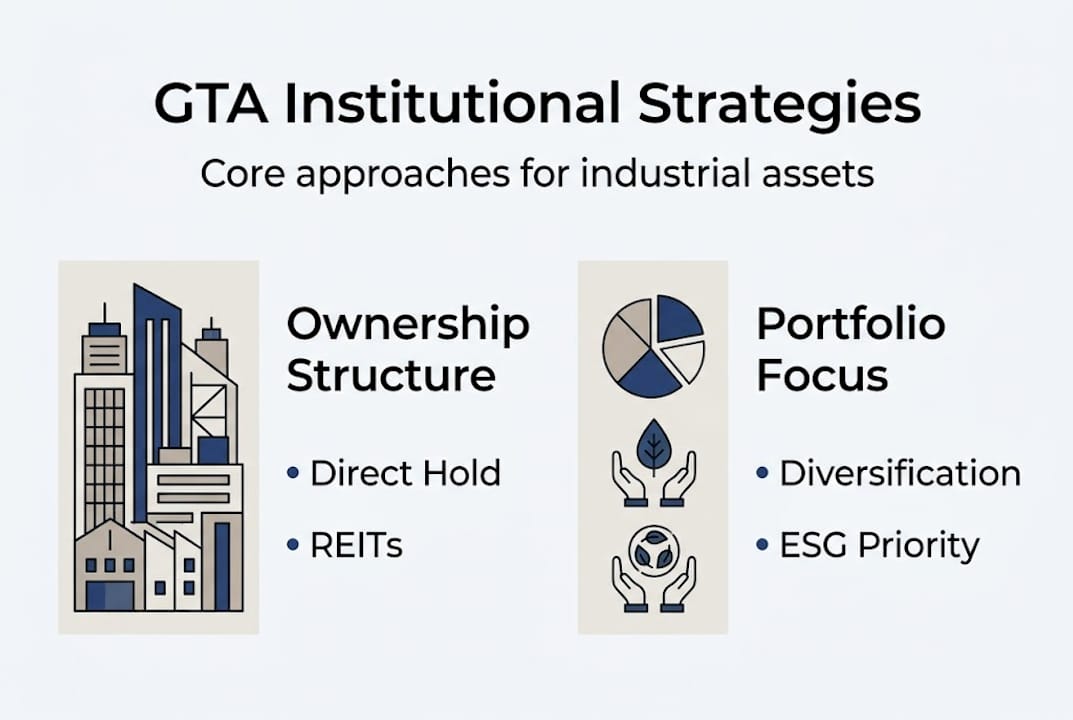
| Ownership structure | Liquidity | Minimum investment | Risk level | Diversification |
|---|---|---|---|---|
| Publicly traded REIT | High | Low (publicly listed) | Low to medium | High |
| Direct ownership | Low | $10M+ | Medium to high | Low to medium |
| Private equity fund | Medium | $1M to $5M | Medium to high | Medium |
REITs complement private real estate for liquidity, sector, and geographic diversification. This is why most large institutions hold a blend rather than committing exclusively to direct ownership.
When building a diversified industrial portfolio, institutions typically follow a structured process:
- Define target allocation: Determine what percentage of the total portfolio belongs in industrial real estate versus other asset classes
- Select submarkets: Use industrial market reports to identify high-growth nodes with favourable supply-demand dynamics
- Screen assets: Apply filters for building specifications, tenant quality, lease term, and ESG compliance
- Underwrite conservatively: Model multiple scenarios including rising vacancy and interest rate sensitivity
- Execute and manage actively: Monitor lease expiries, capital expenditure needs, and submarket rent trends on an ongoing basis
For a deeper look at how transactions are structured in the GTA, the GTA investment sales explained resource breaks down the mechanics clearly.
Pro Tip: Smaller investors can mimic institutional diversification by pairing a publicly traded industrial REIT with one or two direct investments in GTA submarkets. You get the liquidity of the REIT and the upside of local market knowledge.
To see how and why these strategies matter, let's look at the key factors and trends guiding institutional investment decisions in the GTA.
Key factors and trends shaping institutional strategies
Institutional decision-making is not static. The factors that drive acquisitions and dispositions shift as market conditions evolve, and 2026 has brought several notable changes to how institutions approach the GTA industrial sector.
The top investment drivers currently shaping institutional behaviour include:
- Vacancy rates: GTA industrial vacancy has risen from historic lows, creating selective buying opportunities for well-capitalised institutions
- Rental growth benchmarks: Net asking rents remain elevated relative to pre-pandemic levels, supporting income-focused strategies
- Tenant credit quality: Institutions are tightening their tenant screening, prioritising national and multinational covenants
- Supply chain realignment: Nearshoring trends are increasing demand for specialised manufacturing and cold storage in the GTA
- ESG compliance: Green building standards are now a hard filter, not a soft preference, in most institutional acquisition criteria
- Regional economic indicators: Employment growth, population density, and infrastructure investment in areas like Hamilton and Oshawa are influencing where institutions look next
Monitoring industrial property trends is essential for anticipating where institutional capital will flow before prices reflect that demand.
The research is clear on portfolio construction:
"Portfolios with both REITs and private real estate outperform private alone."
This finding has practical implications. Institutions are not choosing between REITs and direct ownership. They are using both, and the combination produces better risk-adjusted returns than either approach in isolation. Data analytics and ESG integration are not just compliance exercises. They are genuine risk management tools that help institutions avoid assets that will underperform as environmental regulations tighten and tenant expectations shift.
Understanding these shifts puts you in a position to better anticipate institutional moves and how they will affect the GTA industrial landscape.
What most miss about institutional real estate in the GTA
The prevailing view is that institutional capital crowds out smaller investors, pushing prices beyond reach and locking up the best assets. That narrative is incomplete. Institutional presence in a submarket raises standards across the board. When a major pension fund acquires a logistics park in Brampton, it sets a new pricing benchmark, attracts higher-quality tenants, and often triggers infrastructure improvements in the surrounding area. Smaller investors benefit from that rising tide.
More importantly, institutional activity is one of the most reliable leading indicators available. When institutions begin acquiring aggressively in a submarket, it typically precedes a broader pricing run-up by 12 to 24 months. When they begin exiting, it often signals a market peak or a shift in submarket fundamentals. The industrial investment sales guide covers how to read these signals in the GTA context.
Smart local investors do not just compete with institutions. They study institutional behaviour, align their acquisitions with institutional-grade standards, and position their assets to attract the same tenant base. That is how you build a portfolio that commands premium rents and attracts buyers when you are ready to exit.
Pro Tip: Track institutional acquisition and disposition announcements in the GTA through SEDAR filings and REIT quarterly reports. These disclosures often reveal submarket conviction before it shows up in broader market data.
Discover GTA properties with institutional potential
The strategies institutions use are not reserved for billion-dollar funds. With the right data and local expertise, private investors and decision-makers can apply the same rigorous frameworks to GTA industrial acquisitions at any scale.

Michael Law Real Estate provides institutional-grade market intelligence and advisory services across every major GTA industrial corridor. Whether you are evaluating GTA institutional-grade properties or looking to benchmark your existing assets against current market standards, the commercial real estate expertise available through the platform gives you the analytical foundation to make confident decisions. Reach out to explore how institutional frameworks can be applied to your next GTA industrial investment.
Frequently asked questions
What makes a property 'institutional grade'?
Institutional-grade properties are large-scale, modern, well-located assets with long-term leases and high-quality tenants, making them ideal for institutional investors. Key markers include clear heights above 32 feet, ESFR sprinklers, and tenants with investment-grade credit ratings.
Why do institutions invest in industrial properties in the GTA?
The GTA's industrial sector offers scale, robust tenant demand, and strong logistics connections, making it attractive for institutional capital seeking stability and growth. Institutions target logistics and distribution assets specifically for their growth potential in Canada's largest consumer market.
How can smaller investors benefit from institutional trends?
Smaller investors can follow institutional activity for market direction and gain access to similar diversification using REITs or direct investment in selective GTA assets. REITs offer diversification and liquidity to all investor types, not just large funds.
What is the role of ESG in institutional real estate investing?
ESG standards now strongly influence institutional investment selection, with a focus on sustainability, governance, and tenant impact in new and existing assets. ESG is a growing priority for institutional real estate managers across the GTA and beyond.