

TL;DR:
- Genuine market intelligence involves understanding supply, demand, and macroeconomic factors, not just rental prices.
- Using multiple data sources and local expertise enhances accuracy in leasing and investment decisions.
- Tailored, current insights enable tenants and investors to negotiate better terms and identify market opportunities.
Relying on last quarter's leasing rates or a neighbour's anecdotal advice is not a strategy. It's a gamble. The Greater Toronto Area industrial market moves fast, with vacancy rates shifting quarter over quarter and rental rates responding to supply constraints across Brampton, Mississauga, and the Durham Region. Investors and tenants who act on stale data risk overpaying, missing prime opportunities, or locking into lease terms that erode their competitive position. Real market intelligence goes several layers deeper than a basic listing search, and understanding how to harness it is what separates well-positioned players from those constantly reacting to the market.
Table of Contents
- What is market intelligence in GTA real estate?
- Core data sources and analytical methods
- Using market intelligence for leasing and investment decisions
- Technology and tools for GTA real estate intelligence
- The overlooked power of tailored real estate intelligence
- Unlock deeper market intelligence for your next real estate move
- Frequently asked questions
Key Takeaways
| Point | Details |
|---|---|
| Context matters | Market intelligence is more than numbers; it includes local context and future projections. |
| Data-driven decisions | Investors and tenants in the GTA get stronger outcomes with verified, current information. |
| Technology advantage | Digital tools and expert brokerages make market intelligence actionable for real estate success. |
| Custom insights win | Tailored intelligence outperforms generic reports, driving better leases and investments. |
What is market intelligence in GTA real estate?
Market intelligence is not simply knowing what a warehouse leases for in Vaughan. It is understanding why that rate is where it is, what forces are pushing it higher or lower, and where it is likely to go next. For GTA industrial real estate, that means synthesising leasing rates, vacancy trends, absorption data, competitor behaviour, and macroeconomic signals into a coherent picture you can act on.
Here is what genuine market intelligence covers:
- Leasing rate benchmarks across submarkets, including net asking rents and effective rents after incentives
- Vacancy and availability rates broken down by building size, clear height, and location
- Demand drivers such as e-commerce growth, reshoring of manufacturing, and last-mile logistics expansion
- Competitor behaviour, including which tenants are expanding, contracting, or relocating
- Pipeline supply, meaning new developments under construction or recently approved
- Absorption trends, showing how quickly available space is being taken up
The critical distinction is between static information and dynamic insight. A listing database gives you static information. Market intelligence gives you the context to interpret it. As noted in GTA real estate trends, market intelligence equips investors with contextual data for decisions, not just raw numbers.
"The GTA industrial market is one of the most supply-constrained in North America. Without real intelligence, you are navigating one of the continent's tightest markets with a blindfold on."
For tenants, this means knowing when to act before a submarket tightens. For investors, it means identifying an asset that is underpriced relative to its submarket trajectory, not just its current rent roll. The GTA's geography makes this especially important. Toronto West, North GTA, and the East GTA corridors each behave differently, and a blanket view of the market will mislead you every time.
Core data sources and analytical methods
Knowing that market intelligence matters is one thing. Knowing where to find credible data and how to analyse it is where most investors and tenants fall short. The GTA industrial market is well-served by several reliable data streams, but the real skill is in triangulating across them.
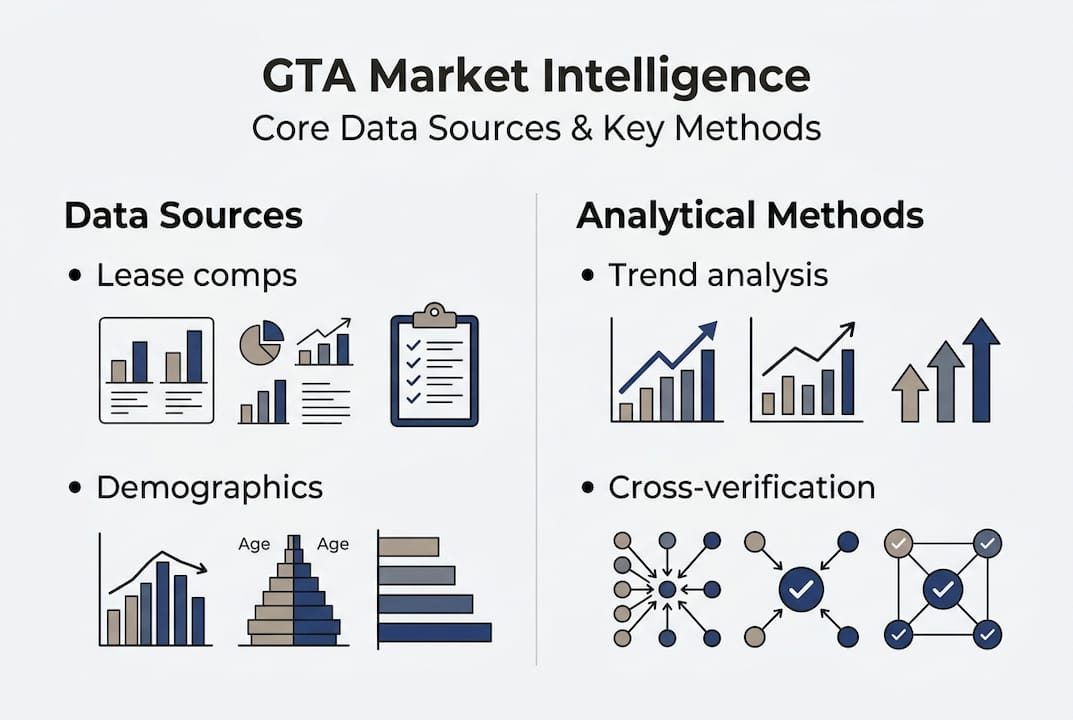
Primary data sources for GTA industrial intelligence:
| Source | What it reveals |
|---|---|
| Lease comparables | Actual transacted rents, term lengths, incentives |
| Vacancy statistics | Available space by submarket and building class |
| Demographic data | Labour pool quality, consumer proximity for logistics |
| Property tax records | Assessed values, ownership history, cost benchmarks |
| Development permits | Incoming supply, land use changes |
How to apply the data analytically:
- Benchmarking: Compare your target property's rent against recent lease comps in the same submarket and size range.
- Trend analysis: Track vacancy and absorption over six to eight quarters to identify directional momentum.
- Predictive modelling: Layer in pipeline supply and demand drivers to forecast where rents are heading in 12 to 24 months.
- Sensitivity analysis: Test your investment thesis against multiple scenarios, including a demand slowdown or interest rate shift.
- Submarket segmentation: Never aggregate the entire GTA. Analyse Mississauga Airport Corridor separately from Oshawa or Burlington.
The value of working with industrial broker advantages is that experienced advisors already have proprietary lease comp databases and submarket models that would take years to build independently. As highlighted through real estate advisory services, advanced analytics and advisory are crucial for accurate intelligence in a market this competitive.
Pro Tip: Never rely on a single data source. Cross-verify asking rents against actual transacted lease comps, and always check pipeline supply before committing to a long-term lease or acquisition.
Using market intelligence for leasing and investment decisions
Market intelligence is only valuable when it changes your behaviour. Let's look at how it translates into real outcomes for GTA industrial tenants and investors.
For tenants, the most immediate application is lease negotiation. When you know the actual vacancy rate in a specific submarket, the average incentive packages being offered, and which landlords have upcoming lease expirations in their portfolio, you negotiate from a position of strength rather than hope. You can push for free rent periods, tenant improvement allowances, or flexible renewal options that a less-informed tenant would never think to request.

For investors, market intelligence helps you identify assets where the current rent roll is below market, where a submarket is on the cusp of tightening, or where a building's functional obsolescence is masking genuine upside potential. The difference in outcomes is stark:
| Scenario | Without market intelligence | With market intelligence |
|---|---|---|
| Lease negotiation | Accept asking rent | Benchmark and negotiate 10-15% below asking |
| Investment acquisition | Pay market price | Identify below-market assets in tightening submarkets |
| Lease renewal | Renew at landlord's proposed rate | Renegotiate based on current comps |
| Site selection | Choose based on availability | Prioritise submarkets with labour and logistics advantages |
Key applications for both groups include:
- Timing market entry and exit based on absorption trends
- Avoiding submarkets with heavy incoming supply that will suppress rents
- Identifying owner-user opportunities before they hit the open market
- Structuring lease terms with built-in flexibility for growth or contraction
As demonstrated through property trend impact, monitoring property trends drives better lease outcomes, particularly in a market where conditions can shift within a single quarter. For those considering acquisitions, a solid investment sales guide can clarify how intelligence feeds directly into transaction strategy.
Technology and tools for GTA real estate intelligence
The quality of your market intelligence depends heavily on the tools and platforms you use to gather and interpret data. The GTA industrial market has seen significant growth in digital intelligence resources over the past several years, and knowing which tools are worth your time matters.
Platforms and tools worth using:
- Property databases: Commercial MLS platforms and broker-exclusive databases offering lease comps, sale transactions, and availability listings
- Market analytics dashboards: Tools that aggregate vacancy, absorption, and rental rate data by submarket and property type
- Demographic and logistics mapping: GIS-based tools that overlay labour pool data, transportation infrastructure, and consumer density
- Advisory dashboards: Custom reporting tools offered by specialised brokerages, providing hyper-local GTA data not available through generic platforms
- News and permit monitoring: Tracking municipal planning applications and development permits to anticipate incoming supply before it is publicly listed
Generic national platforms often lag behind local conditions by a full quarter or more. The most actionable intelligence comes from advisors with live transaction data across the GTA's specific corridors. For strategies on maximising GTA returns, pairing digital tools with expert advisory is consistently the highest-value approach.
It is also worth noting that digital tools expand access to timely market intelligence, particularly for investors who are not embedded in the local brokerage community. Technology lowers the barrier to entry for data, but interpretation still requires local expertise.
Pro Tip: Prioritise platforms that source data from verified local transactions rather than aggregated national feeds. GTA submarket conditions can diverge sharply from national averages, and acting on national data in a local deal is a costly mistake.
The overlooked power of tailored real estate intelligence
Here is an uncomfortable truth: most market reports are written to be broadly applicable, which means they are specifically useful to almost no one. A quarterly report covering the entire GTA will tell you average vacancy is tight. It will not tell you that a specific node in Pickering has three large blocks of space coming available in the next six months, or that a Brampton landlord is quietly offering aggressive incentives to fill a recently vacated distribution centre.
Generic intelligence creates generic decisions. Tailored intelligence, built around your specific asset class, size requirement, submarket, and timeline, is what actually moves the needle. We have seen tenants secure lease terms significantly below asking because their advisor had live, hyper-local data that the landlord did not expect them to have. We have seen investors acquire assets at below-replacement cost because they understood a submarket's trajectory before the broader market caught on.
As shown through market intelligence success, applied market intelligence leads to successful transactions, not just better-informed ones. The distinction matters. Intelligence is not a comfort blanket. It is a competitive weapon, and it only works when it is specific, current, and interpreted by someone who knows the GTA industrial market from the ground up.
Unlock deeper market intelligence for your next real estate move
If the frameworks above resonate, the next step is putting them to work with data and expertise built specifically for the GTA industrial market.

Michael Law Real Estate delivers institutional-grade market intelligence across every major GTA industrial corridor, from Mississauga and Brampton to Markham, Vaughan, and the Durham Region. Whether you are negotiating a lease, evaluating an acquisition, or repositioning an asset, our advisory is grounded in live transaction data and hyper-local submarket knowledge. Explore current industrial property listings or connect directly for custom market analysis tailored to your goals. Visit Michael Law Real Estate to get started with expert GTA advice that goes well beyond a standard market report.
Frequently asked questions
How does market intelligence differ from standard real estate data?
Market intelligence adds context, analysis, and predictive insights to raw data, helping you anticipate shifts and make informed leasing or investment choices rather than simply reacting to what is already visible. Market intelligence equips investors with the contextual layer that raw listings cannot provide.
What are the main data sources for GTA market intelligence?
Industrial leasing comps, vacancy statistics, demographic studies, and local brokerage reports are the most commonly used sources. Advanced analytics and advisory services layer these sources into coherent, actionable intelligence.
How can market intelligence improve lease negotiations?
Up-to-date intelligence lets you benchmark terms against actual transacted comps and identify undervalued opportunities, giving you a measurably stronger negotiation position. Monitoring property trends is particularly effective when timed to submarket vacancy cycles.
Which types of technology support real estate market intelligence?
Platforms offering real-time analytics, custom advisory dashboards, and verified GTA property databases are most effective. Digital tools expand access to timely data, though local expert interpretation remains essential for accurate application.