
TL;DR:
- Build-to-suit leasing involves custom-built properties designed specifically for tenants, with agreements signed before construction begins. It offers operational efficiency and location advantages but entails long-term commitments, higher rents, and construction risks. Proper planning and expert guidance are essential to securing a purpose-built facility that meets evolving business needs in the GTA's tight industrial market.
Most industrial tenants in the Greater Toronto Area assume their leasing options boil down to a shortlist of existing spaces, a standard form lease, and a negotiation over rent and term. That assumption costs them. What is build-to-suit leasing? It is a fundamentally different arrangement where a developer constructs a facility to your exact specifications and you commit to a lease before the first shovel breaks ground. For logistics operators, manufacturers, and distribution companies competing in one of North America's tightest industrial markets, understanding this option is not just useful — it can define whether your facility actually fits your operation or merely tolerates it.
Table of Contents
- What is build-to-suit leasing and how does it differ from traditional leases?
- Key benefits and risks of build-to-suit leasing for GTA industrial tenants
- The build-to-suit leasing process: from planning to occupancy
- Understanding tenant improvement work letters and lease terms in BTS deals
- Financial considerations and lease structure insights for industrial BTS tenants
- How build-to-suit leasing fits into the Greater Toronto Area industrial market
- What most tenants miss about build-to-suit leases in the GTA industrial sector
- Explore customised industrial properties and expert BTS support with Michael Law
- Frequently asked questions
What is build-to-suit leasing and how does it differ from traditional leases?
Build-to-suit leasing is a commercial arrangement where a tenant commits to leasing a property that a developer constructs specifically for that tenant's operational needs, with the lease negotiated before construction starts. The defining distinction is timing. In a standard lease, the building already exists. You inspect it, negotiate terms, and move in. In a build-to-suit deal, the building does not exist yet, and your requirements drive every design decision from ceiling height to column spacing to dock door placement.
This model flips the traditional leasing dynamic in a few important ways:
- No compromise on design. A standard 200,000 sq ft warehouse in Brampton is built to appeal to the broadest possible tenant pool. A build-to-suit warehouse in Brampton is built for you, with your truck volumes, racking system, temperature requirements, and power loads embedded in the design from day one.
- Lease commitment precedes construction. You are not choosing a finished product. You are signing an agreement that triggers the development process, which means your credit profile and operational credibility matter to the developer.
- Longer lease terms are standard. Because the building is purpose-built and cannot be easily re-leased to another tenant, developers require longer initial terms, typically 10 to 20 years, to justify the capital investment and risk.
- Rent is negotiated on pro forma projections. Unlike existing spaces where comparable market rents guide negotiation, BTS rent is calculated based on projected construction costs, financing, and developer return requirements.
The practical effect is that build-to-suit properties give tenants a facility that functions exactly as the business requires, without the capital outlay of ownership. For a large e-commerce distribution centre in Mississauga or a cold chain logistics facility in Vaughan, the operational value of a purpose-built space is enormous.
Key benefits and risks of build-to-suit leasing for GTA industrial tenants
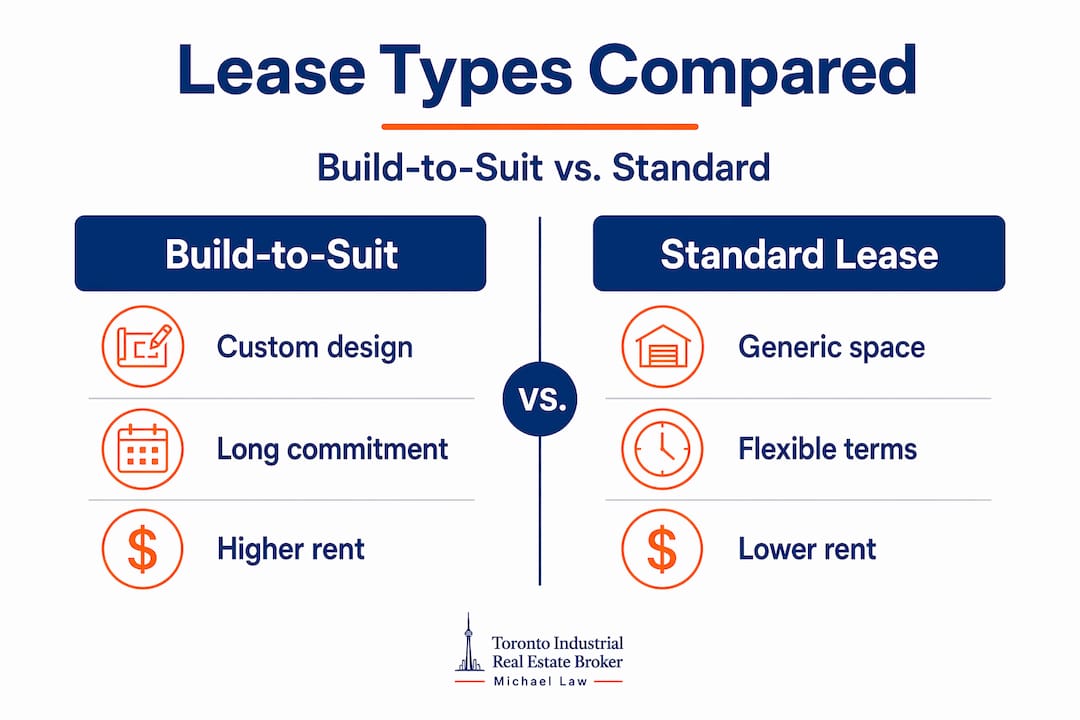
With an understanding of what BTS leasing entails, let us examine its specific benefits and risks for industrial tenants in the GTA.
The core financial logic is straightforward. Build-to-suit is designed to preserve tenant capital because the developer funds and manages construction, but the long-term lease commitment allows the developer to recoup costs and assume risk. Rather than tying up tens of millions of dollars in a facility purchase or construction project, you redirect that capital to operations, inventory, equipment, or growth.
Key benefits for GTA industrial tenants:
- Custom operational design. Ceiling clearances tailored to your racking heights, power capacity matched to your equipment loads, dock ratios aligned to your truck volume, and yard depth suited to your trailer management. None of this requires retrofitting after move-in.
- Capital efficiency. The developer finances the build. You pay through rent over the lease term, preserving working capital for the business itself.
- Cost certainty. BTS lease economics are agreed in advance, giving finance teams predictable occupancy costs over a fixed term, which simplifies business planning considerably.
- Location specificity. You can secure a site in a particular industrial node — say, near Highway 400 in Vaughan or the 401/410 interchange in Brampton — that aligns with your supply chain, rather than settling for whatever existing space is available in that corridor.
Key risks to understand:
- Long-term commitment with limited flexibility. If your business shrinks, pivots, or is acquired, you remain obligated to a building designed for an operational model that may no longer apply.
- Higher effective rent. Because the developer embeds construction costs and financing into the rent, you will often pay more per square foot than for a comparable generic building.
- Construction risk during development. Delays, cost overruns, and permit issues can push occupancy timelines and create operational disruption.
- Specialised space is hard to sublet. A facility built specifically for your operation may be difficult to sublease if circumstances change, which limits your exit options.
Pro Tip: Before signing a build-to-suit agreement, engage industrial leasing due diligence early. Verify that the site's zoning, servicing, and environmental history support your intended use before the lease is executed, not after.
The build-to-suit leasing process: from planning to occupancy
Understanding the benefits and risks, let us now review the detailed BTS leasing process from start to finish.
BTS projects can take from 12 to 36 months depending on complexity, requiring early planning and coordination of design, permits, and approvals. That timeline surprises many tenants who are accustomed to moving into existing space within weeks. Here is how the process typically unfolds:
- Tenant requirements definition. You document your operational needs in detail: building size, clear height, dock and drive-in doors, power, HVAC, office component, yard dimensions, trailer parking, and any specialized features such as cold storage or chemical storage compliance.
- Site selection and developer engagement. A developer or landowner is identified whose site, financial capacity, and development experience align with your requirements. This is where working with an experienced real estate advisor changes the outcome materially; they know which developers are actively pursuing BTS mandates and which sites have the servicing capacity to support your build.
- Letter of intent and lease negotiation. Before construction begins, you negotiate and execute a lease or a binding letter of intent that locks in rent, term, tenant improvement scope, permitted use, and key construction milestones. BTS lease negotiation insights confirm that this stage sets the foundation for everything that follows.
- Design development and permit applications. The developer's team, including architects and engineers, develops construction drawings based on your requirements. Permit submissions follow, which in municipalities like Brampton or Markham can take several months depending on the review queue.
- Construction and tenant coordination. The developer manages the build. You review progress at agreed milestones and approve any scope changes through a formal change order process. This stage is where unclear scopes create the most friction.
- Substantial completion and occupancy. Once the building passes inspection and is certified as substantially complete, rent commencement typically begins, regardless of whether minor deficiencies remain outstanding.
Pro Tip: Negotiate a rent commencement date tied to a specific completion milestone, not just a calendar date. If construction is delayed, your obligation to pay rent should not begin until the facility is genuinely ready to operate.
Understanding tenant improvement work letters and lease terms in BTS deals
After outlining the overall process, we focus on the lease details and improvement work letters vital to BTS success.
The tenant improvement (TI) work letter is arguably the most consequential document in a build-to-suit transaction, and it is also the one most frequently under-negotiated. The TI work letter defines the build scope, timeline, approval process, financing responsibilities, and permits, turning lease agreements into actionable construction plans. Without precision here, disputes during construction are nearly inevitable.
What a thorough work letter should address:
- Scope of base building vs. tenant work. Clearly separate what the developer delivers as base building (structure, mechanical, electrical, shell) versus what falls under your tenant improvement scope.
- Specification standards. Define material and system specifications to avoid substitution disputes. "High-quality finishes" means nothing in a dispute. "Epoxy-coated concrete floor at 6,000 psi compressive strength" does.
- Permit responsibilities. Assign who pulls each permit, who manages inspections, and who bears costs and delays associated with regulatory approvals.
- Change order protocols. Establish the process for approving scope changes, pricing methods, and timeline impacts.
- Completion milestones and consequences. Define what "substantial completion" means, what deficiencies are acceptable at handover, and how long the developer has to cure them.
| Work letter component | Landlord responsibility | Tenant responsibility |
|---|---|---|
| Base building structure | Yes | No |
| Mechanical/electrical base | Yes | Upgrade costs |
| Tenant-specific fit-out | Negotiated | Yes |
| Permit applications | Base building | Tenant improvements |
| Inspection management | Shared | Shared |
| Change order pricing | Developer proposes | Tenant approves |
Lease terms in BTS deals also reflect the rent escalation structures tied to construction financing. Expect annual escalations in the range of two to three percent, with some deals using CPI-linked adjustments. The initial term, again often 10 to 20 years, is structured to allow the developer to fully amortise construction debt and generate a return, which is why shorter BTS terms are rare and usually come with higher base rents.
Financial considerations and lease structure insights for industrial BTS tenants
Building on lease details, we now explore key financial aspects and rent structures unique to BTS leases.
BTS rent normally bundles construction financing, specialised design, and developer risk amortised over a long lease term, making comparisons to standard leases complex. A net rent of $18 per square foot on a BTS deal and $18 per square foot on a standard industrial lease are not equivalent propositions. The BTS figure reflects construction recovery; the standard figure reflects market conditions for an existing asset.
How BTS rent economics work:
- Construction cost amortisation. If a developer spends $150 per square foot to build a 150,000 sq ft facility at a cost of $22.5 million, the rent must service that capital over the lease term. At a 5.5% cap rate on a 15-year term, the net rent needed to justify the investment is considerably higher than a comparable generic building.
- Risk premium. The developer is building a facility that is difficult to re-lease to another tenant if you default or vacate. That risk is priced into the rent.
- Financing environment matters. In 2026, with construction financing costs elevated relative to the decade prior, BTS rents in GTA industrial markets are notably higher than deals executed in 2019 or 2020. The financing environment at the time of construction is effectively locked into your lease economics.
| Factor | BTS lease | Standard industrial lease |
|---|---|---|
| Upfront capital required | Minimal (rent only) | Security deposit |
| Facility customisation | Full | Limited or none |
| Typical initial term | 10 to 20 years | 3 to 10 years |
| Rent basis | Construction cost plus return | Market comparables |
| Flexibility | Low | Moderate |
| Subletting ease | Difficult | Easier |
Pro Tip: When evaluating a BTS deal, calculate your total occupancy cost over the full term, including rent escalations, operating costs, and any capital you would spend modifying a generic space to meet your needs. That comparison, rather than the headline net rent, is how to determine whether a sale-leaseback alternative or an existing lease makes more financial sense.
How build-to-suit leasing fits into the Greater Toronto Area industrial market
With finances covered, we examine BTS leasing's strategic fit within the GTA industrial real estate landscape.
The GTA industrial market has spent the past several years in a state of historically compressed vacancy, with BTS emerging as a popular strategy enabling tenants to secure tailored space while preserving operational capital amid tight vacancy and rising rents. When existing supply is scarce and what is available does not meet your technical requirements, build-to-suit stops being a niche option and becomes a practical solution.
Consider what this means for specific industrial users:
- Third-party logistics operators (3PLs) managing multiple client SKUs need specific racking heights, dock configurations, and yard depths. Generic warehouse space routinely falls short on two or three of these criteria. BTS eliminates the compromise.
- Cold chain and food processing tenants face regulatory requirements around CFIA compliance, sanitation design, and temperature control that virtually no existing speculative building accommodates. BTS is often the only viable path.
- Advanced manufacturers need power capacity, floor load ratings, ventilation, and sometimes crane rail systems that speculative buildings do not include. Purpose-built design is not a luxury; it is a requirement.
- E-commerce fulfillment operators require complex mezzanine systems, high dock-to-grade ratios, and extensive trailer parking that most existing GTA industrial stock cannot provide without costly retrofitting.
Why the GTA market context amplifies BTS demand:
- Vacancy rates across core GTA submarkets including Mississauga, Brampton, and Vaughan remain tight by historical standards, meaning tenants cannot simply wait for the right building to become available.
- Industrial property trends show continued escalation in purpose-built logistics and cold storage development across the outer GTA, particularly in Burlington, Hamilton, and the Durham Region.
- Municipal intensification pressures in Toronto proper are redirecting large-format industrial demand to the 400-series highway corridors, where land assembly for BTS projects remains more achievable.
What most tenants miss about build-to-suit leases in the GTA industrial sector
Here is the uncomfortable truth about BTS leasing in the GTA: most tenants spend the majority of their negotiating energy on headline rent and initial term, and almost no time on the technical documents that actually determine whether they get the building they need.
In industrial BTS negotiations, early technical scope exhibits are often more critical than headline lease terms because unclear specifications lead to disputes and costly change orders during construction. Once construction has started, your leverage evaporates. The developer has capital deployed, timelines to protect, and every change you request becomes a negotiation where you are the less urgent party.
The pattern is predictable. A tenant focuses on getting to $16.50 net per square foot instead of $17.25. They negotiate hard on the lease term and renewal options. Then they sign a work letter that describes the dock doors as "commercial grade" without specifying manufacturer, weight capacity, or insulation rating. Eight months into construction, they discover the base specification does not meet their carrier's dock requirements, and the change order to rectify it costs $400,000. They paid to save $0.75 per square foot and spent three times that correcting a vague specification.
The second thing tenants underestimate is the operational inflexibility that comes with a 15 or 20-year commitment to a purpose-built facility. Businesses evolve. The logistics model that requires a 40-foot clear height and 42 dock doors today may look very different in 2035 if automation reshapes your warehouse operations. BTS leases offer very limited ability to modify, sublease, or exit without significant financial consequence.
This is exactly why having an experienced advisor throughout BTS negotiations is not optional. The complexity of coordinating design specifications, lease economics, permit timelines, and risk allocation across a multi-year construction process requires someone who has done it before, many times, in markets like Brampton, Vaughan, and the Durham Region where local permit timelines and development fees vary considerably.
Our perspective: BTS leasing is a genuinely excellent tool for the right tenant in the right situation. But it rewards preparation and punishes assumptions. Tenants who invest in detailed scoping and qualified representation consistently get better buildings, fewer disputes, and lease structures they can actually live with for two decades.
Explore customised industrial properties and expert BTS support with Michael Law
If you are a logistics operator, manufacturer, or distribution company exploring build-to-suit leasing in the GTA, the quality of guidance you receive at the outset determines everything that follows. Michael Law Real Estate brings deep local expertise across all major GTA industrial corridors, from Mississauga and Brampton to Vaughan, Markham, and the Durham Region.
Whether you are assessing customised industrial properties across the GTA or exploring specific development opportunities such as Caledon industrial real estate where new BTS projects are gaining traction, the team at Michael Law provides site selection expertise, lease negotiation support, and the technical knowledge to protect your interests through every stage of a BTS transaction. Reach out to discuss your operational requirements and learn how a purpose-built facility can be structured to work for your business, not just your landlord's pro forma.
Frequently asked questions
What does a build-to-suit lease mean for an industrial tenant?
It means you lease a custom-built property designed specifically for your operations, with a lease agreed before construction starts, often lasting 10 to 20 years.
How long does the build-to-suit construction process usually take in the GTA?
Typically, it takes 12 to 36 months depending on project size, permitting, and complexity, so early planning is essential to avoid occupancy gaps.
What responsibilities do tenants have for permits and approvals in BTS leases?
Tenants and landlords agree in the lease work letter who manages permits and inspections, which directly affects occupancy timing and legal compliance.
Are build-to-suit leases more expensive than standard industrial leases?
They often carry higher effective rent because BTS rent bundles custom design and developer financing amortised over a long lease, but they preserve significant tenant capital upfront.
How can tenants protect themselves during BTS lease negotiations?
Focus on detailed technical scopes in work letters, clarify permit responsibilities, and engage qualified industrial real estate advisors to manage risks and construction timelines effectively.