

Most property managers and corporate tenants in the Greater Toronto Area assume that tracking industrial property trends is a job for major investors with large portfolios. That assumption is costing them money. A shift in vacancy rates across Brampton or a surge in demand for last-mile logistics space in Mississauga can change your lease terms, your renewal leverage, and your occupancy costs within a single quarter. This guide breaks down what industrial property trends actually are, what drives them, and how you can use that knowledge to make sharper leasing and investment decisions right now.
Table of Contents
- Understanding industrial property trends in the GTA
- Key factors that drive industrial property change
- Why monitoring trends improves your leasing and investment strategy
- Tools and resources for tracking industrial property trends
- Common pitfalls to avoid when following industrial property trends
- How expert guidance can optimise your industrial property decisions
- Frequently asked questions
Key Takeaways
| Point | Details |
|---|---|
| Trend monitoring boosts results | Understanding current industrial property trends gives you better leasing and investment outcomes. |
| GTA-specific insights matter | Local trends in the Greater Toronto Area can differ from national shifts, so regional focus is crucial. |
| Avoid common pitfalls | Cross-check data and consult experts to sidestep costly mistakes from misreading industrial property trends. |
| Use expert services | Professional advisors and digital tools simplify trend tracking and help maximise property value. |
Understanding industrial property trends in the GTA
Industrial property trends are the measurable shifts in how industrial real estate is used, priced, and valued over time. They reflect changes in supply and demand, tenant requirements, building specifications, and broader economic conditions. When industrial real estate trends shape investment and leasing decisions in the GTA, the effects ripple across every stakeholder, from a small manufacturer in Vaughan to a logistics REIT acquiring assets in Hamilton.
The GTA is one of Canada's most active industrial corridors. Land scarcity, population growth, and the rise of e-commerce have compressed vacancy rates and pushed net rents to record levels in recent years. That makes trend awareness not a luxury but a practical necessity.
Current trend categories worth monitoring include:
- Location shifts: Growing demand in East GTA submarkets like Pickering, Ajax, and Oshawa as core markets tighten
- Building specifications: Increased preference for higher clear heights (36 to 40 feet), larger truck courts, and EV charging infrastructure
- Lease rate movements: Net rent fluctuations driven by new supply pipelines and absorption rates
- ESG adoption: Sustainability requirements becoming standard in institutional leases
- Tenant mix evolution: Shift from traditional manufacturing to logistics, cold storage, and life sciences users
"The GTA industrial market is not monolithic. Trends in Mississauga's Airport Corridor behave differently from those in Durham Region, and treating them as identical leads to poor decisions."
For a broader view of what's shaping the market right now, the Michael Law real estate blog publishes regular updates on submarket performance and emerging opportunities across all major GTA nodes.
Key factors that drive industrial property change
With market context established, it's vital to look at the main forces driving these trends.
Economic cycles are the most immediate driver. When businesses expand, demand for warehouse and distribution space rises quickly. When contraction hits, tenants downsize or exit leases, pushing vacancy up and giving remaining tenants negotiating power. Understanding where the cycle sits helps you time renewals and acquisitions more effectively.

Technology is reshaping what tenants need from a building. Automation and robotics require higher clear heights, reinforced floor slabs, and robust power supplies. Smart warehouse systems demand fibre connectivity and sophisticated HVAC. A building that met tenant needs five years ago may already be functionally obsolete for today's logistics operators.
Regulatory changes also move the market. Zoning amendments, employment land protections, and updated building codes all affect what can be built, where, and at what cost. Ontario's ongoing efforts to protect employment lands from residential conversion have direct implications for industrial supply in the GTA.
ESG considerations are gaining real weight in investment value, not just as a branding exercise but as a financial metric. Institutional tenants and investors increasingly require LEED certification, solar-ready roofs, and measurable carbon reduction targets as conditions of occupancy or acquisition.
Key drivers to watch in 2026:
- Interest rate movements and their effect on cap rates and acquisition financing
- Federal and provincial incentives for green building retrofits
- Labour market conditions influencing where tenants want to locate
- Infrastructure investments such as highway expansions and transit corridors
- Changes to property types in Toronto and how they are classified for zoning purposes
Pro Tip: Watch municipal budget announcements and provincial infrastructure plans. Government spending on roads, transit, and utilities often signals where industrial demand will migrate next, sometimes years before the market catches up.
Why monitoring trends improves your leasing and investment strategy
After understanding what's behind change, let's explore how trend monitoring tangibly impacts your investment and leasing outcomes.
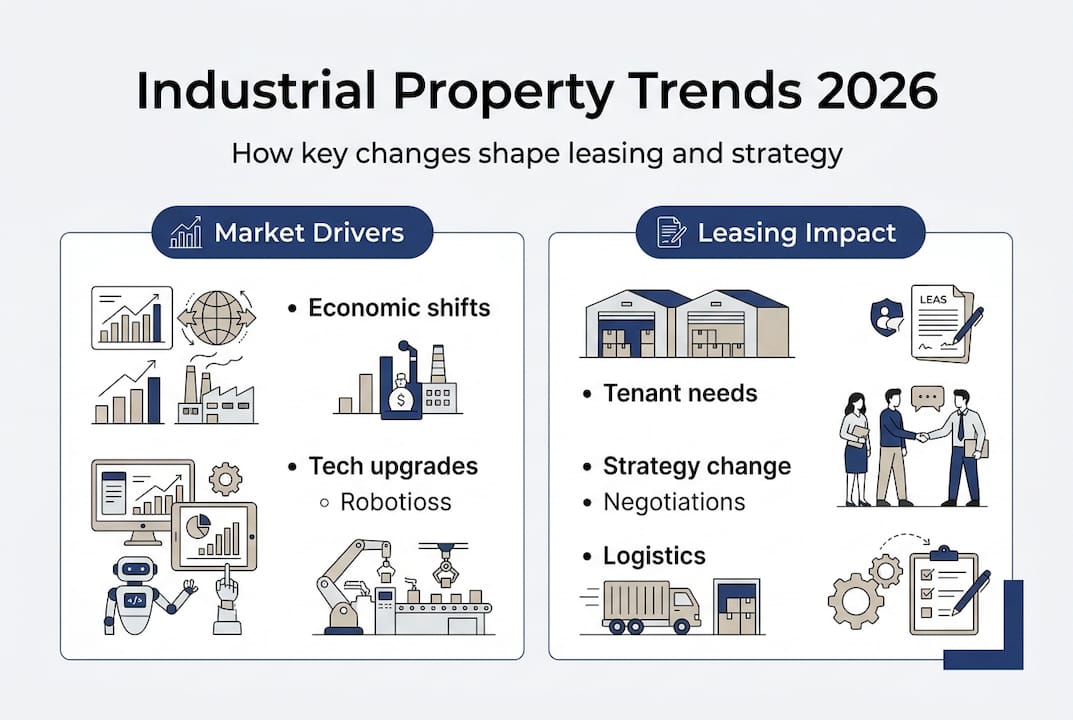
Shifting tenant types and industry trends directly influence investment returns in the GTA. A property leased to a legacy manufacturer at below-market rent looks very different on a discounted cash flow model than the same property repositioned for a last-mile logistics operator at current market rates.
Trend-aware vs. uninformed decision-making: a direct comparison
| Decision area | Trend-aware manager | Uninformed manager |
|---|---|---|
| Lease renewal timing | Renews early when market favours landlord | Waits and loses leverage |
| Rent benchmarking | Uses current submarket data | Relies on outdated comparables |
| Tenant selection | Targets high-growth sectors | Accepts first available tenant |
| Capital improvements | Invests ahead of spec demand | Reacts after vacancy occurs |
| Exit timing | Sells at cycle peak | Holds through downturn |
Here is a practical step-by-step approach to using trend data in your strategy:
- Establish a baseline. Know your current rent relative to the submarket average. If you are 15% below market, you have a renewal risk or an opportunity, depending on which side of the lease you are on.
- Track absorption quarterly. Net absorption tells you whether tenants are taking more space than is being vacated. Positive absorption tightens the market and supports rent growth.
- Monitor new supply pipelines. Upcoming completions in your submarket can soften rents within 12 to 18 months. Factor this into your negotiation timeline.
- Segment by tenant type. Different industries have different space requirements and credit profiles. Knowing which sectors are growing helps you attract and retain the right tenants.
- Consult before committing. Before signing or renewing, review current data on acquiring industrial assets to ensure your terms reflect actual market conditions.
Tenant retention is directly tied to trend awareness. When you understand what tenants in your sector need next, you can offer it before they start looking elsewhere.
Tools and resources for tracking industrial property trends
With the benefits clear, let's examine how to effectively stay ahead with trend tracking resources.
Advisory services help maximise industrial property value by analysing trend data and translating it into actionable recommendations. But you do not need to rely solely on advisors. A combination of digital platforms, market reports, and local networks gives you a well-rounded picture.
GTA industrial trend tracking resources
| Resource type | Examples | Best for |
|---|---|---|
| National brokerage reports | CBRE, Colliers, Cushman & Wakefield | Quarterly market overviews |
| Local advisory blogs | Michael Law Real Estate blog | Submarket-specific insights |
| Government data portals | Statistics Canada, CMHC | Macro economic and employment data |
| Industry associations | NAIOP Canada, BOMA | Regulatory updates and networking |
| Listing platforms | CoStar, ICX | Real-time vacancy and rent data |
Useful practices for staying current:
- Subscribe to quarterly reports from at least two national brokerages for cross-referencing
- Follow submarket-specific commentary from industrial real estate experts who cover your specific nodes
- Review the industrial investment sales guide for current transaction benchmarks
- Attend NAIOP Canada events to hear directly from developers and institutional owners
Pro Tip: Set up Google Alerts for terms like "GTA industrial vacancy," "Brampton warehouse lease," and "Ontario employment lands" to receive news and reports automatically. Pair this with a monthly review of at least one institutional market report to separate signal from noise.
When evaluating any data source, ask three questions: How recent is it? Does it cover your specific submarket? And does it distinguish between different building classes and sizes? Aggregate data can mask important local variations.
Common pitfalls to avoid when following industrial property trends
Knowing where to look isn't enough. Let's also tackle common mistakes made when analysing industrial property trend data.
The most frequent error is over-reliance on outdated information. A market report from 18 months ago may show conditions that have completely reversed. In a market as dynamic as the GTA, stale data leads to mispriced leases and missed opportunities.
Other common pitfalls include:
- Using a single data source. One report rarely captures the full picture. Cross-referencing multiple sources reveals inconsistencies and gives you more confidence in your conclusions.
- Confusing short-term fluctuations with long-term trends. A single quarter of rising vacancy does not signal a structural shift. Look for patterns across at least three to four quarters before adjusting your strategy.
- Ignoring local specifics. GTA-wide averages can be misleading. Markham and Milton behave very differently from each other, even within the same quarter.
- Acting on trends without context. A rising rent trend in one submarket may reflect a single large lease transaction rather than broad demand. Always understand the story behind the numbers.
"Data without interpretation is just noise. The value is in understanding what a trend means for your specific asset, lease, or investment thesis."
Using real estate analytics insights is essential to accurately identify industrial property trends and distinguish genuine market movements from statistical anomalies. When in doubt, seek a second opinion from someone with direct transaction experience in your submarket.
How expert guidance can optimise your industrial property decisions
Tracking trends is one thing. Translating them into a lease negotiation, an acquisition decision, or a repositioning strategy is another. That is where working with a specialist makes a measurable difference.

At Michael Law Real Estate, we apply hyper-local GTA trend data to every client engagement, whether you are negotiating a renewal in Vaughan, evaluating a purchase in Burlington, or repositioning an asset in the Durham Region. Our industrial real estate services cover leasing, investment sales, tenant representation, and market consulting across all major GTA industrial nodes. You can browse current GTA property listings to see what is available in your target submarket, or reach out directly for a tailored consultation. The market moves fast. Having the right data and the right advisor in your corner means you move with it, not behind it.
Frequently asked questions
Why do industrial property trends matter for tenants as well as owners?
Industrial real estate trends shape investment and leasing decisions equally for both sides. Trends affect lease terms, space availability, and operational costs, meaning tenants who ignore them often sign unfavourable agreements or miss better options nearby.
What is the easiest way to stay up to date on GTA industrial property trends?
Set up automated alerts from industry platforms and follow local broker blogs and advisory reports regularly. Advisory services that analyse trend data are particularly useful for translating raw numbers into actionable guidance.
How often do industrial property trends change in the GTA?
Major structural trends shift on an annual basis, but local fluctuations can occur quarterly or even monthly. Industry reports highlight both annual and quarterly GTA market shifts, so reviewing them regularly keeps your strategy current.
Can monitoring trends help avoid costly mistakes in leasing?
Yes. Trend awareness lets you negotiate better terms, avoid prolonged vacancies, and identify undervalued assets before competitors do. Shifting tenant types and industry trends directly influence investment returns, making this knowledge a practical financial advantage.