

TL;DR:
- Accurate rent assessment requires understanding key factors like highway access vacancy rates and building specs.
- Transacted rents and concessions reveal true market value more reliably than asking rents alone.
- Prioritize property fit, flexibility, and location over solely seeking the lowest base rent for long-term success.
Relying on published asking rents to assess industrial space in the Greater Toronto Area is one of the costliest mistakes a tenant or investor can make. Landlords post headline figures that rarely reflect what deals actually close at, and in a market where tenants risk overpaying by depending on those numbers, the gap between perception and reality can translate into hundreds of thousands of dollars over a lease term. This guide walks you through a practical, step-by-step method for assessing GTA industrial rent accurately, so you can negotiate from a position of knowledge rather than guesswork.
Table of Contents
- Key factors influencing industrial rent in the GTA
- Understanding market data: Asking rents, net rents, and concessions
- Step-by-step: How to benchmark and negotiate industrial rent
- Validating your rent analysis: Pitfalls and best practices
- A fresh perspective: Why context matters more than numbers
- How we help GTA clients make smarter industrial rent decisions
- Frequently asked questions
Key Takeaways
| Point | Details |
|---|---|
| Check physical features | Location, ceiling height, power, and zoning drive industrial rent levels in the GTA. |
| Use real market data | Benchmark against recent transacted rents and consider current concessions, not just listed rates. |
| Prioritize cash flow | Focus on long-term lease stability over headline rent growth projections. |
| Validate your analysis | Check for pitfalls like environmental risks and always cross-reference with expert market reports. |
Key factors influencing industrial rent in the GTA
Before you can benchmark a rent figure, you need to understand what drives value differences across GTA industrial properties. Not all industrial space is created equal, and two buildings sitting two kilometres apart can command rents that differ by 20% or more based on a handful of physical and locational variables.
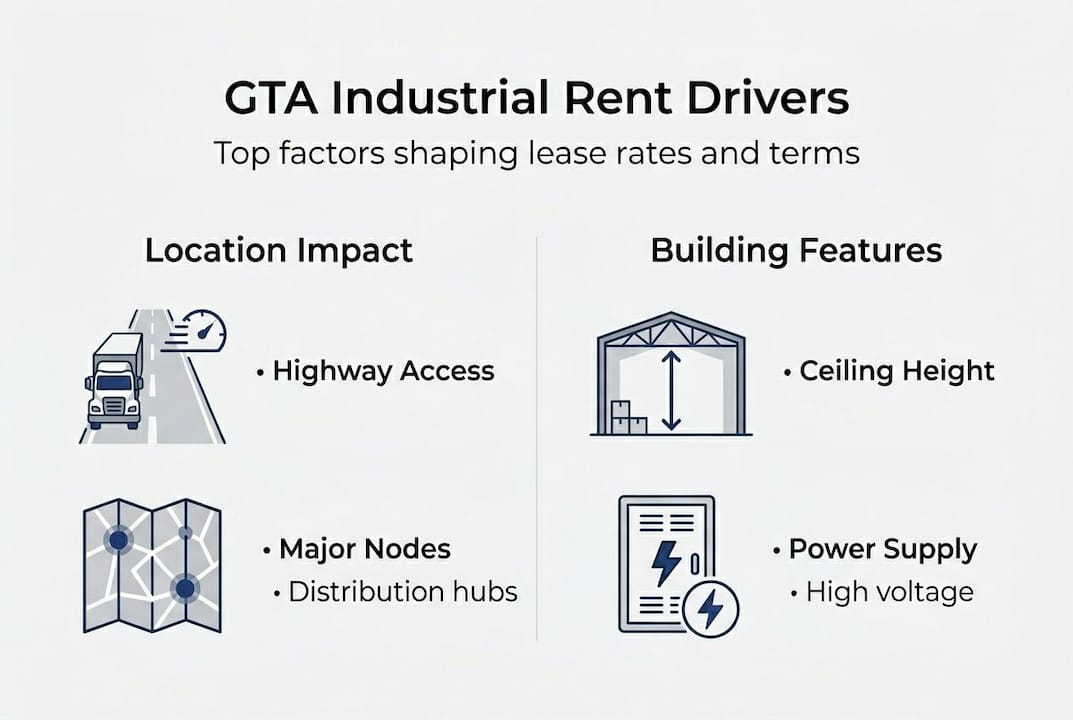
Highway access is the single biggest locational premium in this market. Properties within close proximity to the 401, 400, or 427 corridors consistently command higher rents because logistics operators and distributors pay for speed and connectivity. The further a site sits from a major interchange, the harder it becomes to justify top-of-market rent, regardless of how new or well-maintained the building is.
Vacancy is the other major lever. When vacancy tightens below 5%, landlords gain significant negotiating leverage and rents climb accordingly. Conversely, rising vacancy softens that power dynamic and opens the door for tenants to push for concessions. Understanding where vacancy sits in your target submarket is not optional; it is foundational to any rent assessment.
Building specifications matter enormously, particularly for industrial tenant examples in logistics and manufacturing. Clear ceiling height, the number and type of loading doors (dock-level versus grade), electrical capacity, and floor load ratings all affect what a property can command. Older buildings with 16-foot clear heights are simply not comparable to modern facilities with 36-foot clearances.
Zoning flexibility and environmental clearances also play a significant role. A property zoned for a broader range of industrial uses, or one that has already completed environmental remediation, is more desirable and commands a premium. Key rent drivers include proximity to highways, vacancy rates, functional specs, zoning flexibility, and environmental risks, and missing any one of these in your analysis will skew your assessment.
Pro Tip: When evaluating new-build or recently renovated industrial space, treat 4,000 amps of electrical capacity and a minimum 28-foot clear height as your baseline. Anything below that threshold will face leasing friction in today's market and should be priced accordingly.
Here is a quick reference checklist of factors to evaluate for any GTA industrial property:
- Highway proximity (401, 400, 427, QEW corridors)
- Vacancy rate in the immediate submarket
- Clear ceiling height (28 feet minimum for modern use)
- Number and type of loading doors
- Electrical capacity (4,000A+ preferred)
- Floor load rating and slab condition
- Zoning classification and permitted uses
- Environmental status and any outstanding remediation
- Age and functional obsolescence of the building
| Feature | Premium tier | Standard tier |
|---|---|---|
| Location | Highway-adjacent, major node | Secondary road, inner suburb |
| Clear height | 28 to 40 feet | 16 to 22 feet |
| Power supply | 4,000A and above | Under 2,000A |
| Loading | Multiple dock doors, grade access | Limited or grade-only |
| Zoning | Broad industrial, flexible use | Restricted or single-use |
For a deeper look at how these features vary across asset classes, the overview of industrial property types in Toronto is a useful starting point.
Understanding market data: Asking rents, net rents, and concessions
Knowing which property features drive value is only half the equation. The other half is understanding how to read and interpret the numbers themselves, because the figures you see advertised are rarely the figures that deals actually close at.
Here is a step-by-step process for collecting and interpreting current GTA industrial lease data:
- Identify comparable properties. Start with buildings that match your target in size, age, clear height, and submarket. Broad comparisons across different nodes will produce misleading averages.
- Separate asking rents from transacted rents. Asking rents are what landlords advertise. Transacted rents are what tenants actually agreed to pay. The gap between these two figures is where your negotiating room lives.
- Account for concessions. Free rent periods, tenant improvement (TI) allowances, and flexible term structures all reduce the effective cost of a lease. A deal at $18 per square foot net with six months free rent is materially cheaper than a deal at $16 per square foot with no concessions.
- Adjust for lease structure. Net, semi-gross, and gross leases allocate operating costs differently. Always convert to a comparable basis before drawing conclusions.
- Track trends, not snapshots. A single quarter of data is not enough. Look at direction: are rents rising, flat, or softening?
The GTA market has shifted meaningfully. Vacancy has reached 4.7% and rents declined 6% year-over-year, which means tenants who anchored their expectations to 2022 or 2023 asking rents are now in a stronger position than they realise. Staying current on GTA industrial market reports is essential for keeping your analysis grounded in reality rather than lagging data.
| Metric | Asking rent | Transacted rent | With concessions |
|---|---|---|---|
| Typical range (GTA, 2026) | $17 to $22/sq ft net | $14 to $18/sq ft net | Effective $12 to $16/sq ft |
| Landlord flexibility | Low | Moderate | High |
| Negotiation leverage | Minimal | Moderate | Strongest |
The pitfall most tenants fall into is fixating on the headline asking rent as though it were a fixed price. It is not. It is an opening position. Tenants who understand tracking industrial rent trends and bring transacted data to the table consistently outperform those who negotiate blind.
Step-by-step: How to benchmark and negotiate industrial rent
With solid market data in hand, here is how you apply it to measure, negotiate, and optimise your lease agreement.

Step 1: Establish a benchmark using comparable properties. Pull five to ten recent leases in your target submarket that match your size range and building specifications. This is your baseline. Without it, you are negotiating on instinct rather than evidence.
Step 2: Adjust for property-specific differences. A comparable building with superior loading or higher clear height will naturally command more. Discount or premium your benchmark accordingly. This adjustment process is what separates a credible analysis from a rough estimate.
Step 3: Factor in vacancy, concessions, and lease structure. In a market where cash flow stability is now prioritised over aggressive rent growth projections, landlords are more willing to offer free rent or TI dollars to secure quality tenants on longer terms. Build these into your effective rent calculation.
Step 4: Present your findings in negotiation. Arrive at the table with supporting data, not just a counter-number. Showing a landlord that comparable deals in the submarket closed at $15 per square foot net, not the $19 they are asking, changes the dynamic entirely. It is harder to dismiss a data-backed position.
Pro Tip: Request evidence of recently transacted rents, not just broker opinions of value. If you are reviewing a renewal or a complex multi-unit lease, involving a real estate expert who has access to closed-deal data can pay for itself many times over.
One mistake to avoid: fixating on achieving the lowest possible base rent at the expense of manageable lease terms. A slightly higher rent with flexible break clauses, reasonable escalation caps, and a strong TI package will often serve your operation better than a rock-bottom rate locked into a rigid 10-year structure. Consider industrial subleasing strategies and value-adding upgrades as part of your overall lease optimisation plan.
Validating your rent analysis: Pitfalls and best practices
Once you have completed your assessment and negotiation, make sure your conclusions hold up by cross-validating with the following checks. Even a well-constructed analysis can miss something important.
The most common pitfalls in GTA industrial rent assessments include:
- Ignoring environmental risk. Environmental risks and zoning issues can directly affect rent and leaseability. A property with unresolved contamination may look cheap on paper but carry significant hidden costs.
- Overgeneralising comparables. Using deals from a different submarket or a different building vintage distorts your benchmark. A 1980s building in Etobicoke is not comparable to a 2020 build in Brampton, even if the square footage matches.
- Missing hidden incentives. Landlords sometimes offer non-monetary concessions such as early access, free parking, or storage arrangements. These have real value and should be captured in your effective rent calculation.
- Ignoring upcoming area changes. A new interchange, a rezoning decision, or a major employer moving into a submarket can shift rent dynamics quickly. Your analysis should account for forward-looking factors, not just current conditions.
Always conduct thorough zoning and environmental due diligence before finalising any industrial lease or acquisition. Overlooking these factors is the most expensive mistake you can make in GTA industrial real estate.
Best practice is to have your rent review cross-checked by a third party or specialist before you sign. Independent industrial asset acquisition tips and market reports can serve as a useful sanity check. If your conclusions diverge significantly from what current reports show, investigate why before proceeding.
A fresh perspective: Why context matters more than numbers
Here is something that does not get said enough: a bargain rent is not always a good deal. We have seen tenants lock in below-market rates on properties that constrained their operations within two years, either because the building specs could not support their growth, the location added friction to their supply chain, or the lease terms offered no flexibility when circumstances changed.
The numbers matter, but they are not the whole story. The 2026 industrial trends shaping the GTA market reward tenants and investors who think about strategic fit, not just cost minimisation. Location quality, lease flexibility, and building functionality have repeatedly proven to be worth more over a five to ten year horizon than shaving a dollar per square foot off the base rent.
The most successful tenants we work with come in asking not just "what is the cheapest option?" but "what is the right option for where our business is going?" That shift in framing changes everything about how you negotiate and what you prioritise.
How we help GTA clients make smarter industrial rent decisions
Assessing industrial rent accurately takes more than a spreadsheet. It requires access to closed-deal data, submarket expertise, and the experience to know when a deal is genuinely competitive and when it is not.

At Michael Law Real Estate, we work with tenants, investors, and owners across the GTA to benchmark rents, structure negotiations, and validate lease decisions with real market intelligence. Whether you are renewing, relocating, or acquiring, our team brings the data and the relationships to get you to the right outcome. Work with a GTA industrial expert to protect your interests, or browse available GTA industrial properties to see how current listings compare on features and pricing.
Frequently asked questions
What is the difference between asking rent and net rent for GTA industrial properties?
Asking rent is the initial quoted price posted by landlords, while net rent reflects the contracted rate tenants actually pay, often adjusted downward through concessions or negotiation. Focusing on transacted rents and concessions gives you a far more accurate picture of true market value.
Which building features most affect industrial rent costs in the GTA?
Highway access, submarket vacancy, clear ceiling height, electrical capacity, and zoning flexibility are the primary drivers. Key factors for rent assessment consistently point to these variables as the most influential across GTA industrial assets.
How can I be sure my industrial rent analysis reflects current GTA market trends?
Cross-check your findings against recent market reports, prioritise leases that have actually closed rather than listings, and validate your conclusions with a specialist. Avoid over-relying on lagging asking rents in a softening market.
What concessions are common in recent GTA industrial leases?
Rent abatement periods, tenant improvement allowances, and flexible term structures are the most common concessions in 2026. Landlords prioritising cash flow stability over aggressive growth are increasingly willing to offer these to secure quality long-term tenants.