

TL;DR:
- Subleasing in the GTA is a strategic tool for cost management and operational flexibility.
- Approval from the landlord is usually needed, but consent cannot be unreasonably withheld.
- Proper vetting of operational fit and legal compliance is crucial for successful subleases.
Subleasing industrial space is often misread as a sign of distress, a last resort for companies bleeding cash or shrinking fast. That framing misses the bigger picture entirely. In the Greater Toronto Area, where logistics and manufacturing demand has reshaped the real estate landscape over the past several years, subleasing is a deliberate, strategic tool used by savvy operators to manage costs, maintain flexibility, and position themselves for growth. Whether you own industrial property or occupy it, understanding how subleasing works, what the law requires, and what the current GTA market looks like will help you make sharper decisions.
Table of Contents
- What is subleasing? Definitions and fundamentals
- How subleasing compares to assignment and direct leasing
- Key steps and legal requirements for industrial subleases in the GTA
- Market realities: GTA industrial subleasing trends and benchmarks
- Subleasing: What most industrial players overlook
- How we can help with your industrial sublease
- Frequently asked questions
Key Takeaways
| Point | Details |
|---|---|
| Subleasing defined | Subleasing lets existing tenants offer space to new occupiers while keeping original lease obligations in place. |
| Legal and process essentials | Landlord consent, proper documentation, and compliance with zoning are key to successful industrial subleasing. |
| GTA market advantages | Industrial subleases in the GTA offer cost savings and flexibility in a tight market driven by logistics and e-commerce. |
| Risk management focus | Screen subtenants carefully and align insurance to mitigate operational and financial risks. |
What is subleasing? Definitions and fundamentals
A sublease is a lease agreement created by an existing tenant, who becomes the sublandlord, with a new party called the subtenant. The original tenant does not exit the picture. They remain bound by every obligation in their head lease, the agreement they signed with the property owner. The subtenant pays rent to the sublandlord, who in turn continues paying the head landlord. Three parties, two agreements, one property.
In the industrial context, this arrangement shows up frequently. A logistics company that leased 80,000 square feet during a period of rapid expansion may now need only 50,000. Rather than sitting on unused space and paying full rent, they sublease the surplus to another operator. A manufacturer relocating to a larger facility may sublease their existing space for the remainder of their lease term rather than trying to exit early.
The key roles break down like this:
- Head landlord: Owns the property and holds the original lease with the tenant.
- Tenant/sublandlord: The original tenant who creates the sublease and retains all obligations under the head lease.
- Subtenant: The new occupant who leases from the sublandlord, not directly from the head landlord.
Landlord consent is almost always required before a sublease can proceed. Landlord consent is required but cannot be unreasonably withheld under Ontario's Commercial Tenancies Act, and the sublease agreement must be drafted as subordinate to the head lease to prevent conflicting obligations. The sublandlord collects rent from the subtenant to offset their head lease costs.
Pro Tip: Before you approach a subtenant or list your space, review your head lease carefully. Some industrial leases include specific consent clauses, permitted use restrictions, or notice requirements that could delay or complicate the process if ignored.
For logistics and manufacturing tenants, subleasing offers a practical way to right-size operations without breaking a lease or absorbing dead rent on idle space.
How subleasing compares to assignment and direct leasing
Having defined subleasing, it's important to distinguish it from other common lease arrangements. The three options most industrial occupants encounter are subleasing, lease assignment, and direct leasing. Each carries different implications for liability, flexibility, and operational continuity.
With a sublease, the original tenant stays on the hook. If the subtenant defaults, the sublandlord still owes rent to the head landlord. With a lease assignment, the original tenant transfers their full lease interest to a new party. The assignee steps into the original tenant's shoes. However, as noted in Ontario case law, assignment may retain liability for the original tenant depending on how the agreement is structured. With direct leasing, a new tenant negotiates fresh terms directly with the landlord, with no prior tenant involved.
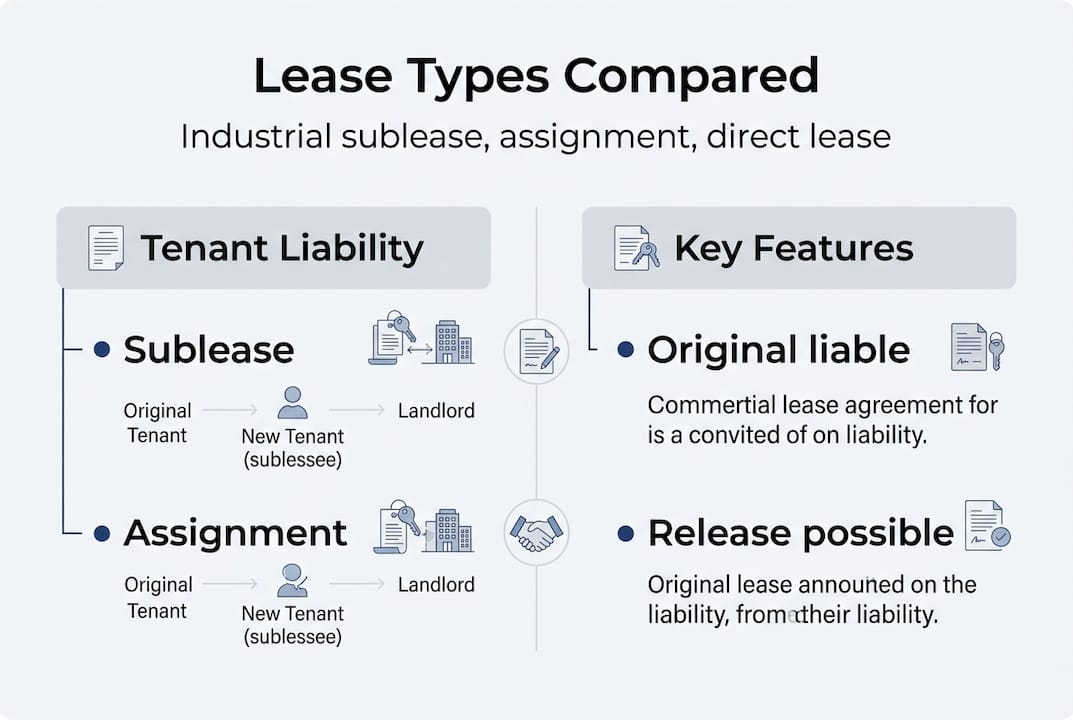
Here is a quick comparison:
| Feature | Sublease | Assignment | Direct lease |
|---|---|---|---|
| Original tenant liability | Remains | May remain | Not applicable |
| Landlord consent needed | Usually yes | Usually yes | Yes |
| Lease term flexibility | Subtenant's term ends before head lease | Full remaining term transfers | Negotiated fresh |
| Best for | Partial space, short-term relief | Full exit from space | New occupancy |
For industrial users, a few edge cases matter. Subletting only part of a space is common in large warehouses but may be restricted under some head leases. Ontario's Commercial Tenancies Act section 17 also provides that a sublease can survive a head lease surrender in certain circumstances, which is an important protection for subtenants.
To decide which route fits your situation, work through these steps:
- Determine whether you want to retain any interest in the space or exit completely.
- Review your head lease for assignment and subletting clauses.
- Assess the subtenant's or assignee's financial strength and operational fit.
- Consult your broker and legal counsel before approaching the landlord.
- Choose the structure that best balances your liability exposure and operational goals.
A sublease keeps the original tenant in the equation. An assignment tries to remove them. Neither option is inherently better. The right choice depends on your specific lease, your risk tolerance, and how cleanly you want to exit or share the space.
Key steps and legal requirements for industrial subleases in the GTA
Understanding the key differences leads naturally to the practical question: how do you sublease industrial space in the GTA? The process has clear steps, but each one carries real risk if handled carelessly.
- Review your head lease. Identify consent requirements, permitted use clauses, and any restrictions on subletting. Some leases require the landlord's consent within a specific timeframe.
- Seek landlord consent. Submit a formal written request. Include information about the proposed subtenant, their intended use, and financial background. Landlord consent cannot be unreasonably withheld under Ontario's Commercial Tenancies Act, but delays are common without a well-prepared submission.
- Confirm zoning and permitted use. In the GTA, subtenant use must comply with applicable zoning, including E1.0 employment industrial designations, and must meet operational requirements like heavy power supply and truck access. A food-grade logistics operator has very different needs from a light manufacturer.
- Draft the sublease agreement. The sublease must be subordinate to the head lease. Any term that conflicts with the head lease creates legal exposure for both the sublandlord and subtenant. Engage a commercial real estate lawyer.
- Align insurance requirements. Both parties need appropriate coverage. Subtenant default can expose the sublandlord to significant liability, so insurance alignment is not optional.
- Establish remedies for default. The sublease should clearly define what happens if the subtenant fails to pay rent or violates the terms. The sublandlord needs enforceable remedies that do not conflict with their own obligations to the head landlord.
Pro Tip: If you're subleasing a logistics or manufacturing space, review GTA tenant fit-out planning early. Operational requirements like dock doors, clear heights, and power capacity must be confirmed before any subtenant commits.
Many subleases fall apart not because of price, but because the operational specs don't match. A subtenant who discovers the power supply is insufficient after signing creates a costly dispute for everyone involved.
Market realities: GTA industrial subleasing trends and benchmarks
With the process clear, let's ground your strategy in the current GTA market landscape. The numbers tell a compelling story about why subleasing has become a serious option for industrial occupants across the region.
As of Q4 2025, GTA industrial asking rents sit in the range of $16.50 to $17.50 per square foot net. Sublease listings typically offer a discount to those direct market rates, sometimes meaningfully so, depending on the sublandlord's motivation and remaining lease term. For a subtenant, that discount can translate into significant savings on a five-year commitment.

Absorption in 2025 remained strong, with positive absorption of 3.6 to 6.6 million square feet driven by e-commerce growth and ongoing logistics demand across the GTA. That means well-located sublease space gets leased quickly. Sitting on an opportunity too long in this market is a real risk.
| Metric | GTA benchmark (2025/2026) |
|---|---|
| Average asking rent (net) | $16.50 to $17.50 psf |
| Typical sublease discount | 5% to 15% below direct rent |
| Net absorption (2025) | 3.6 to 6.6 million sq ft |
| Vacancy rate trend | Tightening across major nodes |
What makes subleasing particularly attractive in a market like the GTA right now:
- Subtenants can access quality, already-improved space without paying for tenant improvements.
- Sublandlords can offset rent costs on space they no longer fully utilise.
- Shorter terms are available, which suits companies in transition or testing a new market.
- Locations in established industrial nodes like Mississauga, Brampton, and Vaughan are harder to access through direct leasing.
For a broader view of where the GTA industrial market is heading, the GTA industrial real estate trends report offers useful context. Owners looking to maximise returns from their holdings can also explore strategies for maximising GTA industrial returns across different market conditions.
Subleasing: What most industrial players overlook
The numbers and laws matter, but experience on the ground changes outcomes in ways that spreadsheets rarely capture. After working across the GTA's industrial corridors, the pattern that stands out most is this: the biggest subleasing mistakes are almost never about rent. They're about operational fit and subtenant quality.
Too many sublandlords focus entirely on filling the space and stopping the financial bleeding. They accept the first subtenant who can pay, without properly vetting whether that subtenant's operations are compatible with the space, the building's systems, or the head landlord's expectations. That shortcut creates problems that cost far more than the rent relief was worth.
On the subtenant side, the missed opportunity is just as common. Industrial operators often treat a sublease as a temporary fix rather than a strategic foothold. A well-negotiated sublease in the right GTA submarket can serve as a launchpad, giving you time to assess a location, build relationships with local carriers and suppliers, and negotiate a direct lease from a position of knowledge rather than urgency.
The broker advantages for GTA subleasing are real and measurable. A local broker who knows the submarket, the landlord's preferences, and the operational requirements of logistics and manufacturing space will surface issues before they become disputes. Involving them early is not a cost. It's risk management.
Pro Tip: When evaluating a subtenant, go beyond financials. Visit their current operation. Understand how they use space, how they manage loading, and what their growth trajectory looks like. A subtenant who outgrows the space in 18 months creates as many problems as one who defaults.
How we can help with your industrial sublease
Navigating an industrial sublease in the GTA involves more moving parts than most tenants and owners expect the first time through. From landlord consent and zoning compliance to finding the right subtenant and structuring a sound agreement, every step carries real consequences.
At Michael Law Real Estate, we work with industrial owners and tenants across the GTA to evaluate sublease opportunities, negotiate terms that protect your position, and ensure the process runs smoothly from first approach to signed agreement. Whether you need help identifying available industrial properties or want a strategic review of your current lease, our team brings the local market knowledge and transaction experience to get it right.
Frequently asked questions
Is landlord consent always required for subleasing industrial property in Ontario?
Yes, in most cases landlord consent is required, but under Ontario's Commercial Tenancies Act it cannot be unreasonably withheld. Always submit a thorough consent request to avoid unnecessary delays.
What makes industrial subleasing different from assignment?
With a sublease, you retain your head lease obligations and remain liable if the subtenant defaults. With an assignment, you transfer your full lease interest, though you may retain liability depending on how the agreement is structured.
How do I ensure my subtenant is the right operational fit for my space?
Confirm that their intended use complies with zoning and E1.0 industrial designations, verify power and access requirements match the building, and align insurance responsibilities before finalising any agreement.
Are industrial subleases generally cheaper than direct leases in the GTA?
Yes. Subleases typically offer discounts compared to direct market rents, and with GTA absorption at 3.6 to 6.6 million square feet in 2025, motivated sublandlords are often willing to negotiate on price to fill space quickly.