

TL;DR:
- Rent escalation clauses significantly impact total lease costs over time, especially with compounded increases.
- Tenants should understand and negotiate escalation methods, caps, and bases to control future expenses.
- Proper preparation, market data, and legal review are essential to optimize escalation terms in industrial leases.
Imagine signing a five-year industrial lease in Mississauga at $18 per square foot, only to discover three years in that your rent has quietly climbed to nearly $20 per square foot. No sudden shock, just steady, contractual increases that were always there in the fine print. Rent escalation clauses are among the most consequential yet least scrutinised elements of any GTA industrial lease. For logistics operators, manufacturers, and warehouse tenants, even a 2% annual increase compounds into a substantial budget gap over a full lease term. The good news is that these terms are not set in stone. This guide walks you through how escalation works, how to prepare, how to negotiate, and how to protect yourself from costly oversights.
Table of Contents
- Understanding industrial rent escalation: Key principles
- Preparing for negotiation: What tenants and managers need
- Step-by-step: How to approach rent escalation negotiations
- Avoiding pitfalls: Common mistakes and how to verify your lease terms
- A fresh look: Why rent escalation strategy is more opportunity than obstacle
- Find the right support for your next industrial lease
- Frequently asked questions
Key Takeaways
| Point | Details |
|---|---|
| Master escalation basics | Understanding rent escalation clauses empowers you to manage industrial lease costs more effectively. |
| Prepare before negotiating | Gather comparable data, lease documents, and expert advice to maximize your leverage. |
| Mitigate risk with clear terms | Negotiate caps and double-check calculations to avoid costly surprises down the line. |
| View escalation strategically | Approached smartly, rent escalation can become a tool for gaining negotiating power and long-term value. |
Understanding industrial rent escalation: Key principles
Rent escalation refers to the contractual mechanism by which base rent increases over the course of a lease term. In industrial leasing, this is not optional language buried in the back of a document. It is a core financial term that shapes your occupancy costs for years. Understanding it clearly is the first step toward managing it effectively.
The GTA industrial market uses three primary escalation methodologies. Fixed percentage increases are the most straightforward. Your lease specifies a set annual increase, often 2-3% or 3-4%, and your rent rises by that figure every year regardless of what happens in the broader economy. CPI-linked escalation ties annual increases to the Consumer Price Index (CPI), meaning rent rises in step with inflation. Hybrid structures combine both approaches, sometimes using CPI as a baseline with a fixed minimum and maximum cap.
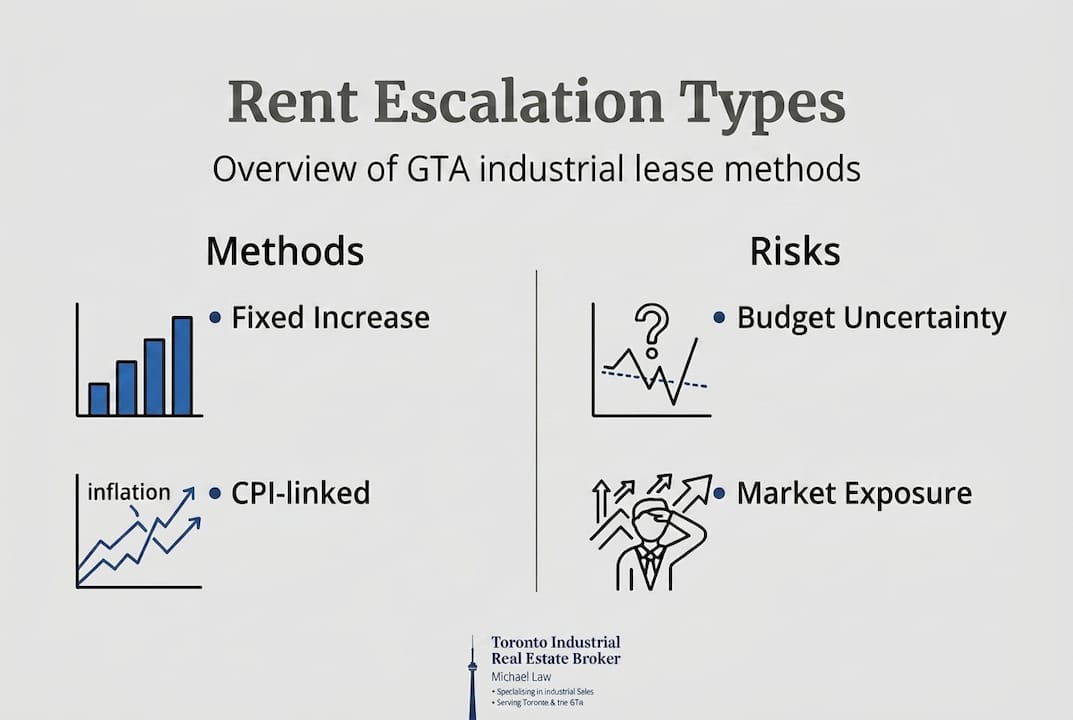
Each method carries different risks. Fixed percentage increases offer predictability, which is valuable for budgeting, but they can work against tenants when inflation runs below the agreed rate. CPI-linked clauses feel fair in theory, but during high-inflation periods like Canada experienced in 2022 and 2023, they can produce sudden and painful rent jumps. This is why CPI-linked increases with caps are broadly recommended for tenants seeking balance between fairness and protection.
Here is how the numbers play out in practice over a five-year lease at a $20 per square foot base rent:
| Escalation type | Year 1 | Year 2 | Year 3 | Year 4 | Year 5 |
|---|---|---|---|---|---|
| 2% fixed annual | $20.00 | $20.40 | $20.81 | $21.22 | $21.65 |
| 3% fixed annual | $20.00 | $20.60 | $21.22 | $21.85 | $22.51 |
| CPI (avg. 3.5%) | $20.00 | $20.70 | $21.42 | $22.17 | $22.95 |
| CPI with 2% cap | $20.00 | $20.40 | $20.81 | $21.22 | $21.65 |
The difference between a 2% and 3.5% escalation on a 50,000 square foot facility can exceed $650,000 in cumulative rent over five years. That is not a rounding error. That is a material business cost.
When reading an escalation clause, pay attention to these critical elements:
- Base year: The reference point from which increases are calculated. An incorrect base year inflates all future amounts.
- Trigger date: Whether escalation begins at lease commencement or after a rent-free period ends.
- Compounding vs. simple: Compounded increases grow faster than simple increases applied to the original base.
- Cap and floor language: A cap limits maximum increases; a floor sets a minimum. Floors protect landlords; caps protect tenants.
Staying current with industrial property trends in your submarket gives you a realistic benchmark for what escalation terms are actually being agreed to in current transactions, not just what a landlord proposes.
The GTA market has seen tightening conditions across Brampton, Vaughan, and the Airport Corridor. Reviewing 2026 GTA industrial trends before entering any lease discussion will position you with current, relevant data rather than outdated assumptions.
Preparing for negotiation: What tenants and managers need
Preparation is where most tenants lose the negotiation before it even starts. Walking into a lease discussion without the right information is like entering a price negotiation without knowing the market value. Here is what you need to assemble before any conversation about escalation terms.
Start with your existing documents if you are renewing, or request full disclosure if you are a prospective tenant:
- Current lease agreement, including all schedules and appendices
- Escalation schedule, if separate from the main lease body
- Historical rent statements showing actual increases applied in prior years
- CPI index references used in previous calculations, including the specific Statistics Canada index cited
- Any correspondence or amendments related to rent adjustments
Once you have your documents, gather market intelligence. You want to know what similar GTA industrial tenants are actually paying in escalation terms right now. This means comparable lease transactions, ideally in the same submarket, completed within the last 12 to 18 months. Submarkets like Mississauga Airport, Milton, and Oshawa can behave quite differently, so local data matters.
| Data point | Why it matters |
|---|---|
| Comparable lease escalation rates | Sets your benchmark for counter-offers |
| Vacancy rate in target submarket | Higher vacancy gives tenants more leverage |
| Landlord's recent transaction history | Reveals typical deal structures they accept |
| CPI trend data (Statistics Canada) | Supports arguments for capping CPI clauses |
| Your own rent-to-revenue ratio | Clarifies how much exposure you can absorb |
With data in hand, verify these specific lease terms before sitting down to negotiate:
- Confirm the base year is correct and matches lease commencement
- Check whether the escalation is compounded or simple interest
- Identify whether there is any cap language, and if not, flag it as a negotiation priority
- Look for floor clauses that guarantee minimum increases even if CPI drops
- Clarify whether escalation applies to gross rent or net base rent only
One area where tenants consistently leave money behind is strategies to maximise GTA property returns, which often hinge on understanding total occupancy costs, not just the headline lease rate.
Pro Tip: Bring in a qualified industrial real estate advisor before you respond to any landlord's initial proposal. The first draft of an escalation clause is always written in the landlord's favour. An experienced advisor can spot non-standard language and immediately identify where terms are outside market norms, before you have anchored yourself to the wrong starting position.
Step-by-step: How to approach rent escalation negotiations
Negotiating rent escalation is not about winning every point. It is about achieving terms that give your business financial predictability and protection against unfavourable market shifts. Here is a clear process to follow.
Step 1: Establish your position. Before the first meeting, define your acceptable range. What maximum annual escalation can your business absorb without affecting operations? What is your ideal? Know both numbers before you speak.

Step 2: Make your initial ask clearly. Do not hint at what you want. State it. If you are targeting a 2% fixed annual increase with no compounding, say exactly that. Landlords respect informed, specific requests. Vague positions invite landlords to fill the gap with their own preferences.
Step 3: Understand your leverage points. In slower markets, vacancy rates favour tenants. In tight markets like the GTA has experienced, leverage shifts toward landlords. However, you still have tools. Long lease terms, creditworthy covenants, early renewal commitments, and upfront capital investment all create bargaining currency.
Step 4: Decide between fixed percentage and CPI. This is the most consequential structural choice. Fixed versus CPI escalation each carry distinct risk profiles. Fixed is predictable but can overshoot. CPI is fair but volatile. If CPI is non-negotiable, push hard for a cap of 2% to 2.5% per year.
A 3% annual compounded increase on a 40,000 sq ft facility at $16 per square foot adds up to over $390,000 in additional rent by year five compared to a flat lease. That figure alone justifies the cost of expert representation.
Step 5: Counter-offer strategically. When the landlord counters, do not automatically split the difference. If they propose 3% and you asked for 2%, countering at 2.5% anchors the final outcome higher than necessary. Instead, justify your position with market data. Reference comparable transactions and negotiation tactics for better deals that tie your ask to demonstrable market evidence.
Step 6: Finalise and document everything. Once terms are agreed verbally, ensure every detail is reflected precisely in the written lease. Escalation start dates, reference indices, cap percentages, and compounding methodology all must be captured explicitly. Verbal agreements about rent escalation are unenforceable.
For tenants unfamiliar with how industrial leases are structured, hiring an industrial real estate expert with GTA-specific transaction experience is the single highest-return preparation step available before entering any negotiation.
Pro Tip: Ask for a rent schedule as an exhibit to the lease. This is a table showing the exact rent for every year of the term. If a landlord hesitates, that hesitation tells you something. A properly structured lease should always be able to produce this schedule without ambiguity.
Avoiding pitfalls: Common mistakes and how to verify your lease terms
Even tenants who negotiate well can be caught off guard after the lease is signed. The execution phase, reviewing and verifying final documents, is where mistakes solidify into binding obligations.
Here are the most common escalation-related errors tenants and property managers encounter:
- No escalation cap. This is the most dangerous omission. Without a cap, a CPI-linked clause during a high-inflation year has no ceiling. Rents can jump by amounts that were never anticipated during negotiations.
- Incorrect base year. If the base year is set one year too early, every subsequent increase is calculated from a higher starting point than intended. Small error, compounding consequences.
- Wrong CPI index. There are multiple Statistics Canada CPI indices. All-items CPI behaves differently from core CPI or regionally specific indices. The lease should name the exact index being used.
- Overlooked compounding. Many tenants agree to escalation without realising it is compounded annually rather than applied as simple interest. Compounding accelerates cost growth noticeably by years four and five.
- Subleasing and escalation interaction. If you sublease part of your space, understanding how escalation affects your subtenancy obligations is critical. Review industrial subleasing concepts before finalising any lease that includes sublease rights.
CPI clauses with no caps deserve particular scrutiny in Ontario. Annual CPI adjustments can appear modest in early lease years but create compounding exposure over a full five-year or ten-year term that most tenants underestimate when they sign.
Capital improvements are another area where escalation clauses interact in unexpected ways. If a landlord funds significant industrial property upgrades during your lease term, some agreements allow the landlord to increase the base rent to recover that capital. Understanding whether your escalation clause separates operational rent from capital recovery charges is essential.
To verify your final lease terms, follow this process:
- Have legal counsel review the final lease document, specifically the escalation schedule and any CPI index references
- Request a written rent schedule from the landlord showing year-by-year rents for the full term
- Cross-reference the escalation methodology against commercial lease standards in Ontario to confirm terms are within market norms
- Document every negotiated change in writing before execution, including email confirmations of agreed points
- Set calendar reminders to review escalation calculations annually, particularly in CPI-linked leases
Small verification steps taken before signing can prevent disputes that cost far more than the time invested in reviewing.
A fresh look: Why rent escalation strategy is more opportunity than obstacle
Most tenants approach escalation clauses as an unavoidable cost of doing business. They accept the landlord's proposed structure, negotiate slightly at the margins, and move on. That mindset leaves a lot on the table.
Here is the contrarian view worth considering. Escalation clauses are not just cost mechanisms. They are leverage tools, if you know how to use them.
Consider this: a landlord who insists on a 3% fixed annual escalation is effectively projecting future rental value. If you believe the market will soften, agreeing to that rate locks in a rent trajectory above where the market may actually settle. That is a risk. But if you use that landlord projection as leverage, you can trade concessions. Accept the 3% escalation in exchange for a longer rent-free period, a tenant improvement allowance, or flexible renewal options. You have turned a cost term into a negotiating chip.
We have seen GTA deals where tenants used CPI cap negotiations to unlock other concessions entirely. The landlord would not budge on rate, so the tenant pushed for flexibility on term length and early termination rights instead. The result was a lease that gave the tenant far more operational control than a lower headline rate would have provided.
Strategies to maximise industrial property returns consistently show that the best outcomes come not from squeezing every basis point of escalation, but from building leases with the flexibility to adapt as your business grows. Escalation is one lever in a larger deal structure. When you treat it that way, your negotiating position becomes much stronger.
Find the right support for your next industrial lease
Navigating rent escalation terms in the GTA industrial market requires more than a careful read of the lease document. It requires current market data, transaction experience, and the kind of submarket-specific insight that only comes from being active in these deals every day.
Michael Law Real Estate specialises in exactly this work, representing industrial tenants and property managers across Mississauga, Brampton, Vaughan, Markham, and throughout the GTA. Whether you are approaching a new lease, preparing for renewal, or trying to make sense of escalation language that does not add up, our team can help you interpret the terms, benchmark against the market, and negotiate with confidence. Explore available industrial properties across the GTA or connect directly through Michael Law Real Estate to discuss your leasing strategy with an advisor who knows this market deeply.
Frequently asked questions
What is the most common rent escalation method for industrial leases in the GTA?
The most common methods are fixed percentage increases, typically 2-3% annually, and CPI-linked adjustments that include a negotiated cap to limit exposure during high-inflation periods.
How can tenants limit risk from CPI-linked escalation clauses?
Tenants can negotiate a maximum annual cap, often 2% to 2.5%, so that even if CPI rises sharply, rent increases remain within a predictable, manageable range.
Is it possible to negotiate rent escalation terms in GTA industrial leases?
Yes, escalation clauses are negotiable at the drafting or renewal stage, particularly when tenants come prepared with comparable market data and a clear position.
What documents should be reviewed before signing a lease with escalation?
Review the full lease agreement, all escalation schedules, the specific CPI index referenced, and any capital recovery language, and engage legal counsel to confirm all terms reflect what was agreed during negotiation.