

TL;DR:
- The GTA industrial market has become highly competitive and complex, requiring specialized market knowledge.
- Advisors enhance negotiation, access off-market deals, and mitigate risks, especially with triple-net leases.
- Engaging an expert early leads to smarter investments, better lease terms, and long-term portfolio success.
Many GTA businesses assume that handling industrial real estate in-house saves money. It sounds logical until you see how dramatically the market has shifted. Modern warehouses now dominate recent lease activity, bringing with them specialised requirements, complex legal structures, and tighter competition for quality space. The GTA industrial market is no longer a straightforward transaction environment. Lease structures, zoning nuances, and valuation challenges have all grown more intricate. A professional advisor brings negotiation expertise, local market intelligence, and strategic clarity that most in-house teams simply cannot replicate. This article breaks down exactly how advisors add measurable value.
Table of Contents
- The evolving GTA industrial property landscape
- Core benefits of hiring an industrial real estate advisor
- Tackling complex leases: Why expertise matters
- Optimising your GTA industrial real estate investment strategy
- The uncomfortable truth experts rarely share about GTA industrial real estate
- Connect with a GTA industrial real estate advisor for your next step
- Frequently asked questions
Key Takeaways
| Point | Details |
|---|---|
| Market complexity demands expertise | Modern leases and evolving regulations in the GTA mean specialised guidance is no longer optional. |
| Advisors unlock better deals | Professional advisors negotiate optimal terms and identify hidden risks and opportunities that others miss. |
| Customised strategies create value | With ongoing market intelligence, advisors help businesses and investors grow their portfolios strategically. |
| Avoid costly lease mistakes | Expert advisors protect clients from pitfalls in triple-net and complex agreements common in the GTA. |
The evolving GTA industrial property landscape
The GTA industrial market has undergone a fundamental shift over the past five years. What was once a relatively straightforward sector of commercial real estate has become one of the most competitive and technically demanding in Canada. Vacancy rates have tightened dramatically, rental rates have climbed, and the types of properties in demand have changed entirely.
Key stat: 59% of recent industrial leases in the GTA are for modern warehouses built after 2020, signalling a clear shift toward higher-specification facilities.
This means older, functionally obsolete buildings are losing favour fast. Tenants now require higher clear heights, advanced dock configurations, heavy power capacity, and proximity to major logistics corridors. E-commerce growth has accelerated these demands, pushing logistics operators toward purpose-built facilities in Brampton, Mississauga, and Vaughan.
The regulatory environment has also grown more layered. Zoning by-laws, environmental compliance, and municipal development charges all affect site selection and total occupancy costs. Tracking these industrial property trends requires dedicated resources that most businesses do not have internally.
Here is a snapshot of how the GTA industrial landscape compares across submarkets:
| Submarket | Vacancy rate (approx.) | Primary demand driver |
|---|---|---|
| Mississauga/Airport | Very low (under 2%) | Logistics and e-commerce |
| Brampton | Low (2-3%) | Distribution and warehousing |
| Vaughan | Low (2-4%) | Manufacturing and last-mile |
| Durham Region | Moderate (4-6%) | Cost-sensitive users |
Without access to current market reports, investors and tenants risk making decisions based on outdated assumptions. A site that looks affordable on paper may carry hidden costs in transportation inefficiency, inadequate power supply, or restrictive zoning. The complexity is real, and it compounds quickly without expert guidance.
Key forces reshaping the GTA industrial sector include:
- Rapid growth in last-mile delivery requirements near urban cores
- Increasing preference for LEED-certified and energy-efficient buildings
- Triple-net lease structures becoming the standard rather than the exception
- Rising land values pushing development further into the 905 and beyond
Core benefits of hiring an industrial real estate advisor
The value an advisor delivers is not abstract. It shows up in lease terms, purchase prices, and avoided mistakes. Here is how that value breaks down in practice.
1. Negotiation power you cannot replicate alone. Advisors know what comparable deals look like. They understand landlord motivations, market softness, and where flexibility exists. That knowledge translates directly into better terms.

2. Access to off-market opportunities. A significant portion of GTA industrial transactions never appear on public listings. Advisors with strong networks surface these deals first, giving clients a genuine competitive advantage.
3. Objective valuations. Emotion and urgency can distort judgment in a tight market. An advisor provides a grounded, data-backed assessment of whether a property is priced fairly and whether the lease structure aligns with your operational needs.
4. Time and risk reduction. Sourcing, evaluating, and negotiating industrial space is time-consuming. Advisors manage this process so your team can focus on running the business.
Specialised brokers handle triple-net lease complexities and investment valuations that would overwhelm most in-house teams. The broker advantages are especially pronounced in a market where deal structures have grown more sophisticated year over year.
| Approach | Negotiation leverage | Market access | Risk management |
|---|---|---|---|
| In-house team | Limited | Public listings only | Reactive |
| Industrial advisor | Strong | Off-market included | Proactive |
Pro Tip: Engage your advisor before you begin searching. The earlier they are involved, the more leverage they can create on your behalf, particularly around lease commencement dates and tenant improvement allowances.
The full scope of advisory services available to GTA clients goes well beyond finding a space. It includes strategic site selection, lease renewal negotiation, and long-term portfolio planning.
Tackling complex leases: Why expertise matters
Triple-net leases are now the dominant structure in GTA industrial real estate. Under a triple-net arrangement, the tenant pays base rent plus property taxes, building insurance, and maintenance costs. On the surface, this sounds manageable. In practice, it creates significant financial exposure if you do not understand what you are signing.
Hidden risks in triple-net leases include:
- Unexpected capital repair obligations (roof, HVAC, structural components)
- Ambiguous maintenance language that shifts costs to the tenant
- Annual escalation clauses that compound over a five or ten-year term
- Personal guarantee requirements that expose business owners beyond the lease itself
"Specialised advisors are critical for negotiating triple-net leases and navigating valuation challenges that can catch even experienced operators off guard."
A skilled advisor reads lease language with the same scrutiny a lawyer brings to a contract. They identify clauses that appear standard but carry material financial risk. They negotiate caps on operating cost increases, push back on unreasonable maintenance obligations, and structure exit provisions that protect your flexibility.
For a detailed breakdown of how these structures work, the triple-net lease guide is an excellent resource for both tenants and investors entering the GTA market.
Pro Tip: Always request a full reconciliation of estimated versus actual operating costs from the previous tenant before signing. This single step can reveal thousands of dollars in annual exposure that was not visible in the initial offer.
The question of choosing your advisor carefully matters here. Not every broker specialises in industrial. You want someone who understands the operational realities of warehousing and logistics, not just the transactional mechanics of real estate.
Optimising your GTA industrial real estate investment strategy
Hiring an advisor is not just about closing a single deal. The real value accumulates over time through smarter portfolio decisions, better market timing, and proactive risk management.
Advisors use current market data to identify when rental rates are softening in specific submarkets, when new supply is about to come online, and which locations are gaining traction with logistics operators. This intelligence allows investors to act ahead of the market rather than react to it.
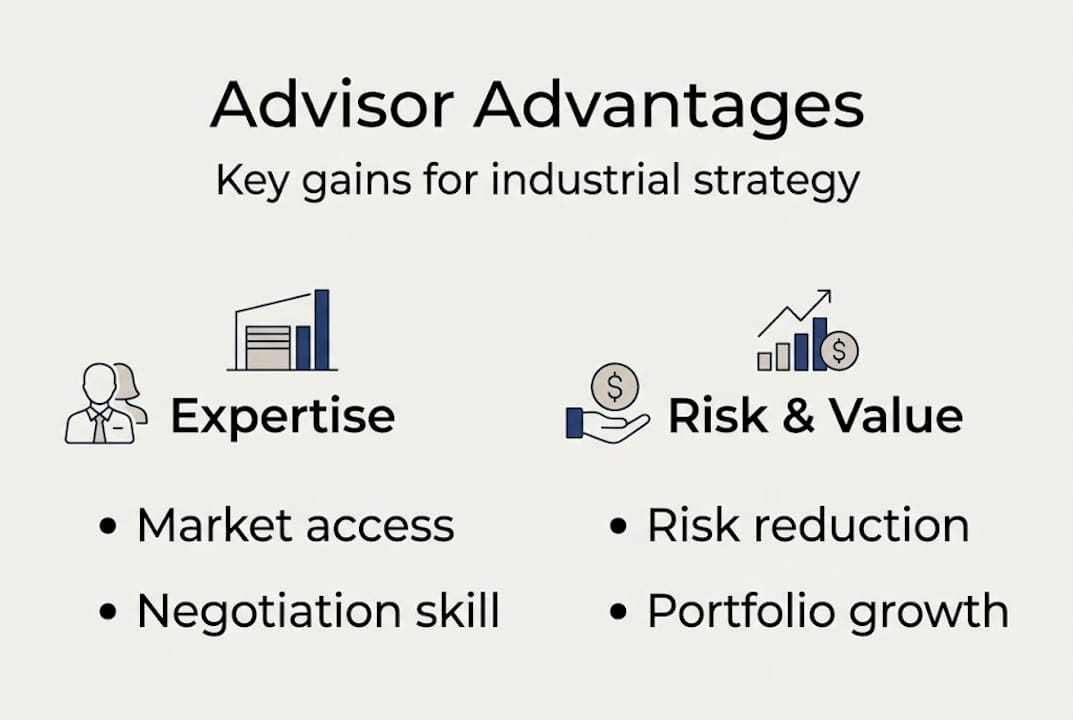
Specialised brokers' market intelligence helps investors maximise returns by identifying value before it becomes obvious to the broader market. That timing advantage is worth considerably more than any advisory fee.
How advisors support long-term investment performance:
- Tracking absorption rates and vacancy trends across GTA submarkets
- Identifying properties with value-add potential through intensification or repositioning
- Timing lease renewals to align with favourable market conditions
- Structuring acquisitions to optimise financing and tax efficiency
Here is how reactive versus proactive investment approaches compare over a typical hold period:
| Strategy | Decision basis | Typical outcome |
|---|---|---|
| Reactive (no advisor) | Available listings, gut feel | Market-rate returns, higher risk |
| Proactive (with advisor) | Data, timing, off-market access | Above-market returns, managed risk |
For investors building a portfolio, the resources on market intelligence for investors and strategies to maximise returns provide a strong analytical foundation. Understanding investment sales explained is also essential before entering the acquisition side of the GTA market.
The uncomfortable truth experts rarely share about GTA industrial real estate
Here is what most industry commentary avoids saying directly: the GTA industrial market punishes overconfidence. Experienced business owners and seasoned investors regularly underestimate how much the local context matters. A deal structure that works in Calgary or Vancouver may carry entirely different risk in Mississauga or Brampton due to municipal regulations, landlord practices, and submarket dynamics.
The instinct to go it alone is understandable. Advisory fees feel like an added cost. But the real cost is invisible until something goes wrong. A missed lease clause, a poorly timed renewal, or an acquisition at the wrong point in the cycle can cost far more than years of advisory fees combined.
Edge cases and complexities overwhelm even resource-rich businesses when they lack specialised industrial real estate knowledge. The competitive edge in this market does not come from knowing everything. It comes from knowing who to call and when to call them. The insider advisor perspective on this is clear: the businesses that thrive are the ones that treat expert guidance as a strategic asset, not an optional expense.
Connect with a GTA industrial real estate advisor for your next step
The GTA industrial market moves quickly, and the cost of hesitation is real. Whether you are a logistics operator searching for your next facility, an investor evaluating acquisition targets, or a business owner facing a lease renewal, the right advisor changes your outcome significantly.

At Michael Law Real Estate, we bring deep submarket knowledge, institutional-grade data, and a proven transaction track record to every client engagement. We cover all major GTA industrial corridors, from Mississauga and Brampton to Durham Region and Hamilton. Explore our industrial real estate advisor services or browse available properties to see what is currently on the market. Reach out today for a no-obligation consultation tailored to your specific needs.
Frequently asked questions
What does an industrial real estate advisor actually do?
They guide leasing, acquisitions, and long-term strategy using current market data and specialised expertise, handling triple-net lease complexities and valuations that in-house teams are rarely equipped to manage effectively.
When should a business or investor consider hiring an advisor in the GTA?
Engage an advisor early, particularly when facing complex leases or significant capital decisions. With 59% of leases post-2020 involving modern warehouses, the technical requirements alone justify early expert involvement.
What is a triple-net lease and why is it risky?
A triple-net lease requires tenants to cover property taxes, insurance, and maintenance on top of base rent. Without expert guidance, the hidden obligations within these structures can create significant unplanned financial exposure over a multi-year term.
How does an advisor help improve investment performance over time?
They provide ongoing market intelligence that supports smarter timing, portfolio optimisation, and proactive risk management, consistently delivering returns that reactive, unadvised approaches rarely achieve.