

TL;DR:
- Only 12% of Toronto's land is designated for employment but supports 27% of the city's jobs.
- Industrial zoning in the GTA is complex, with core and general designations affecting permitted uses.
- Understanding zoning rules and exceptions is crucial for maximizing long-term investment value.
Most people picture smokestacks and forklift lanes when they hear "industrial zoning." The reality is far more strategic. Only 12% of Toronto's land is zoned for employment, yet it supports 27% of the city's jobs, making it one of the most economically productive land designations in Canada. For investors and corporate tenants, that ratio tells a powerful story: industrial-zoned land is scarce, valuable, and tightly regulated. Understanding exactly what you can and cannot do with it shapes everything from lease negotiations to acquisition returns. This guide walks through the foundational definition of industrial zoning in the Greater Toronto Area, the regulatory framework governing it, real edge cases that catch investors off guard, and concrete strategies for extracting long-term value.
Table of Contents
- What industrial zoning means in the GTA
- How Toronto regulates industrial properties: by-laws, standards, and maps
- Case studies: special situations and edge cases
- Optimising industrial-zoned property for long-term value
- What most miss about industrial zoning in Toronto
- Explore GTA industrial real estate opportunities
- Frequently asked questions
Key Takeaways
| Point | Details |
|---|---|
| Industrial zoning basics | Defines land uses and restrictions for GTA manufacturing, warehousing, and allied business activities. |
| By-law and map compliance | Toronto’s Zoning By-law sets critical standards to verify before every property deal. |
| Navigating edge cases | Special site situations and conversion requests require in-depth checks and often municipal review. |
| Maximizing asset value | Aligning property use with employment and zoning policies secures long-term investment returns. |
What industrial zoning means in the GTA
Industrial zoning in the GTA is not a single blanket designation. Toronto's Official Plan places most industrially zoned land within what are called Employment Areas, which are parcels specifically set aside for business and economic activities including manufacturing, warehousing, distribution, and related uses. Think of Employment Areas as the city's deliberate effort to keep productive land out of the hands of residential developers and retail sprawl.
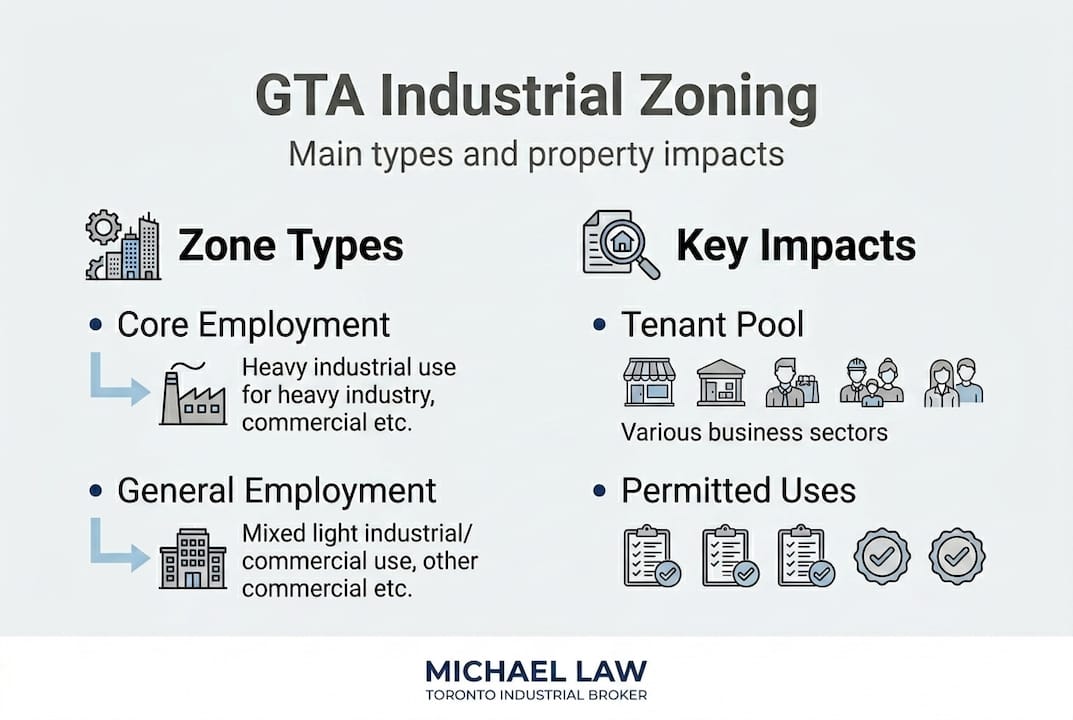
Within Employment Areas, there are two major sub-designations that every GTA investor and tenant must distinguish:
- Core Employment Areas: The most protected industrial parcels. These are reserved for heavy economic activity and resist any non-employment intrusion.
- General Employment Areas: Still primarily industrial, but with more flexibility at the edges, particularly for certain retail formats.
The permitted uses vary meaningfully between the two categories. This distinction has enormous implications for the types of industrial properties you might pursue and for the industrial real estate benefits each category offers.
| Use type | Core Employment Areas | General Employment Areas |
|---|---|---|
| Manufacturing and processing | Permitted | Permitted |
| Warehousing and distribution | Permitted | Permitted |
| Offices and R&D | Permitted | Permitted |
| Utilities and waste management | Permitted | Permitted |
| Ancillary restaurants and services | Permitted (small-scale) | Permitted (small-scale) |
| Retail stores | Not permitted | Permitted at periphery with restrictions |
| Residential uses | Not permitted | Not permitted |
| Large-format retail | Not permitted | Generally not permitted |
Why does this distinction matter in practice? Consider a logistics company looking at two seemingly similar warehouse buildings on opposite sides of a road. One sits within a Core Employment Area; the other is in a General Employment Area adjacent to a retail power centre. The permitted ancillary uses, potential co-tenants, and future redevelopment risk are completely different, even if the buildings look identical.
The 12% of Toronto land that carries employment zoning supports 27% of city jobs. That concentration of economic productivity is exactly why the city guards these areas fiercely. Retail incursion, residential conversion, or misaligned tenant use erodes the employment base that Toronto depends on.
For investors, understanding the sub-designation before acquisition is not optional. It determines the tenant universe you can attract, the ancillary services that can operate on site, and whether future intensification or mixed-use plays are even possible.
How Toronto regulates industrial properties: by-laws, standards, and maps
Knowing the zone type is step one. Knowing the rules that govern building and use within that zone is what separates informed investors from expensive mistakes.
Toronto operates on a two-layer planning system. The Official Plan sets broad policy intent, articulating what the city wants land to achieve over decades. Zoning By-law 569-2013 then translates that policy intent into hard, property-specific standards covering height, setbacks, density, and lot coverage. Both documents apply simultaneously, and a property must comply with both.

Here is what those key standards typically control for industrial properties:
| Standard | What it governs | Why it matters to investors |
|---|---|---|
| Building height | Maximum allowable height in metres | Limits warehouse clear height and mezzanine potential |
| Lot coverage | Percentage of lot that can be covered by buildings | Affects site density and expansion room |
| Front and rear setbacks | Minimum distance from property lines | Shapes truck court depth and trailer parking |
| Floor space index (FSI) | Ratio of gross floor area to lot area | Determines how intensively a site can be built out |
| Parking requirements | Minimum stalls per unit of floor area | Directly impacts operating logistics |
Verifying a property's actual zoning before signing anything is non-negotiable. Here is how to do it step by step:
- Identify the property address and its legal description from the listing or title search.
- Access the City of Toronto's online zoning map through the city's planning portal.
- Confirm both the Employment Area designation (Core or General) and the specific zoning code.
- Cross-reference with By-law 569-2013 to read the applicable standards for that code.
- If the intended use is not explicitly listed as permitted, consult with a planner or industrial real estate expert before proceeding.
Pro Tip: Do not rely on a vendor's verbal description of zoning. Pull the official zoning certificate or confirm directly through the Toronto real estate platform or the city's online tools. Discrepancies between listed and actual zoning are more common than investors expect.
When a desired use does not fit within the permitted list, a Minor Variance or Rezoning Application may be possible. Minor variances address small deviations from standards (say, a setback that is two metres short). Rezoning is a heavier process involving public consultation and council approval. Neither is guaranteed, and both add time and cost to a project. The industrial space examples across the GTA show how varied these outcomes can be from one municipality to the next.
Brampton, Mississauga, Vaughan, and other GTA municipalities each have their own zoning by-laws, though the principles mirror Toronto's framework. Always confirm which municipality's rules apply, particularly for properties near municipal boundaries.
Case studies: special situations and edge cases
The rules look clean on paper. Real GTA transactions are messier. Here are the types of edge cases that consistently catch investors and tenants off guard.
Former non-residential use on the fringe of residential areas. Imagine a small machine shop that operated for decades in a mixed block near a residential neighbourhood. The property is still zoned industrial, but any significant change of use or expansion triggers a compatibility review. Compatibility checks assess noise, traffic, emissions, and hours of operation relative to neighbouring residential parcels. What looked like a straightforward acquisition becomes a planning exercise.
Commercial vehicle parking in the wrong zone. A logistics operator trying to park a fleet of commercial trucks on a site zoned for a lower-intensity industrial use may find themselves in violation. Commercial vehicle parking is permitted within industrial zones but is generally restricted in residential zones and even some lighter commercial areas. Operators who lease space and later expand fleet size without checking parking permissions face fines and operational disruptions.
Employment Area conversion attempts. Some investors acquire industrial land hoping to rezone it for residential or large-format retail, expecting the pressure of housing demand to make the city flexible. It rarely works that way. Conversion to non-employment uses requires a Municipal Comprehensive Review, a province-wide planning exercise that happens on a fixed cycle, not on an investor's timeline.
Employment Areas are among Toronto's most protected land designations. The city has repeatedly signalled that the economic function of these lands is not negotiable in the short term, regardless of development pressure.
Common edge cases GTA investors have encountered include:
- Retail uses creeping into Core Employment Areas through technically compliant but policy-contrary lease structures
- Accessory office space exceeding permitted ratios and triggering by-law enforcement
- Site plan approvals required for what an investor assumed was a simple interior fit-out
- Boundary disputes near municipal lines where two different by-laws apply to different parts of the same parcel
- Industrial property tenants with specialised equipment requiring structural modifications that need building permit review
Pro Tip: Before any material site change, commission a zoning compliance review from a licensed planner. The cost of a compliance report is trivial compared to the cost of an enforcement order or a failed site plan application. Staying current on industrial trends in 2026 also helps anticipate where regulatory attention is heading.
Optimising industrial-zoned property for long-term value
Once you understand the rules and their exceptions, the real work begins: turning zoning knowledge into measurable investment value.
Start with employment density targets. Employment Areas are targeted for a minimum of 50 jobs per gross hectare. Properties that meet or exceed this benchmark align with municipal policy goals, which makes them more defensible against rezoning pressure from adjacent land uses and more attractive to institutional tenants who need long-term lease certainty. A site performing at 70 jobs per hectare is genuinely more valuable than one sitting underutilised at 20.
Three steps for optimising a GTA industrial asset:
- Assess the site's full permitted use envelope. Many owners use only a fraction of what their zoning allows. A warehouse that also permits ancillary office, R&D space, and small-scale food service for employees has a wider tenant universe than a pure storage play.
- Align with permitted uses before marketing. Trying to attract a tenant whose operation falls outside the permitted use list is a waste of time and exposes you to liability. Match your leasing strategy to what the zone actually allows.
- Monitor by-law amendments and Official Plan updates. Zoning is not static. The city updates Employment Area policies, and those changes can expand or restrict what is possible on your site. Set a calendar reminder to review the city's planning notices at least annually.
Mistakes to avoid when optimising for tenant mix or expansion:
- Assuming that because a neighbouring property houses a certain use, yours can too
- Ignoring parking ratios when pursuing high-density employment tenants like call centres or tech assembly operations
- Overlooking the ESG value of green building standards, which increasingly influence tenant attraction and property valuation in industrial assets
- Treating zoning as a fixed constraint rather than a framework to actively navigate
- Failing to disclose zoning limitations during lease negotiations, which creates legal exposure later
Investors who treat zoning as a living document, rather than a fixed box, consistently outperform those who treat it as background noise. The scarcity of employment-zoned land in the GTA means every permitted square metre of industrial space carries genuine scarcity premium. Use it.
What most miss about industrial zoning in Toronto
After years of working with investors and tenants across the GTA, the pattern is clear: the bottleneck is rarely the regulation itself. It is the misunderstanding of what the regulation actually permits.
Most investors approach industrial zoning as a ceiling, a limit on what they can do. The sharper way to read it is as a floor, a guaranteed set of high-value permitted activities that residential or retail zoning cannot offer. When you own or lease a Core Employment Area property, you hold a scarce asset that the city is actively defending from conversion. That is not a constraint. That is a competitive moat.
Short-term thinking is the more persistent problem. Treating a well-located industrial property purely as a storage box, when the same zone permits manufacturing, R&D, distribution, and ancillary services, leaves significant tenant optionality on the table. Multi-use employment hubs command stronger rents, attract creditworthy tenants, and hold value through market cycles better than single-purpose warehouses.
There is also a negotiation angle that most investors never exploit. Understanding zoning deeply gives you credibility in conversations with vendors, municipalities, and tenants. A vendor trying to pass off a General Employment Area site as suitable for uses only permitted in Core Employment Areas cannot do so to a buyer who has read the GTA industrial investment guide. Zoning knowledge is leverage. Most buyers leave that leverage sitting on the table.
The investors who build durable industrial portfolios in the GTA are not the ones with the most capital. They are the ones who read the zoning map like a strategy document.
Explore GTA industrial real estate opportunities
Ready to put this industrial zoning knowledge into action? Michael Law Real Estate works with investors and corporate tenants across the GTA to identify, evaluate, and secure industrial properties that align with both operational needs and long-term value creation.

Whether you are sourcing a distribution centre in Mississauga, evaluating an acquisition in Brampton, or negotiating a lease renewal in Vaughan, having an advisor who understands the zoning intricacies at the parcel level changes the outcome of every deal. Browse GTA industrial properties to see current opportunities across Toronto's most active industrial corridors, or explore industrial locations in Toronto to find the submarket that fits your strategy. The right property, in the right zone, with the right guidance is where investment returns are built.
Frequently asked questions
What is the difference between core employment and general employment areas?
Core Employment Areas primarily allow manufacturing, warehousing, and ancillary services without retail, while General Employment Areas permit restricted retail at the periphery. Choosing between them depends entirely on your intended tenant mix and operational requirements.
Can an industrial property be converted to residential use?
No. Conversion to non-employment uses requires a Municipal Comprehensive Review, a formal provincial planning process that is not initiated by individual property owners and is generally not approved outside of scheduled review cycles.
What are common zoning standards that affect industrial buildings?
Zoning By-law 569-2013 governs height, density, setbacks, and lot coverage for industrial properties. These standards directly determine how intensively a site can be developed and what operational configurations are possible.
How do I check the zoning of a GTA industrial property?
Use the City of Toronto's zoning maps through the city's online planning portal, then cross-reference with By-law 569-2013 for property-specific standards. For properties outside Toronto, check the applicable municipal zoning portal or consult a real estate advisor.
Why is industrial zoning significant for GTA investors?
Industrial zoning directly controls permitted uses, tenant eligibility, and development potential. With employment zoning supporting 27% of Toronto's jobs on just 12% of its land, these assets are scarce, well-protected, and fundamentally linked to long-term investment returns.