

Industrial property owners and investors in the Greater Toronto Area face mounting pressure to integrate environmental, social, and governance factors into their portfolios. Yet many still view ESG as a compliance burden rather than a strategic advantage. The reality is that ESG attributes directly influence valuations, tenant demand, and access to capital in today's market. This guide demystifies ESG methodologies, reveals GTA benchmarks, addresses implementation challenges, and demonstrates how sustainability initiatives translate into measurable investment returns for industrial real estate stakeholders.
Table of Contents
- Key takeaways
- What is ESG in industrial real estate and why it matters
- Methodologies and reporting standards shaping ESG in GTA industrial real estate
- GTA ESG benchmarks and real-world examples of industrial properties
- Challenges, nuances, and strategic opportunities in ESG for industrial assets
- Investment value and future outlook of ESG integration in GTA industrial real estate
- Explore expert commercial real estate services in the GTA
- Frequently asked questions
Key Takeaways
| Point | Details |
|---|---|
| ESG scope | ESG in industrial properties evaluates environmental, social, and governance factors and informs valuations, tenant demand, and access to capital. |
| ESG methodologies | Investors rely on certification schemes such as BOMA BEST and other reporting frameworks to guide ESG strategy and disclosure. |
| GTA benchmarks | The guide outlines typical GTA benchmarks and practices used by owners and lenders in industrial real estate. |
| Retrofit challenges | Retrofitting facilities and measuring ESG impact present technical and financial hurdles that require baseline metrics and expert guidance. |
| Investment benefits | Integrating ESG can boost valuations, attract longer leases, reduce operating costs, and align portfolios with future capital requirements. |
What is ESG in industrial real estate and why it matters
ESG represents a comprehensive framework evaluating how industrial properties perform across environmental stewardship, social responsibility, and governance practices. The environmental pillar examines energy efficiency, renewable integration, and climate risks inherent to facility operations. Social considerations encompass employee wellness programmes, transport accessibility for workers, and community impact mitigation strategies. Governance addresses compliance protocols, facility management transparency, and reporting integrity that institutional investors demand.
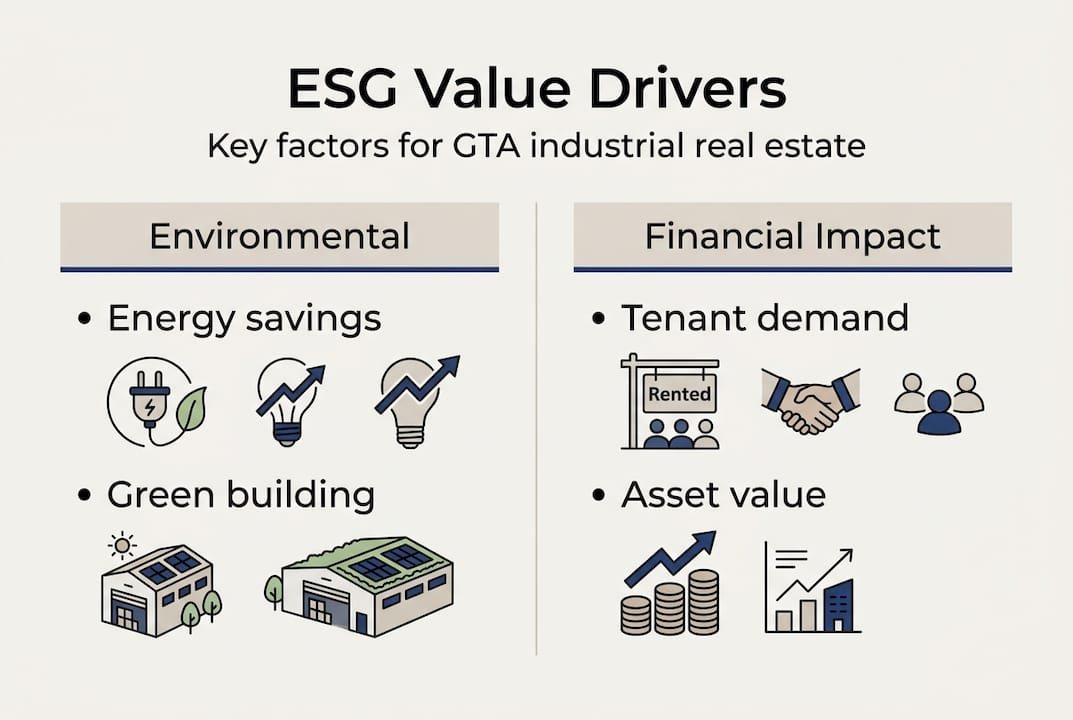
These factors matter because they directly influence property valuations and tenant acquisition in competitive markets. Banks increasingly require ESG attributes in valuation assessments, whilst tenants actively seek facilities that enhance their corporate sustainability credentials and reduce operating expenses. Industrial occupiers recognise that ESG-compliant buildings deliver tangible cost savings through reduced energy consumption, lower insurance premiums, and improved workforce productivity.
The financial implications extend beyond immediate operational benefits. Properties demonstrating strong ESG performance command valuation premiums, attract longer lease commitments, and provide portfolio resilience against regulatory shifts. Owners who neglect sustainability risk obsolescence as tenant preferences evolve and climate disclosure requirements tighten. Modern industrial tenants evaluate potential facilities through an ESG lens, weighing carbon footprints, renewable energy access, and social amenities alongside traditional location and layout factors.
Brand enhancement represents another compelling driver. Industrial facilities with documented sustainability achievements bolster tenant corporate social responsibility narratives, creating mutual value. This alignment strengthens landlord-tenant relationships and justifies premium rental rates. Moreover, ESG integration positions properties favourably for institutional capital seeking responsible investment opportunities, expanding the potential buyer pool during disposition.
"Industrial real estate stakeholders who embed ESG principles into asset management strategies unlock competitive advantages through enhanced valuations, operational efficiencies, and future-proofed portfolios that align with evolving market expectations."
Pro Tip: Begin ESG integration by conducting energy audits and establishing baseline metrics for utility consumption, waste generation, and emissions. These foundational measurements enable targeted improvements and credible reporting to stakeholders.
Partnering with experts who understand both sustainability frameworks and commercial real estate expertise ensures strategic implementation tailored to GTA market dynamics and investment objectives.
Methodologies and reporting standards shaping ESG in GTA industrial real estate
Industrial property investors navigate multiple certification schemes and reporting frameworks when structuring ESG strategies. Understanding these methodologies enables informed decision-making about which standards align with specific asset profiles and investment goals.
Major certification programmes include:
- BOMA BEST evaluates building environmental performance and management practices across Canadian commercial properties, offering tiered certification levels.
- LEED certification assesses sustainable design, construction, and operational excellence through a points-based system recognising various achievement thresholds.
- Zero Carbon Building (ZCB) designation verifies facilities achieving net-zero operational carbon emissions through efficiency measures and renewable energy integration.
- GRESB provides comparative ESG performance benchmarking specifically for real estate portfolios, enabling peer comparison and investor transparency.
These certifications employ goal-programming models comprising two phases. The passive gap assessment phase identifies current performance deficiencies against target standards. The active optimisation phase then develops improvement strategies within financial and operational constraints, balancing competing objectives like cost minimisation and environmental impact reduction.
Life cycle assessment (LCA) methodology examines environmental impacts across construction material sourcing, building operations, and eventual decommissioning. This holistic approach reveals hidden sustainability costs and opportunities that traditional analyses overlook. LCA informs material selection, renovation planning, and long-term asset management strategies by quantifying embodied carbon and operational efficiency trade-offs.
Standardised reporting frameworks provide consistency for stakeholder communication:
| Framework | Focus area | Primary benefit |
|---|---|---|
| GRESB | Portfolio-level ESG performance benchmarking | Enables institutional investor comparison and capital attraction |
| SASB | Financially material sustainability disclosure | Aligns reporting with investor decision-making priorities |
| TCFD | Climate-related financial risk transparency | Addresses regulatory requirements and physical/transition risks |
These frameworks complement certification programmes by structuring how organisations communicate ESG achievements and risks to investors, lenders, and tenants. GRESB surveys facilitate annual performance tracking and peer benchmarking across global real estate portfolios. SASB standards identify which sustainability factors genuinely influence financial performance within specific industries, focusing disclosure efforts. TCFD guidelines address climate scenario analysis and risk governance, increasingly mandatory for institutional asset managers.
Pro Tip: Select certification programmes based on tenant preferences and investor requirements rather than pursuing multiple credentials simultaneously. A focused approach delivers clearer value propositions and more efficient resource allocation.
Implementing these methodologies and reporting standards requires expertise in both sustainability principles and commercial real estate operations. Engaging advisors with commercial real estate expertise ensures alignment between ESG initiatives and investment performance objectives.
GTA ESG benchmarks and real-world examples of industrial properties
The Greater Toronto Area industrial market demonstrates varying ESG adoption levels, with leading operators establishing performance benchmarks that influence investor expectations and tenant demands.
Pure Industrial REIT exemplifies proactive sustainability leadership through comprehensive certification efforts. The portfolio encompasses approximately 1.5 million square feet certified under BOMA BEST standards, demonstrating commitment to operational excellence. Green lease penetration reaches 68% of total gross leasable area, embedding sustainability provisions directly into tenant agreements. The organisation pursued Zero Carbon Building designation for its Lakeridge facility, showcasing ambition beyond conventional efficiency improvements.

Dream Industrial REIT provides another compelling case study with measurable outcomes. The portfolio achieved a GRESB score of 68 out of 100, placing it competitively amongst North American industrial peers. Solar capacity installations total 21 megawatts across multiple facilities, generating substantial renewable energy and reducing grid dependence. Greenhouse gas emissions decreased 24% through targeted efficiency programmes and renewable integration, translating environmental commitments into quantifiable results.
Matheson Kennedy Industrial Centre represents best-in-class sustainable construction, earning LEED Gold certification through energy-efficient design, water conservation systems, and indoor environmental quality enhancements. This designation attracts tenants prioritising facility sustainability credentials whilst commanding premium lease rates justified by operational cost savings.
Comparative performance metrics reveal strategic differentiation:
| Operator | GRESB score | Renewable capacity | Green lease penetration | Notable achievements |
|---|---|---|---|---|
| Dream Industrial | 68/100 | 21MW solar | Data unavailable | 24% emissions reduction, $1.5M annual solar NOI |
| Pure Industrial | Not disclosed | Limited public data | 68% | 1.5M sq ft BOMA BEST, ZCB pursuit |
| Matheson Kennedy | Not applicable | Not disclosed | Not disclosed | LEED Gold certification |
These benchmarks establish performance expectations for institutional investors evaluating GTA industrial opportunities. Properties lacking comparable sustainability credentials face valuation discounts and tenant acquisition challenges as market standards evolve.
Pro Tip: Review tenant lease agreements for sustainability clauses addressing utility consumption transparency, waste management responsibilities, and improvement cost-sharing provisions. These terms influence ESG measurement accuracy and operational flexibility.
Investors seeking to position assets competitively should evaluate current performance against these benchmarks and develop targeted improvement roadmaps. Partnering with advisors offering commercial real estate expertise facilitates strategic ESG integration aligned with GTA market dynamics and investment return objectives.
Challenges, nuances, and strategic opportunities in ESG for industrial assets
Implementing ESG initiatives across industrial portfolios presents practical obstacles requiring strategic navigation and resource prioritisation.
Primary challenges include:
- Retrofit costs for older facilities often exceed economic viability thresholds, particularly for properties with limited remaining useful life or constrained rental income potential.
- Capital constraints force difficult trade-offs between sustainability improvements and other value-creation initiatives like tenant improvements or portfolio expansion.
- Data tracking complexity intensifies in multi-tenant buildings where individual occupier consumption requires submetering infrastructure and ongoing monitoring protocols.
- ESG backlash and greenwashing concerns create reputational risks, causing some organisations to minimise public sustainability commitments despite genuine efforts.
The economic reality of brown asset retrofits sometimes favours strategic repurposing or disposition rather than extensive capital investment. Properties valued below $30 million typically receive less institutional ESG scrutiny, creating bifurcated market expectations. Multi-tenant configurations complicate accurate performance measurement when individual occupiers control significant operational decisions affecting overall building sustainability metrics.
Emerging ESG resistance trends compound these practical challenges. The phenomenon of 'green-hushing' reflects organisational reluctance to publicise sustainability achievements amidst political backlash and greenwashing accusations. Major financial institutions have exited net-zero banking alliances, signalling shifting priorities. However, local regulations and tenant demands continue driving ESG focus, particularly regarding financially material factors directly influencing property performance and risk profiles.
Strategic opportunities emerge for investors who navigate these complexities effectively:
- Incremental ESG integration focusing on high-return improvements like LED lighting, HVAC optimisation, and renewable energy procurement delivers measurable financial benefits without overwhelming capital requirements.
- Technology solutions including IoT sensors, building automation systems, and platforms like Measurabl enhance data accuracy whilst reducing manual tracking burdens.
- Emphasising measurable outcomes over certification labels aligns with the trend towards financial materiality, appealing to pragmatic investors prioritising returns alongside sustainability.
- Selective retrofit targeting properties with strong tenant credit, extended lease terms, and sufficient rental income to justify capital investment maximises return on ESG expenditures.
"Successful ESG strategies balance environmental ambitions with financial realities, prioritising improvements that enhance both sustainability credentials and investment returns whilst avoiding performative initiatives lacking substantive impact."
Pro Tip: Implement utility benchmarking across portfolio holdings to identify outlier properties with disproportionate consumption, then target efficiency improvements where savings potential justifies investment.
Navigating these challenges requires expertise balancing sustainability principles with commercial real estate fundamentals. Engaging advisors with commercial real estate expertise ensures ESG initiatives support rather than compromise investment performance objectives.
Investment value and future outlook of ESG integration in GTA industrial real estate
ESG integration delivers quantifiable financial benefits extending beyond operational cost savings to influence property valuations, capital access, and portfolio resilience.
Valuation impacts manifest through multiple channels. Properties demonstrating strong ESG performance attract premium tenants willing to pay higher rents for facilities supporting their corporate sustainability objectives. Operating cost reductions from energy efficiency and waste minimisation directly enhance net operating income. Modern GTA industrial properties with comprehensive sustainability features command cap rates below 4%, reflecting investor confidence in long-term value preservation and income stability.
Green financing advantages provide additional value creation opportunities. Lenders offer preferential terms for properties meeting sustainability criteria, reducing borrowing costs and improving investment returns. Dream Industrial's solar installations generate approximately $1.5 million in annual net operating income whilst enhancing environmental credentials, demonstrating how renewable energy investments deliver dual benefits.
The market increasingly emphasises financial materiality over broad ESG narratives, focusing on sustainability factors directly influencing property performance and risk profiles. This pragmatic approach aligns investor interests with environmental objectives, creating sustainable value rather than performative compliance. Expert practitioners recommend integrating ESG considerations into valuation analyses based on functional utility and tenant creditworthiness, applying sustainability metrics retrospectively to validate assumptions, and structuring GRESB reporting to emphasise return on investment alongside environmental achievements.
"ESG-integrated industrial properties demonstrate superior resilience through economic cycles, attracting institutional capital, commanding premium valuations, and positioning portfolios advantageously as regulatory requirements and tenant expectations continue evolving."
Future outlook themes shaping GTA industrial real estate ESG strategies include:
- Enhanced reporting standards requiring more granular disclosure of climate risks, energy consumption, and social impact metrics across portfolios.
- Regulatory shifts potentially introducing carbon pricing, mandatory efficiency standards, or climate risk disclosure requirements affecting property operations and valuations.
- Green technology adoption accelerating as costs decline and performance improves, making renewable energy, battery storage, and advanced building automation economically compelling.
- Tenant demand intensification as corporate sustainability commitments mature, creating competitive advantages for properties enabling occupier ESG goal achievement.
Investors positioning portfolios proactively capture first-mover advantages whilst those delaying face escalating retrofit costs and tenant acquisition challenges. The transition towards sustainable industrial real estate represents both risk mitigation and value creation opportunity for strategic operators.
Partnering with experienced advisors who understand both sustainability frameworks and commercial real estate expertise enables investors to navigate this evolving landscape effectively, optimising ESG integration for maximum financial and environmental impact.
Explore expert commercial real estate services in the GTA
Navigating ESG complexities whilst optimising industrial real estate investments requires specialised expertise combining sustainability knowledge with deep market understanding. Michael Law brings extensive experience advising GTA industrial property investors on strategic acquisitions, dispositions, and asset management aligned with evolving ESG expectations.

Whether evaluating properties for ESG improvement potential, structuring green financing, or positioning assets for institutional buyers prioritising sustainability credentials, strategic guidance ensures initiatives support investment objectives. Explore comprehensive commercial property listings featuring detailed property information and market insights. Discover tailored commercial real estate services addressing investment sales, lease negotiations, and portfolio strategy development.
Pro Tip: Engage advisors early in acquisition due diligence to assess ESG risks and opportunities, ensuring purchase pricing reflects potential improvement costs and value creation upside.
Partner with Michael Law real estate firm to leverage proven expertise optimising GTA industrial investments through strategic ESG integration, market intelligence, and dedicated client service focused on sustainable, profitable outcomes.
Frequently asked questions
What are the most common ESG certifications for industrial properties?
BOMA BEST, LEED, Zero Carbon Building, and GRESB represent widely recognised certifications relevant to industrial real estate, each assessing different aspects of energy efficiency, sustainability practices, and management systems. BOMA BEST focuses on Canadian building operations, whilst LEED evaluates design and construction excellence. Certification selection depends on property characteristics, investor reporting requirements, and tenant preferences within your specific market.
How can industrial property owners measure ESG performance effectively?
Implement reporting frameworks like GRESB and SASB alongside technology platforms such as Measurabl, which aggregate utility data, emissions calculations, and certification tracking in centralised dashboards. Install submetering infrastructure in multi-tenant buildings to capture individual occupier consumption accurately. Conduct regular third-party audits and maintain consistent measurement protocols to ensure data reliability and year-over-year comparability for stakeholder reporting.
What are the financial benefits of ESG for industrial real estate investors?
ESG integration enhances property valuations through premium tenant attraction, reduces operating expenses via energy efficiency, enables access to green financing with favourable terms, and supports lower cap rates reflecting reduced risk profiles. Properties demonstrating strong sustainability performance command rental premiums, experience lower vacancy rates, and appeal to expanding institutional capital pools prioritising responsible investment criteria. These factors collectively improve investment returns whilst building portfolio resilience.
How should investors approach brown asset retrofits with ESG in mind?
Conduct comprehensive cost-benefit analyses comparing retrofit expenditures against potential value uplift, remaining asset life, and tenant demand for improved facilities. Evaluate whether strategic repurposing or disposition represents better capital allocation than extensive sustainability improvements for older properties with limited income potential. Prioritise high-impact, cost-effective upgrades like lighting, HVAC controls, and renewable energy procurement before pursuing expensive envelope or system replacements. Engage experienced advisors to identify financially viable improvement pathways aligned with market positioning objectives.