

TL;DR:
- Toronto's industrial market offers low vacancy rates and strategic location advantages for logistics and manufacturing.
- It is a highly flexible, cost-effective asset class with long-term growth driven by e-commerce and nearshoring.
- Working with specialized industrial brokers ensures better leasing options and market insights in Toronto.
Most businesses hunting for space in Toronto instinctively look at office towers or retail units. That instinct costs them. Industrial real estate in the Greater Toronto Area (GTA) has quietly become one of the most strategically valuable asset classes available, offering advantages that office and retail simply cannot match. Whether you operate a logistics company, run an e-commerce fulfilment operation, or manage a manufacturing facility, the case for industrial space is compelling. This guide walks through what makes Toronto's industrial market unique, the core business advantages, what to evaluate before signing, and the trends shaping decisions in 2026.
Table of Contents
- What makes Toronto's industrial market unique?
- Key advantages of choosing industrial real estate
- Essential factors when evaluating industrial properties
- Trends shaping Toronto's industrial real estate in 2026
- Our take: Why the smart move is industrial real estate
- Find the right industrial real estate for your Toronto business
- Frequently asked questions
Key Takeaways
| Point | Details |
|---|---|
| Market advantage | Toronto’s industrial real estate sector features consistent demand, low vacancy, and strong growth. |
| Strategic location | Proximity to highways, ports, and urban centres supports logistics and e-commerce efficiency. |
| Cost and flexibility | Industrial spaces often provide better value and operational flexibility than other asset types. |
| Critical features | Consider location, ceiling height, and loading docks when evaluating industrial properties. |
| Expert guidance | A qualified GTA industrial real estate professional helps businesses secure the right property. |
What makes Toronto's industrial market unique?
The GTA industrial sector is not just large. It is genuinely distinct from other commercial real estate categories, and understanding why matters before you commit to any space.
Toronto sits at the centre of Canada's most active freight and logistics corridor. The region connects Highway 400, 401, 407, and 427, giving businesses direct access to the U.S. border, Pearson International Airport, and the Port of Hamilton. No other Canadian city offers that combination in one metropolitan area. That infrastructure alone draws a disproportionate share of national distribution activity to the GTA.
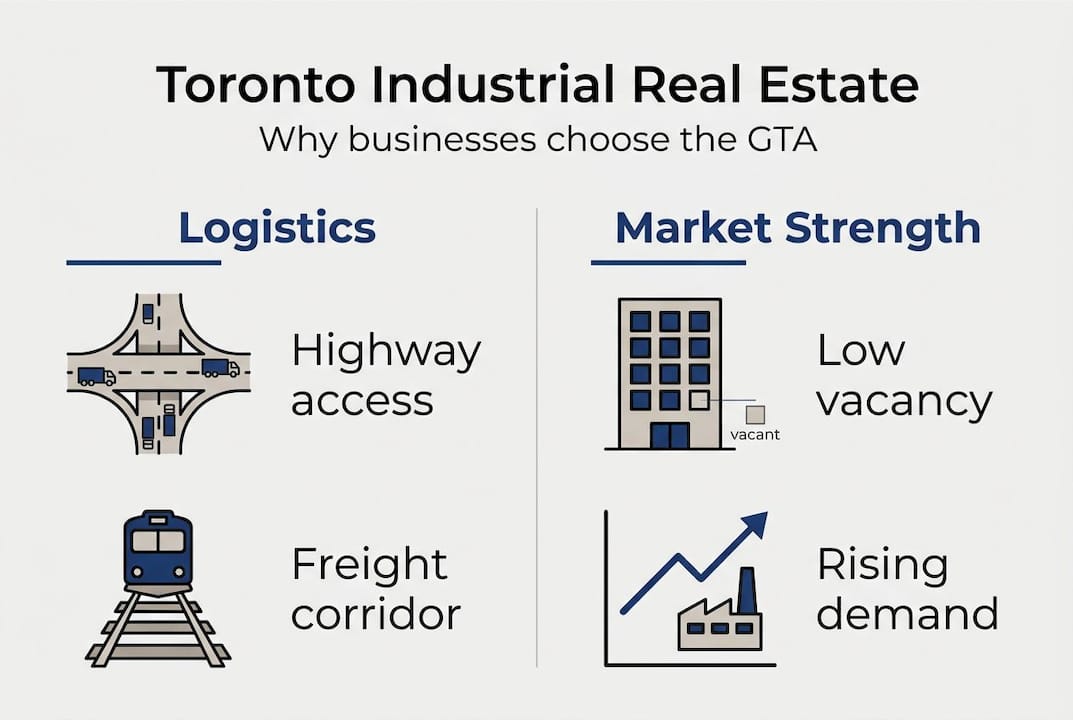
Vacancy is the number that tells the real story. Toronto's industrial vacancy rate sits around 4.3%, reflecting a market where quality space disappears fast and tenants compete hard for well-located buildings. Compare that to office vacancy in downtown Toronto, which has hovered well above 15% in recent years, and the contrast is stark. Industrial demand has stayed resilient through economic cycles that hammered other asset types.
According to industrial real estate trends for 2026, Toronto's industrial market features consistently low vacancy rates and strong tenant demand, driven by e-commerce growth, supply chain restructuring, and nearshoring activity. That is not a short-term blip. It reflects structural shifts in how goods move.
Here is a quick comparison of how industrial stacks up against other asset classes in the GTA:
| Asset class | Average vacancy | Demand driver | Flexibility |
|---|---|---|---|
| Industrial | ~4.3% | E-commerce, logistics, manufacturing | High |
| Office | 15%+ | Knowledge workers, professional services | Medium |
| Retail | 8-12% | Consumer foot traffic | Low |
| Residential | Under 2% | Population growth | Very low |
The industries that benefit most from GTA industrial space include:
- Logistics and third-party logistics (3PL) providers needing large-bay distribution centres
- E-commerce operators requiring fast-turn fulfilment near urban consumers
- Light and heavy manufacturers seeking clear-span floor space and power capacity
- Food and beverage processors needing temperature-controlled environments
- Automotive suppliers clustered around the 400-series highway network
For a deeper look at property formats, the types of industrial properties available in Toronto range from small-bay flex units to large-format distribution centres exceeding 500,000 square feet.
Pro Tip: Do not treat the GTA as one uniform market. Submarkets like Brampton, Mississauga Airport, and Markham each have distinct vacancy profiles and rental ranges. Tracking submarket data through sources like the Colliers market report gives you a real edge when timing your search.
Key advantages of choosing industrial real estate
Having seen what makes the GTA market attractive, let's break down the real business advantages industrial properties deliver.
Industrial space is not just a cost of doing business. For the right operation, it is a competitive asset. Here is why:
- Strategic location for supply chain efficiency. GTA industrial nodes sit within a day's drive of 140 million consumers across Canada and the northeastern United States. That reach is irreplaceable for distribution-focused businesses.
- Access to critical infrastructure. Proximity to Pearson International Airport, the 400-series highways, and rail connections gives tenants logistical advantages that no office park can replicate.
- Modern building stock. New GTA industrial developments routinely feature 36 to 40-foot clear heights, ESFR sprinkler systems, and dock-level loading suited to automated racking and robotics.
- Cost-per-square-foot value. Even with rental growth, industrial net rents in the GTA remain significantly lower per square foot than comparable office space, especially when you factor in the productive floor area you actually get.
- Scalability. Many industrial leases allow for expansion rights or early termination clauses, giving growing businesses room to adjust without starting from scratch.
- Operational flexibility. A single industrial unit can serve warehousing, light assembly, and office functions simultaneously, reducing the need for multiple leased premises.
Market insight: Modern GTA facilities offer logistical, cost, and scalability advantages that are increasingly difficult to replicate in other asset classes, particularly as automation investment rises.
The CBRE industrial outlook reinforces that Canadian industrial assets continue to attract strong occupier demand, with the GTA leading national absorption figures.

Understanding broker advantages for GTA industry is equally important. Navigating lease structures, incentive packages, and landlord concessions requires specialised knowledge that generalist brokers rarely possess.
Pro Tip: When evaluating industrial space, think beyond your current footprint. Negotiate for a right of first refusal on adjacent units. That single clause can save you a costly relocation when your business grows.
Essential factors when evaluating industrial properties
To capitalise on these benefits, know what to look for when evaluating your options.
Not every industrial building suits every operation. A distribution centre has very different requirements from a food processing plant or a tech manufacturer. Getting the evaluation right upfront prevents expensive surprises mid-lease.
Here is a practical checklist of what to assess:
- Ceiling clear height: Minimum 28 feet for modern racking; 36 to 40 feet for automated systems
- Loading dock configuration: Number of truck-level and grade-level doors relative to your shipping volume
- Column spacing: Wider bays (40 x 50 feet or greater) allow more flexible racking layouts
- Power supply: Confirm available amperage and voltage for your equipment
- Yard depth: Sufficient trailer staging area is critical for high-volume shippers
- Office component: Ratio of office to warehouse space and whether it suits your team
- Zoning classification: Confirm the permitted uses align with your operation, including any environmental or noise restrictions
As noted in the guide to key industrial property types, analysing proximity to highways, ceiling height, and loading dock access are among the most important factors tenants overlook when rushing a site selection decision.
Here is how common property types compare on key features:
| Property type | Typical clear height | Loading | Best suited for |
|---|---|---|---|
| Large-bay distribution | 36-40 ft | Multiple truck-level docks | E-commerce, 3PL, retail distribution |
| Small-bay flex | 18-24 ft | Grade-level doors | Light manufacturing, service trades |
| Mid-bay warehouse | 28-32 ft | Mixed dock and grade | General warehousing, food processing |
| Refrigerated/cold storage | 28-36 ft | Specialised dock seals | Food, pharma, floral |
Environmental due diligence is also non-negotiable. Phase I Environmental Site Assessments (ESAs) are standard practice before any purchase, and some leases require them too. The industrial property guide from Realtor.ca outlines the key compliance considerations buyers and tenants face in Ontario.
Zoning matters more than most tenants realise. Toronto and surrounding municipalities each maintain their own zoning by-laws, and what is permitted in Mississauga may be restricted in Markham. Always verify permitted uses with the local planning department before committing.
Trends shaping Toronto's industrial real estate in 2026
With a shortlist of properties, understanding the latest market trends is crucial for making informed decisions.
The GTA industrial market in 2026 is being shaped by forces that go well beyond basic supply and demand. Four trends stand out:
- E-commerce and last-mile delivery. Retailers and logistics providers are racing to position fulfilment nodes closer to urban consumers. This is driving intense competition for smaller, infill industrial sites within Toronto's inner suburbs, particularly in Etobicoke, Scarborough, and North York.
- Automation and building specifications. Tenants investing in robotics and automated storage and retrieval systems (ASRS) are demanding buildings with higher clear heights, reinforced floor slabs (6,000+ PSI), and robust power infrastructure. Older buildings simply cannot accommodate these requirements.
- Sustainability pressures. Landlords and tenants alike are responding to ESG (environmental, social, and governance) requirements. LEED-certified and net-zero-ready industrial buildings command rental premiums but also attract higher-quality tenants and longer lease terms.
- Nearshoring and supply chain resilience. Canadian manufacturers and distributors are reducing dependence on overseas supply chains, driving demand for domestic production and warehousing capacity across the GTA.
"Toronto's industrial market is adapting to automation, last-mile delivery, and sustainability pressures, creating a two-tier market where modern, well-specified buildings outperform older stock by a significant margin."
Rental growth has moderated from the extraordinary pace of 2021 to 2023, but net rents across the GTA remain elevated. Staying current on monitoring property trends helps you time lease decisions and identify submarkets where incentives are more available. The NAIOP industry trends report also tracks North American industrial absorption, providing useful context for GTA-specific decisions.
For investors, the investment sales guide for 2026 outlines where cap rates are compressing and which asset formats are attracting the most institutional interest.
Our take: Why the smart move is industrial real estate
Conventional wisdom in commercial real estate still tilts toward office and retail. Prestige, visibility, and familiarity drive those preferences. But the numbers tell a different story, and we have seen it play out repeatedly across GTA transactions.
Businesses that treat industrial space as a strategic asset rather than a commodity consistently outperform those that simply chase the lowest rent. The difference is almost always in how they think about flexibility, location, and long-term fit. A lease signed in haste at a marginally cheaper rate often costs far more in operational inefficiency over five years.
The uncomfortable truth is that the GTA industrial market rewards those who move with knowledge and speed. Waiting for the "perfect" deal in a 4.3% vacancy environment usually means settling for whatever is left. The businesses winning right now are the ones who boost their industrial strategy by involving a dedicated industrial advisor early, not after they have already toured a dozen unsuitable properties.
Get expert input at the start. It changes everything.
Find the right industrial real estate for your Toronto business
Ready to act on these insights? The GTA industrial market moves fast, and the gap between a well-positioned space and a compromise is often just a matter of weeks. Working with a qualified industrial real estate professional gives you access to off-market opportunities, informed lease negotiation, and the kind of submarket intelligence that public listings simply do not provide.
At Michael Law Real Estate, we specialise exclusively in GTA industrial properties across Mississauga, Brampton, Vaughan, Markham, and the broader Toronto region. Whether you are leasing, buying, or evaluating a renewal, our team delivers the data and deal-making expertise your operation deserves. Browse available industrial property listings or connect directly with Michael Law Real Estate to start a conversation about your specific requirements.
Frequently asked questions
What is the typical vacancy rate for industrial space in Toronto?
Toronto's industrial vacancy rate is around 4.3%, reflecting strong demand and limited supply across the GTA.
Which industries benefit most from Toronto's industrial real estate?
Logistics, e-commerce, distribution, and manufacturing businesses see the largest benefits. The types of industrial properties available in Toronto are specifically suited to these operational needs.
What are the main location factors to consider before leasing?
Prioritise proximity to highways, major transit, and your customer base. Location factors like dock access and highway exposure directly affect your daily operating costs.
How has e-commerce changed industrial real estate needs in the GTA?
E-commerce has increased demand for modern, strategically located distribution spaces, particularly smaller last-mile facilities close to Toronto's urban core.
Should I work with a broker to find industrial space?
Yes. An industrial-focused broker provides market insight, off-market access, and negotiation support. Working with a broker consistently delivers better lease terms and fewer costly surprises.