
TL;DR:
- Subdividing industrial property in the GTA can significantly enhance value but requires navigating complex municipal legislation and policies. Land severance offers a faster, simpler option for small splits, while plans of subdivision are suited for large or phased developments involving more extensive studies and infrastructure. Proper pre-application consultation, understanding employment zone restrictions, and strategic planning are crucial to avoid costly delays and maximize long-term asset returns.
Subdividing industrial property in the Greater Toronto Area is one of the most value-generative moves an owner or investor can make, but it is also one of the most technically demanding. GTA municipalities operate within a dense web of provincial legislation, local zoning by-laws, and employment area policies, and a single misstep in the application process can delay your project by months or trigger conditions that erode your profit margin. Whether you are splitting a large industrial parcel to unlock capital, enabling a phased development programme, or repositioning an asset to attract multiple tenants, understanding the process from start to finish is essential.
Table of Contents
- Understanding subdivision options: severance versus plans
- Key prerequisites and municipal requirements
- Step-by-step: from application to approval
- Special cases: zoning amendments, employment areas, and appeals
- Lessons learned: what most guides miss about GTA industrial subdivision
- How Michael Law Real Estate can support your industrial subdivision
- Frequently asked questions
Key Takeaways
| Point | Details |
|---|---|
| Two main methods | Land severance is ideal for simple splits; plans of subdivision are for larger, more complex divisions. |
| Municipal preparation is crucial | Pre-consultation and zoning checks dramatically reduce risks of application delays or denials. |
| Approval includes conditions | Most subdivisions come with municipal conditions such as road widening or servicing upgrades to be completed before final approval. |
| Employment Area rules apply | Industrial lands in protected Employment Areas are subject to extra scrutiny to maintain industrial uses. |
| Appeals and phased projects | Rejected applications can be appealed, and phased subdivisions can maximise both flexibility and long-term returns. |
Understanding subdivision options: severance versus plans
To clarify the options available for subdividing industrial assets, let's compare severance and subdivision plans.
Not all subdivision processes are equal. The method you choose shapes everything: the timeline, the cost, the conditions you will face, and ultimately the flexibility you gain. In Ontario, including the GTA, industrial property subdivision primarily uses "land severance" or "consent" under the Planning Act for creating one to three new lots from an existing parcel, while plans of subdivision are required for more lots or complex divisions. That distinction matters enormously for planning purposes.
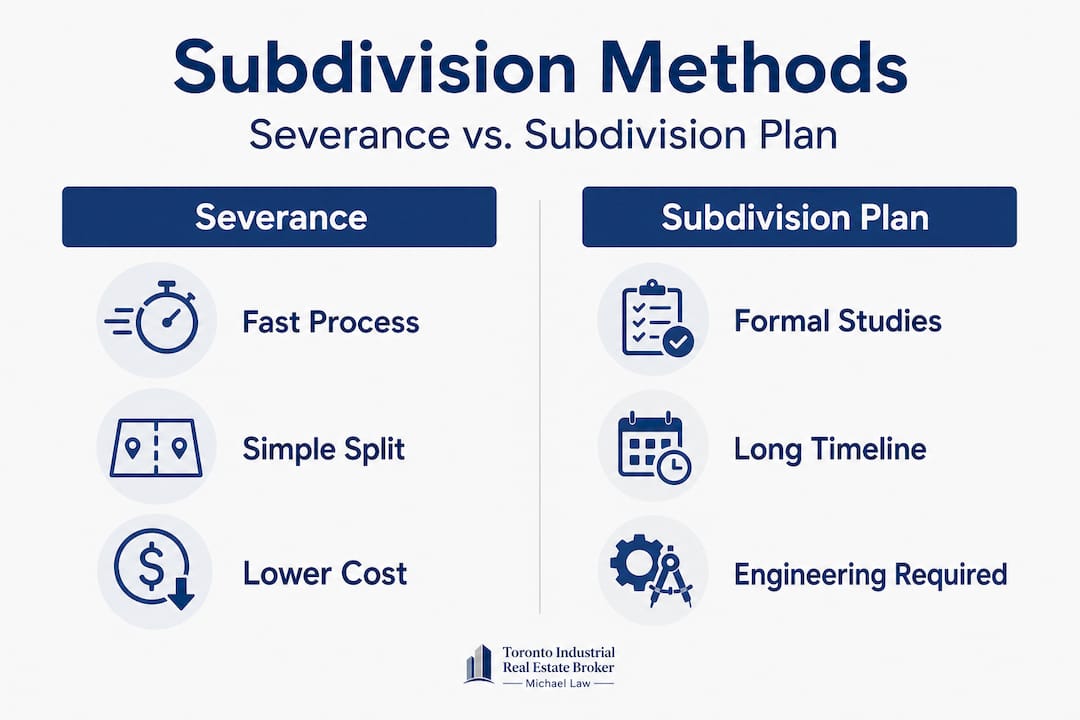
Land severance (consent) is the faster, simpler route. You are asking the municipality for permission to divide one property into two or three distinct parcels. Think of it as the surgical option. If you own a large warehouse campus in Brampton and want to split off one pad for sale while retaining the main building, severance is almost certainly the right tool.
Plans of subdivision are a different beast entirely. They involve a formal draft plan, engineering studies, infrastructure assessments, and a public notice process that can run considerably longer. These are better suited to larger projects involving four or more lots, phased industrial developments, or situations where new roads or municipal servicing infrastructure will be required.
Here is a side-by-side comparison to help you orient quickly:
| Factor | Land severance (consent) | Plan of subdivision |
|---|---|---|
| Number of lots created | 1 to 3 | 4 or more |
| Governing body | Committee of Adjustment or Land Division Committee | Municipality / Regional authority |
| Typical timeline | 3 to 6 months | 12 to 24 months |
| Typical application fee | $1,000 to $1,500 | $5,000 and above |
| Public hearing required | Sometimes | Yes |
| Engineering studies | Limited | Extensive |
| Best for | Simple splits, investor transactions | Phased development, multi-building sites |
When considering types of industrial properties across the GTA, the choice of method also depends on the asset class. A flex industrial building in Markham being split for two owner-users will almost always go the severance route. A logistics campus in Milton with multiple proposed buildings and new internal roads will require a full plan of subdivision.
"Choosing the wrong subdivision method is one of the costliest mistakes an industrial investor can make. It does not just delay your project; it can trigger planning studies and engineering requirements you were never budgeted for."
Key considerations when choosing your method:
- Lot count: Three or fewer favours severance; four or more means you are likely filing a plan of subdivision.
- Servicing complexity: If new water, sewer, or road infrastructure is required, expect a full plan process.
- Timeline sensitivity: Severance is materially faster for straightforward transactions.
- Municipal appetite: Some GTA municipalities are more permissive than others. Mississauga and Brampton each have their own nuances for industrial land division.
- Future phases: If you anticipate a second round of subdivision down the road, planning for it now within a draft plan can save significant time and cost.
Key prerequisites and municipal requirements
Once you've determined the right subdivision approach, preparation is critical, beginning with municipal engagement and due diligence.
Before you file a single form, you need to do your homework. The formal application process starts after pre-consultation with the municipality to assess feasibility against Official Plans, Zoning By-laws, and the Provincial Policy Statement, followed by formal application submission to the Consent Granting Authority (CGA) such as the Committee of Adjustment or Land Division Committee. Skipping or rushing pre-consultation is the single most common mistake investors make, and it shows up later as avoidable conditions or outright refusals.
The GTA industrial zoning guide covers the full spectrum of zone types you will encounter, but for subdivision purposes, the key checks are:
- Official Plan designation: Is the land designated Employment Area? Core Employment? General Employment? Each carries different permissions and restrictions.
- Zoning By-law compliance: Does your proposed lot configuration meet minimum lot size, frontage, and setback requirements?
- Provincial Policy Statement (PPS): Provincial policies place restrictions on converting industrial land to non-industrial uses, and even subdivision can trigger a policy review if it weakens the industrial character of the area.
- Environmental constraints: Contamination, floodplains, or conservation authority overlays can all complicate or delay a subdivision application.
- Servicing availability: Can both resulting parcels be independently serviced? This includes water, sanitary sewer, stormwater management, and road access.
Beyond these checks, you will need to assemble your documentation package. This typically includes a current survey (often a reference plan prepared by an Ontario Land Surveyor), a site plan showing both the existing and proposed lot configurations, a written rationale explaining the purpose and planning merit of the subdivision, and, depending on the municipality, a planning justification report prepared by a professional planner.
Pre-consultation meetings are often held with the municipal planning department, and in some cases with the Region as well. These meetings are not merely procedural. They surface issues early, allow you to shape your application to reflect municipal expectations, and sometimes reveal policy hurdles you were not aware of.
Pro Tip: Bring a registered professional planner to your pre-consultation meeting. They speak the municipality's language, can anticipate objections before they become formal conditions, and often shorten the overall approval timeline by months.
Employment Area designations deserve special attention. Many GTA municipalities, particularly Toronto and Mississauga, have been tightening their policies around Core Employment Areas following provincial direction to protect industrial and employment lands from residential and mixed-use conversion pressure. Even if your subdivision is purely industrial in nature, you must demonstrate that the resulting lots are viable for continued employment use and will not compromise adjacent industrial operations.

Step-by-step: from application to approval
With all prerequisites in place, you are ready to navigate the formal steps from application to approval.
The formal process is more structured than it might seem. Here is how it unfolds in practice:
-
Pre-consultation: Schedule and attend a pre-consultation meeting with the relevant municipal planning department. Confirm which body (Committee of Adjustment or Land Division Committee) has jurisdiction over your application.
-
Engage your team: Retain an Ontario Land Surveyor to prepare a reference plan, a professional planner to prepare or review your planning rationale, and legal counsel to advise on any title or easement issues.
-
Prepare the application package: This includes the completed application form, current survey, site plan, planning rationale, and any supporting studies (environmental, servicing, traffic, etc.).
-
Submit and pay fees: Application fees vary by municipality. In some areas fees start at approximately $1,150 for a severance application, though additional fees for circulation, studies, and conditions are common.
-
Public notice and circulation: Once the application is deemed complete, the CGA circulates notice to adjacent property owners and relevant agencies. Neighbouring owners have the right to comment, and in some cases to appear at a public hearing.
-
Staff report: Municipal planning staff prepare a recommendation report assessing conformity with the Official Plan, Zoning By-law, and provincial policies. This report is a critical document, as it heavily influences the committee's decision.
-
Public hearing or committee meeting: The CGA holds a meeting where applicants can present and neighbours can speak. The committee then deliberates and issues a decision.
-
Decision: approval, refusal, or deferral: The CGA can approve the application with or without conditions, refuse it, or defer for additional information. Conditions may include road widening, easements, or servicing upgrades, and must typically be satisfied within one to two years.
-
Satisfy conditions: Work with your consultants and legal counsel to fulfil all conditions. This stage often involves registered easements, securities deposits, or physical improvements to the site.
-
Certificate of consent: Once conditions are cleared, the CGA issues the Certificate of Consent, which allows registration of the new parcels on title.
| Stage | Typical timeframe |
|---|---|
| Pre-consultation to application submission | 4 to 12 weeks |
| Application deemed complete to public notice | 2 to 4 weeks |
| Committee hearing | 4 to 8 weeks from notice |
| Condition satisfaction | 1 to 24 months |
| Certificate of consent issued | 2 to 4 weeks after conditions met |
Understanding how GTA industrial tenants will use subdivided parcels can also inform how you structure conditions and leasing arrangements post-approval. If you plan to lease rather than sell the new lots, consider how industrial subleasing concepts might apply to your exit or income strategy.
Pro Tip: Do not wait until the certificate is issued to begin planning your post-subdivision leasing or sales strategy. Engaging a broker during the condition satisfaction phase means you can line up tenants or buyers before the ink is dry, shortening your time to revenue significantly. Reviewing tenant fit-out planning steps early also helps prospective tenants understand lead times for occupancy.
For investors acquiring land with subdivision potential already identified, the GTA property acquisition process will help you assess feasibility before you close. And once the assets are created, strategies for maximising GTA industrial returns become your next focus.
Special cases: zoning amendments, employment areas, and appeals
While many subdivisions follow the standard playbook, certain scenarios require additional steps or expert input. Here is what to watch for.
The majority of industrial subdivision applications in the GTA are relatively straightforward from a planning policy perspective. However, a meaningful portion, particularly in constrained or high-demand areas, require additional planning mechanisms before they can proceed.
Employment Area protections are the most common complication. For industrial properties in GTA Employment Areas (Core or General), subdivision must conform to Official Plan policies protecting industrial uses. This means you often need to demonstrate, with supporting studies, that your proposed subdivision preserves or enhances the area's industrial function. Converting a portion of an Employment Area parcel to a non-industrial use, even incidentally through subdivision, can trigger a full Official Plan Amendment (OPA) process.
Zoning By-law Amendments (ZBA) are frequently required when the proposed lot configuration does not comply with existing zone provisions. This might mean your new lot has insufficient frontage, an irregular shape that violates setback rules, or a proposed use that is not permitted in the current zone. A ZBA runs concurrently with your severance application in some municipalities, but in others it must be resolved first.
Phased subdivisions are increasingly common in land-constrained GTA markets. A developer in Mississauga, for instance, may seek approval for a multi-building industrial campus using a phased plan of subdivision, allowing buildings to be developed, sold, or leased in stages over several years. This approach requires careful upfront planning to ensure phasing does not create non-compliant interim lot configurations.
Key triggers for more complex subdivision scenarios include:
- Proposed lot does not comply with minimum size or frontage requirements (ZBA needed)
- Land is designated Core Employment Area with strict non-conversion policies
- New infrastructure (roads, sewer, water) required to service proposed lots
- Environmental assessment triggers from contamination or natural features
- Phased development requiring staged lot creation over multiple years
- Mixed-use or transitional areas where industrial designation is being re-evaluated
"In Toronto and Mississauga, we have seen significant tightening of Core Employment Area policies since 2023. Subdivision applications that might have sailed through five years ago are now subject to much more rigorous justification requirements."
The appeal route, should you need it, runs through the Ontario Land Tribunal (OLT). If the CGA refuses your application, you have the right to appeal the decision, typically within 20 days of the refusal notice. The OLT process involves a formal hearing, often with expert witnesses including planners, engineers, and sometimes economic consultants. It is time-consuming and costly, but it has produced positive outcomes for well-prepared applicants with sound planning rationale.
For further context on how subdivision intersects with broader GTA industrial market dynamics, reviewing GTA industrial examples provides useful real-world benchmarking. The broader GTA commercial real estate landscape is also shifting in ways that make Employment Area policy increasingly important to understand before you invest.
Lessons learned: what most guides miss about GTA industrial subdivision
The standard guides on industrial subdivision in the GTA cover the mechanical steps reasonably well. What they consistently miss is the strategic layer, the decisions about why you are subdividing, not just how, that separate successful projects from expensive lessons.
The most common error we observe is investors treating subdivision as a quick-flip mechanism rather than a long-term asset optimisation tool. A split executed purely to generate a fast sale often sacrifices significant value. A well-structured phased development, by contrast, can produce compounding returns over years, particularly in land-constrained corridors like the Hwy 427 area, the North Yonge corridor, and the eastern 401 industrial belt through Pickering and Ajax.
Consider what happens when you rush the process. An investor buys a large industrial parcel in Vaughan, quickly applies for severance without adequate pre-consultation, and receives conditions requiring substantial road widening and servicing upgrades. The cost of those conditions eats directly into the anticipated profit margin. A better approach: engage a professional planner before you even purchase the land, so you understand the full condition risk before you price the deal.
Phased development unlocks something that a single transaction cannot: the ability to respond to market conditions as they evolve. Rather than selling all your subdivided lots at the same moment in the cycle, a phased approach allows you to hold some assets as rental income generators while selling others when pricing is optimal. This is particularly relevant in GTA submarkets where industrial net rents have been volatile in recent years.
Employment Area restrictions are becoming more, not less, stringent. The provincial direction to protect employment lands from residential encroachment has given municipalities clear political cover to tighten their policies. If your subdivision strategy involves any ambiguity about industrial use, resolve it before you apply, not after. The cost of an OPA process, in both time and fees, is orders of magnitude higher than the cost of strong upfront planning advice.
One underappreciated reality: the proven industrial property strategies that generate the best long-term returns almost always involve patience at the planning stage and decisiveness at the execution stage. Investors who shortchange due diligence to move faster frequently end up moving slower, paying more, and getting less.
Finally, do not underestimate the value of relationships with municipal planning staff. The GTA's planning departments are under significant workload pressure. Applications that are well-prepared, clearly reasoned, and submitted by professionals who communicate respectfully with staff consistently move faster than those that arrive incomplete or adversarially framed. That relationship-building starts at pre-consultation and pays dividends throughout the process.
How Michael Law Real Estate can support your industrial subdivision
Ready to take action on your industrial subdivision project? Here is how our team makes the process seamless.
Navigating industrial subdivision in the GTA requires more than a checklist. It requires local market intelligence, relationships with municipal planners, and the ability to see the full picture from land acquisition through to leasing or sale.
Michael Law Real Estate brings all of that together under one advisory framework. Whether you are evaluating a potential severance in Scarborough, planning a phased development in Caledon, or working through a zoning amendment in Markham, the team has the experience and the local knowledge to guide your project at every stage. You can browse available industrial listings to understand current market comparables, explore opportunities in industrial real estate in Caledon, assess Markham industrial properties, or examine Scarborough industrial assets across active GTA corridors. From site selection and municipal liaison through to entitlement strategy and post-subdivision sales or leasing, we are with you through every step of the process.
Frequently asked questions
How long does the industrial property subdivision process take in the GTA?
Timelines vary, but simple severances typically take several months, while full plan approvals can run 12 to 24 months depending on complexity, municipal workload, and the extent of required studies or condition satisfaction.
What are the typical costs involved in subdividing an industrial property?
Expect official application fees starting around $1,150 in some municipalities, plus consultant charges for surveys, planning reports, and studies, along with costs for fulfilling any municipal conditions such as servicing upgrades or road improvements.
What happens if my subdivision application is refused?
You can appeal the decision to the Ontario Land Tribunal, typically within 20 days of refusal, often after addressing the reasons given or providing additional planning justification.
Are there special restrictions for subdividing industrial properties in GTA Employment Areas?
Yes, Employment Areas have Official Plan policies protecting industrial land; subdivision must support continued industrial use and typically requires detailed servicing, access, and planning justification to demonstrate no adverse impact on the employment area.
Can industrial property be subdivided for purposes other than sale, like phased leasing or development?
Yes, severance and phased subdivisions are well-established tools in the GTA for enabling staged development and long-term leasing, allowing owners to monetise assets gradually or respond to evolving market conditions rather than committing to a single transaction at one point in time.