

TL;DR:
- Choosing the right specialised industrial broker in the GTA can significantly impact lease terms, risk mitigation, and operational success.
- Market-specific knowledge, off-market networks, and tailored negotiation strategies are essential for optimal industrial real estate outcomes.
- Non-specialist brokers often lack the depth to navigate zoning, operational requirements, and market nuances, increasing costly risks.
Choosing the wrong broker for a GTA industrial deal doesn't just cost you a better rent rate. It can lock your business into unfavourable lease terms for five to ten years, expose you to zoning risks you didn't know existed, and leave meaningful money on the table because your advisor didn't know what questions to ask. Many tenants and property owners assume that any licensed commercial broker can handle an industrial transaction, but that assumption is one of the most expensive mistakes made in this market. The GTA industrial sector is among the most competitive and complex in Canada, and the distinction between a generalist and a true specialist changes everything about your outcome.
Table of Contents
- The complexities of GTA industrial real estate
- What makes a broker truly specialised?
- Key advantages of engaging a specialised industrial broker
- How specialisation creates value at each deal stage
- The real story most clients miss about industrial specialists
- Unlock value with an expert GTA industrial broker
- Frequently asked questions
Key Takeaways
| Point | Details |
|---|---|
| Specialists protect your interests | A specialized industrial broker aligns with your goals and reduces conflict-of-interest risks in GTA transactions. |
| Knowledge means leverage | Expert brokers offer market-specific intelligence that can deliver better lease terms and cost savings. |
| Local insight reveals opportunity | Specialists unlock off-market listings, anticipate trends, and address regulatory pitfalls unique to the GTA. |
| Value is delivered at every step | From site search to closing, specialization optimizes outcomes and helps avoid pitfalls generalists may miss. |
The complexities of GTA industrial real estate
The Greater Toronto Area industrial market operates under pressures that have no real parallel in office or retail real estate. Vacancy rates across the GTA have hovered near historic lows, with competing demand from logistics operators, e-commerce fulfillment networks, cold storage providers, and advanced manufacturers all chasing limited supply. When you layer in restrictive zoning bylaws, employment land designations, and the sheer geographic scale of submarkets from Hamilton in the west to Oshawa in the east, you quickly realise that surface-level market knowledge is not enough.
Understanding the industrial real estate benefits specific to each GTA corridor matters enormously because what works in Brampton's Airport Road cluster does not necessarily apply to Markham's Highway 7 node or Milton's new industrial parks. Each submarket carries its own rental benchmarks, landlord profiles, zoning nuances, and competitive absorption rates. A generalist broker who occasionally handles industrial files lacks the transactional depth to spot these differences and use them to your advantage.
The interests of tenants and landlords in industrial transactions also diverge sharply. Landlords want maximum net rent, minimal tenant improvement allowances, long lease terms with limited flexibility, and strong personal guarantees. Tenants want the opposite. When a single broker attempts to serve both parties, or when a broker's business model is built around landlord relationships, the advice you receive as a tenant is filtered through an incentive structure that doesn't prioritise your outcomes.
Key complexities that demand specialised expertise include:
- Zoning and permitted use restrictions that vary block by block in municipalities like Mississauga and Vaughan
- Subleasing clauses that can either protect or expose tenants during business downturns
- Operational requirements such as clear heights, loading dock configurations, truck court depths, and power capacity that generalists often overlook
- Development levies and intensification pressures that affect long-term asset values in transitional industrial areas
- Landlord incentive structures that shift significantly depending on submarket vacancy rates
"A common expert nuance for tenants is conflict-of-interest risk: industrial tenant representation is often best done by advisors whose business model aligns with tenant outcomes rather than landlord outcomes."
Reviewing real GTA industrial tenant examples makes it clear just how varied the operational needs and deal structures are across this market. A food-grade facility in Mississauga has almost nothing in common with a flex-industrial unit in Richmond Hill, yet both require deep local knowledge to transact successfully.
With these risks in mind, it's helpful to understand exactly where specialisation shifts the outcomes for GTA clients.
What makes a broker truly specialised?
Not every broker who handles industrial files is a true industrial specialist. The distinction matters in practice, not just in title. A genuinely specialised industrial broker has a transaction history dominated by industrial leasing and sales, detailed knowledge of each GTA submarket's supply and demand dynamics, and a professional network that includes landlords, developers, REIT asset managers, and municipal planning contacts.
Here is how specialists and generalists compare across the criteria that matter most to GTA industrial clients:
| Criteria | Specialised industrial broker | Generalist commercial broker |
|---|---|---|
| Submarket knowledge | Deep, hyper-local across GTA nodes | Broad, surface-level |
| Off-market access | Strong landlord and developer networks | Limited, MLS-dependent |
| Lease clause expertise | Industrial-specific (TI, dock, power, zoning) | Generic commercial terms |
| Negotiation leverage | Market data and comparable transactions | General pricing awareness |
| Incentive alignment | Can be tenant-focused or landlord-focused | Often mixed or unclear |
| Regulatory navigation | Zoning, employment land, permits | Basic awareness only |
| Transaction speed | Faster due to established relationships | Slower, more reactive |
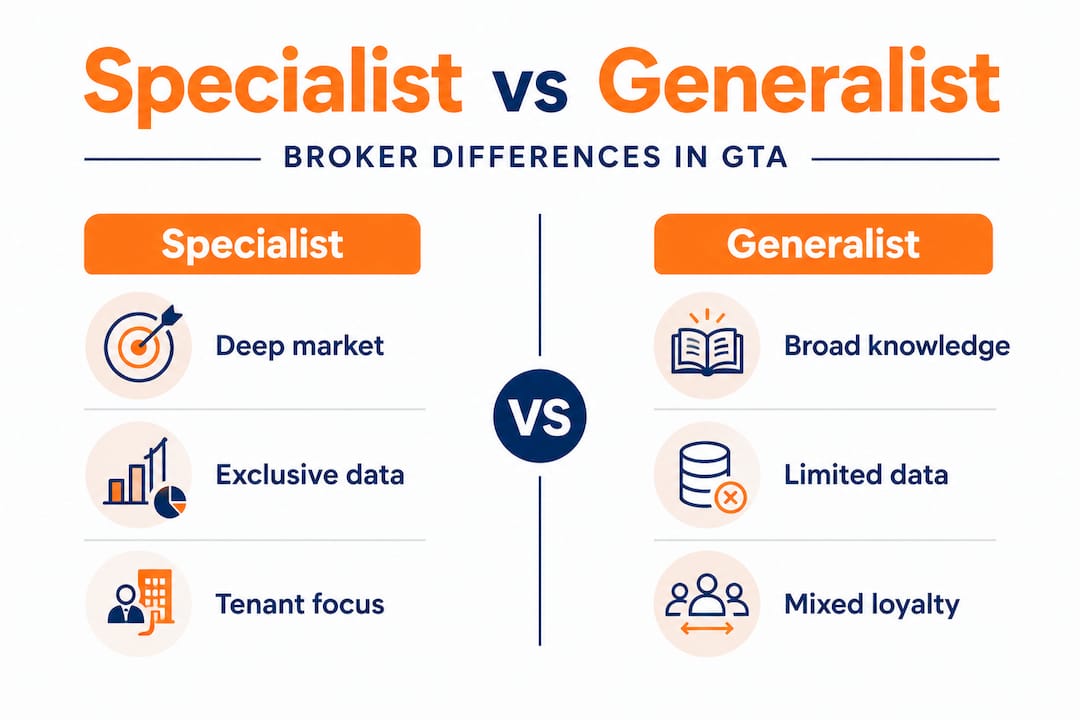
The tenant representation advantages of working with a broker whose business model centres on your outcomes, rather than the landlord's, are significant. Some brokers earn most of their income from landlord-side assignments. That reality affects whose interests they prioritise, even unconsciously, when presenting you with options or advising you on offer strategy.
Industrial broker benefits are most visible when you compare specific deal outcomes. A specialist will know, for example, that a particular landlord in Brampton consistently offers free rent periods in a slow leasing environment, or that a specific submarket is about to see new supply come online that will shift leverage toward tenants. A generalist simply doesn't carry that intelligence.
Red flags that suggest a broker may not be truly specialised include:
- They primarily market themselves as residential or retail brokers who "also do industrial"
- They cannot name current net rental rates by submarket without looking them up
- They have no clear process for uncovering off-market opportunities
- Their lease review process doesn't include industrial-specific clauses as a matter of course
- They represent both landlords and tenants on the same properties without clear disclosure
Pro Tip: Ask any prospective broker to walk you through their last three industrial transactions in detail, including the submarket, the square footage, the lease structure, and how they created value for their client. A specialist will answer with precision and enthusiasm. A generalist will give you vague generalities.
Some online discussion highlights landlord-biased advice as a real and common risk, reinforcing that not all brokerage models create the same incentive alignment for tenants seeking representation. This isn't a minor distinction. It's the difference between an advisor who fights for your lease terms and one who quietly guides you toward a deal that closes quickly because it serves the landlord's timeline.
Key advantages of engaging a specialised industrial broker
The practical benefits of working with a true specialist show up at every stage of the transaction, but they are most pronounced in negotiation, due diligence, and long-term risk management. Here is how specialist engagement directly affects your outcomes.
1. Favourable lease terms secured through comparable data Specialists carry proprietary transaction data that isn't available through public listing platforms. They know what tenants in similar buildings paid per square foot last quarter, what tenant improvement allowances were granted, and how long free rent periods lasted. That intelligence gives you real negotiation leverage rather than guesswork.

2. Access to off-market opportunities A significant share of GTA industrial transactions never appear on public listing databases. They move through broker networks, landlord relationships, and developer connections. A specialist embedded in those networks surfaces opportunities before they reach the broader market, giving clients first access to spaces that fit their operational profile.
3. Risk mitigation across zoning and compliance Industrial properties carry operational risks that don't exist in other asset classes. Power capacity limitations, truck court configurations that don't meet transport requirements, ceiling heights that restrict racking systems, and zoning conditions that prohibit certain industrial uses can all derail your operations. A specialist screens for these issues before you sign a lease, not after.
4. Negotiation tactics tailored to industrial deals Industrial lease negotiations involve provisions that are largely irrelevant in office deals: early access provisions for fit-out, hazardous material storage clauses, floor load specifications, HVAC responsibilities for process cooling, and assignment rights tied to corporate restructuring. A specialist negotiates these with precision. A generalist often leaves them as boilerplate.
5. Ongoing market monitoring as a strategic asset The GTA industrial market shifts. Vacancy rates move, new supply comes online, and rental benchmarks adjust. A specialist tracks these changes continuously and alerts you to renewal timing opportunities, sublease risks, and expansion options before they become urgent. That proactive posture prevents costly reactive decisions.
Consider the numbers that frame the stakes in this market:
| GTA submarket | Typical net rent range (2025) | Vacancy context |
|---|---|---|
| Brampton/Airport | $18 to $22 per sq ft | Persistently tight |
| Mississauga East | $17 to $21 per sq ft | Moderate competition |
| Vaughan | $16 to $20 per sq ft | New supply emerging |
| Markham | $15 to $19 per sq ft | Stable, strong demand |
| Milton | $14 to $18 per sq ft | New development active |
| Durham Region (Oshawa/Whitby) | $12 to $16 per sq ft | Growing logistics corridor |
These ranges matter because the right broker knows when and where you have room to negotiate and when the market gives landlords the upper hand. The benefits of an industrial real estate expert are most tangible when you frame them against the total cost of a five-year lease on a 50,000 square foot facility. Even a modest improvement in net rent or tenant improvement allowance generates hundreds of thousands of dollars in savings.
The way hiring an advisory expert boosts industrial strategy goes beyond cost savings. Strategic advisors help clients make location decisions that support their supply chain design, labour force access, transportation infrastructure requirements, and long-term growth plans.
How specialisation creates value at each deal stage
Understanding the abstract case for specialisation is useful, but seeing how it applies at each stage of a transaction is more actionable. Here is what a specialist does differently from the moment you begin your search to the moment you take possession and beyond.
Stage 1: Site search and market positioning
- The specialist maps your operational requirements against available and soon-to-be-available supply across relevant GTA submarkets.
- They leverage off-market intelligence to surface unlisted opportunities before competitors see them.
- They assess zoning compatibility and permitted uses specific to your industry, flagging regulatory risks before site visits.
- They benchmark asking rents against recent comparable transactions to establish your target range immediately.
The ability to navigate industrial subleasing concepts at this stage is particularly valuable. Subleases often offer below-market rates and short-term flexibility, but they carry risks around head lease conditions, landlord consent requirements, and assignment provisions that require specialised knowledge to evaluate properly.
Stage 2: Negotiation and offer strategy
- The specialist prepares a comparable transaction analysis to anchor your offer in market evidence rather than the landlord's asking price.
- They identify which concessions the landlord is likely to grant based on their submarket knowledge and landlord profile.
- They structure the offer to protect your interests on renewal options, demolition clauses, exclusivity rights, and early termination provisions.
- They ensure incentive alignment is clear: tenant-focused representation means your advisor is not quietly managing the landlord's expectations on your behalf.
Pro Tip: Always clarify your broker's representation model before signing an agency agreement. Ask directly whether they represent landlords in the same market and how they manage potential conflicts. The answer reveals whether their advice will be fully aligned with your interests throughout the negotiation.
Stage 3: Due diligence and closing
Industrial due diligence is operationally complex in ways that catch generalists off guard. Key areas where specialists add value include:
- Environmental assessments and historical site use reviews that affect your liability exposure
- Building systems verification to confirm electrical capacity, HVAC adequacy, and structural load ratings
- Municipal compliance checks for any outstanding work orders, non-conforming uses, or permit issues
- Lease abstract preparation to document all key obligations, options, and critical dates before execution
Tracking industrial property trends is also part of the due diligence process. A specialist assesses whether the submarket you're entering is appreciating or softening, and how that affects your flexibility if you need to sublease or exit early.
Stage 4: Ongoing value after possession
The relationship doesn't end at key handover. A specialist monitors lease expiry timelines, tracks market conditions relative to your renewal options, and identifies expansion opportunities as your business grows. They also watch for sublease risk signals if your space needs change before your lease expires.
The full picture of maximising GTA real estate value includes this post-transaction engagement. Clients who maintain an active advisory relationship typically make better decisions on renewals and relocations because they're acting on current intelligence rather than starting from scratch every five years.
The real story most clients miss about industrial specialists
Here is what most discussions about broker selection get wrong: they frame the decision as a cost-benefit calculation around fees. The real question isn't whether a specialist costs more. It's whether you can afford the compounded cost of getting it wrong in a market as unforgiving as the GTA.
Conventional wisdom suggests that any licensed commercial broker who handles industrial files occasionally can deliver adequate results. That view understates the true risk profile of industrial transactions dramatically. The issue isn't just price. It's the total risk landscape that a non-specialist fails to see clearly.
Consider what happens when a generalist misses a zoning restriction that limits your permitted use. You sign a five-year lease, begin your fit-out, and discover mid-way through construction that your intended operations aren't permitted under the local zoning bylaw. That isn't just an inconvenience. It's a potential business disruption that could take months to resolve through rezoning or variance applications, if it can be resolved at all.
Or consider the subtler problem of a broker whose primary income depends on landlord relationships in the submarkets where they work. They may present your options genuinely, but the framing, the urgency, and the advice around offer timing will be influenced by those relationships in ways that are nearly impossible to detect unless you know what to look for. The insight that all brokerage models don't create the same alignment isn't just an academic point. It's the mechanism by which tenants consistently leave value on the table without ever realising it.
In the GTA industrial market specifically, the stakes are amplified by the competitive intensity of the market itself. When you're competing against multiple tenants for the same 40,000 square foot space in Vaughan or Pickering, your broker's speed of access, depth of relationships, and negotiation precision are the variables that determine whether you secure the space or spend another six months searching. Generic broker advantages for GTA real estate simply don't exist. Every advantage in this market is earned through specialisation, local knowledge, and the right incentive structure.
The clients who get the best outcomes in GTA industrial real estate are not necessarily the ones with the biggest budgets. They are the ones who chose advisors whose entire professional identity is built around industrial transactions in this specific market, and who made that choice before they were already in the middle of a deal.
Unlock value with an expert GTA industrial broker
The education in this article reflects what we see on the ground every day across the GTA industrial market.

At Michael Law Real Estate, our entire practice is built around industrial brokerage across the GTA's most active corridors, from Markham industrial specialists in the north to Milton industrial real estate in the west. Whether you're a tenant seeking conflict-free representation, an investor evaluating acquisitions, or a property owner navigating a complex lease-up, we bring transactional depth, submarket intelligence, and genuine incentive alignment to every engagement. Explore current GTA industrial property listings or reach out directly for a consultation, portfolio review, or site selection analysis. Your next industrial move deserves more than a generalist's best guess.
Frequently asked questions
What is the biggest risk of not using a specialised industrial broker?
The most significant risk is ending up with a lease or deal that favours the landlord's interests rather than yours, due to misaligned broker incentives. Industrial tenant representation is most effective when the advisor's business model is built around tenant outcomes from the outset.
Does a specialised industrial broker cost more than a generalist?
Broker fees in the GTA are typically structured similarly regardless of specialisation level, but specialists consistently deliver better lease terms, stronger negotiation outcomes, and risk avoidance that far outweighs any marginal fee difference. The net savings on a typical five-year GTA industrial lease routinely exceed the cost of representation many times over.
How do I know if my broker is truly specialised?
Ask for a detailed account of their last five industrial transactions, including submarket, square footage, lease structure, and how they created measurable client value. A specialist answers with precision and market-specific detail, while a generalist tends toward vague responses. The distinction that not all brokerage models create the same alignment becomes obvious in how they describe their representation approach.
Is it worth engaging a specialist for smaller industrial spaces?
Absolutely. Specialisation helps surface off-market options that generalists never access, catches costly lease provisions that compound over a multi-year term, and gives even smaller tenants negotiating leverage grounded in real market data. The incentive alignment principle applies regardless of square footage: you want an advisor whose success is defined by your outcome, not the landlord's satisfaction.