

Cap rates for premium industrial properties in the Greater Toronto Area hover at 4 to 4.5%, and a single flawed lease assumption can swing a valuation by millions of dollars. Many property owners, tenants, and investors underestimate just how technically demanding GTA industrial deals have become. Finite land supply, shifting zoning policy, and increasingly sophisticated tenant scrutiny have raised the stakes considerably. Whether you are negotiating a new lease in Brampton, acquiring a logistics facility in Mississauga, or repositioning an asset in Durham Region, the right advisory support is not a luxury. It is the difference between a sound investment and a costly miscalculation.
Table of Contents
- Why advisory services matter in industrial real estate
- Core functions of advisory services: From lease analysis to appraisal
- Strategic insight: Navigating market cycles and institutional risk
- Tactical value: From underwriting to future-proofing your asset
- Find expert advisory support for your GTA industrial portfolio
- Frequently asked questions
Key Takeaways
| Point | Details |
|---|---|
| Advisor expertise delivers value | Professional advisory services help owners and investors avoid costly mistakes and maximise industrial property returns in the GTA. |
| Cap rates and market cycles matter | Understanding and timing market shifts safeguards against overpaying or missing upside in Toronto industrial real estate. |
| Future-proofing is essential | Modern specs, tenant scrutiny, and stress-tested underwriting are crucial for long-term industrial asset value. |
| Data-driven decisions win | Applying advanced valuation tools and local data gives you a competitive edge in leasing, acquisition, and portfolio growth. |
Why advisory services matter in industrial real estate
The GTA industrial market is one of the most competitive and nuanced in Canada. Policy changes, constrained land supply, and evolving tenant requirements create a landscape where even experienced investors can miss critical signals. Understanding key industrial trends in 2026 is essential before committing capital or signing a long-term lease.
Without specialised advisory support, the risks multiply quickly. Consider what can go wrong:
- Overpaying on acquisition because cap rate compression was not stress-tested against local supply pipelines
- Signing unfavourable leases with escalation clauses that erode margins over a 10-year term
- Missing obsolescence risk in buildings with inadequate clear heights or outdated loading configurations
- Ignoring policy friction such as employment land protections or intensification overlays that restrict future use
Advisors who understand industrial real estate expert advantages bring a structured lens to each of these risks. They validate lease income, model cap rate sensitivity, and flag deal-breakers before they become expensive problems. Investors must test for obsolescence, location premiums, and policy risks as a baseline, not an afterthought.
"The GTA industrial market rewards those who do the technical work upfront. Skipping advisory support is not saving money. It is deferring a much larger cost."
The broader commercial real estate sector reflects this reality. Market demand resilience in industrial assets has attracted significant institutional capital, which means private investors and tenants are now competing against more sophisticated counterparties than ever before. Advisory services level that playing field.
Core functions of advisory services: From lease analysis to appraisal
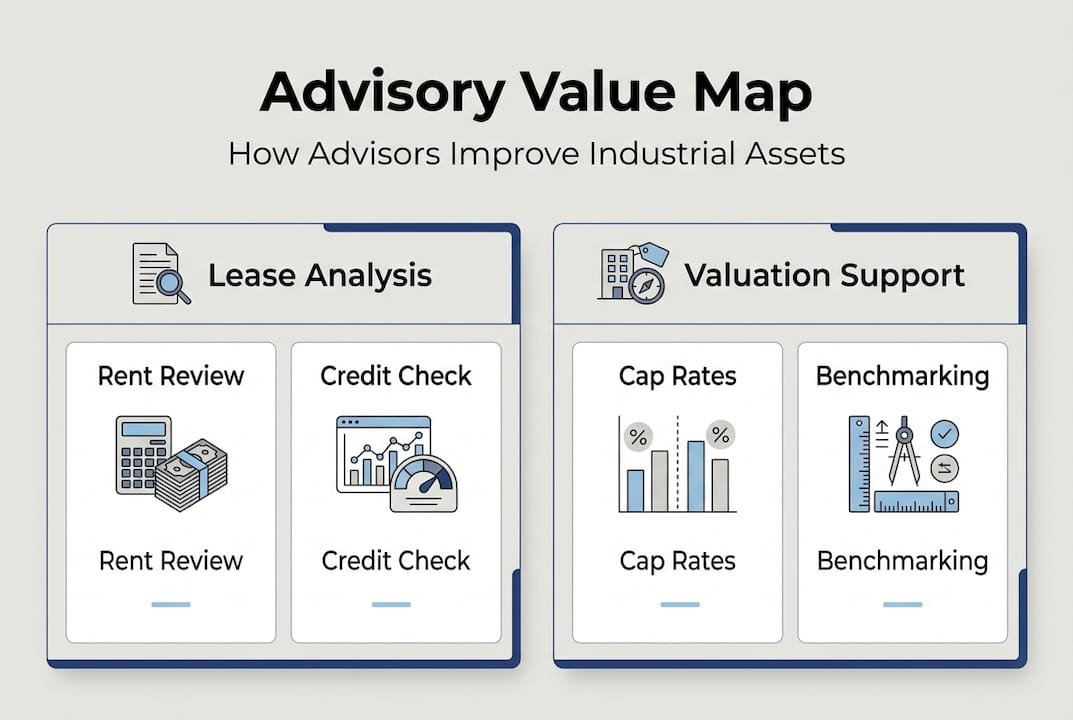
Advisory services in industrial real estate are far more than deal facilitation. They cover a spectrum of technical and strategic functions that directly affect your bottom line. Understanding the scope helps you engage the right expertise at the right stage of a transaction.
On the valuation side, advisors use three primary approaches:
- Income approach: Calculates value based on net operating income (NOI) divided by the prevailing cap rate. In the GTA, this requires precise knowledge of achievable market rents by submarket and building class.
- Sales comparison approach: Benchmarks the subject property against recent comparable transactions. In a market with limited industrial land, finding true comparables requires deep local data access.
- Cost approach: Estimates the value of land plus depreciated replacement cost of improvements. Particularly relevant for owner-user acquisitions and specialised facilities.
Advisory mechanics include benchmarking with cap rates, lease escalation modelling, and valuation triangulation across all three methods to arrive at a defensible, market-supported conclusion.
Lease structure analysis is equally critical. Advisors scrutinise escalation clauses, tenant credit quality, lease expiry profiles, and net versus gross lease structures. A lease with annual 3% fixed escalations looks very different from one tied to CPI in a high-inflation environment. These distinctions materially affect both occupancy costs for tenants and asset valuations for owners.

| Service area | Leasing advisory | Acquisition advisory | Valuation support |
|---|---|---|---|
| Market rent benchmarking | ✓ | ✓ | ✓ |
| Lease clause review | ✓ | ✓ | ✗ |
| Cap rate analysis | ✗ | ✓ | ✓ |
| Tenant covenant assessment | ✓ | ✓ | ✓ |
| Zoning and policy review | ✓ | ✓ | ✗ |
| NOI modelling | ✗ | ✓ | ✓ |
| Comparable transaction data | ✓ | ✓ | ✓ |
For investors navigating the investment sales guide or working through the property acquisition process, this table illustrates how advisory functions overlap and reinforce each other across transaction types.
Pro Tip: Always request a lease abstract summary from your advisor before any acquisition. A structured summary of rent, escalations, expiry dates, and tenant obligations can surface deal-altering issues in minutes rather than weeks.
Strategic insight: Navigating market cycles and institutional risk
Market cycles in GTA industrial real estate move faster than many investors expect. Cap rate compression during peak demand periods can make assets look attractively priced when they are actually overvalued relative to normalised income. Advisors who track cycle indicators help you avoid buying at the top and selling at the bottom.
Recent data underscores the importance of timing. GTA net industrial rents declined 6% year-over-year, while the supply pipeline remains strong. This combination signals a transitional market where buyers have more negotiating leverage than they have had in years. Knowing how to read that signal is what separates disciplined investors from reactive ones.
Here are the key market metrics that experienced advisory firms track continuously:
| Metric | Current GTA trend (2026) | Advisory implication |
|---|---|---|
| Net asking rents | Declining approx. 6% YoY | Tenant leverage improving |
| Cap rates (prime industrial) | 4.0 to 4.5% | Tight; stress-test acquisitions |
| Vacancy rate | Rising from historic lows | More options for tenants |
| New supply deliveries | Pipeline remains robust | Monitor submarket saturation |
| Built-to-suit activity | Steady for large users | Demand from logistics/e-commerce |
Advisors use this data to guide clients through four strategic decisions:
- Timing acquisitions to capture value when rents soften and sellers are more motivated
- Structuring leases to lock in favourable terms before the next demand cycle tightens supply again
- Assessing new supply risk in specific submarkets like Brampton or Oshawa where pipeline deliveries are concentrated
- Evaluating built-to-suit options for large logistics users who need certainty on specifications and location
Understanding the GTA investment sales overview and the range of types of industrial properties available across the region gives investors the context to act decisively rather than reactively.
"In a transitional market, the investors who win are not the ones with the most capital. They are the ones with the most current, localised intelligence."
Tactical value: From underwriting to future-proofing your asset
Strategy without execution is just planning. Here is how advisory services translate market intelligence into concrete actions that protect your investment and position your asset for the next cycle.
Underwriting a GTA industrial acquisition involves five core steps:
- Verify in-place rents against current market. Rents that appear strong today may be below market or, conversely, above sustainable levels. Both scenarios affect your exit valuation.
- Assess building specifications critically. Clear height, column spacing, truck court depth, and power supply directly affect the tenant pool you can attract and retain.
- Test tenant covenant strength. A lease is only as valuable as the tenant behind it. Review financial statements, industry exposure, and lease renewal probability.
- Model multiple cap rate scenarios. Run your NOI at 4.0%, 4.5%, and 5.0% cap rates to understand your valuation sensitivity before committing to a purchase price.
- Review zoning and permitted uses. Employment land designations in the GTA can restrict certain uses and affect redevelopment optionality. Know what you own before you buy it.
Advisors recommend stress-testing specs and tenant mixes for evolving market needs, particularly as e-commerce and last-mile logistics continue reshaping demand patterns across the GTA.
Future-proofing is the next layer. The industrial assets that hold value through multiple cycles share common characteristics: clear heights of 28 feet or more, modern dock-level loading, flexible zoning that accommodates a range of industrial uses, and proximity to major 400-series highways. Buildings that lack these features face a shrinking tenant pool and accelerating obsolescence.
If you are acquiring an asset to acquire industrial assets for long-term hold, also consider ESG in industrial real estate. Environmental and energy performance criteria are increasingly influencing institutional tenant decisions and lender requirements.
Pro Tip: Do not underestimate policy friction or tenant volatility. Small shifts in either can move cap rates by up to 5%, which on a $10 million asset translates to a $500,000 swing in value. Advisory support that monitors these variables continuously is not overhead. It is risk management.
Find expert advisory support for your GTA industrial portfolio
The GTA industrial market rewards precision. Whether you are a tenant negotiating a renewal in Vaughan, an investor evaluating a logistics facility in Milton, or a developer assessing land in Hamilton, the quality of your advisory support directly shapes your outcome.
Michael Law Real Estate provides institutional-grade advisory services across every major GTA industrial submarket, from Toronto's inner suburbs to the outer nodes of Durham Region and Hamilton. Our team brings deep transactional experience, proprietary market data, and a specialised focus on the industrial asset class to every mandate. You can view industrial property listings across the GTA or learn more about Michael Law's advisory services to understand how we support leasing, acquisitions, and investment decisions. If you are ready to act with confidence in a market that rewards preparation, we are ready to help.
Frequently asked questions
What is the biggest risk of navigating GTA industrial real estate without an advisor?
Compressed cap rates can create overpay risk when investors rely on surface-level analysis rather than stress-tested underwriting. Missing local supply and demand signals compounds that risk significantly.
How do advisory services determine the value of industrial property?
NOI stabilisation and cap rate application are the primary valuation tools, combined with lease structure analysis and benchmarking against recent comparable GTA transactions.
Do market cycles really impact industrial real estate values in the GTA?
Yes. Leasing slowed slightly in 2025, rents down 6% YoY, and advisors use these cycle signals to time acquisitions and structure leases more favourably for clients.
What future-proofing features are most important for GTA industrial assets?
Future-proofing specs amid finite land means prioritising clear heights above 28 feet, modern loading dock configurations, flexible zoning, and strong highway access to maintain long-term tenant demand.