

Corporate tenants in Toronto's industrial real estate market often misunderstand what tenant representation truly involves, confusing it with landlord brokerage or general consulting. This confusion can lead to missed opportunities for favourable lease terms and strategic site selection. Tenant representation is a specialized service where brokers advocate exclusively for tenant interests throughout the leasing process. Understanding this role is critical for corporate decision-makers seeking to optimise their industrial space decisions in the Greater Toronto Area. This guide clarifies what tenant representation entails, how it benefits your organisation, and how to select the right representative for your leasing needs.
Table of Contents
- Key takeaways
- Understanding tenant representation in industrial real estate
- How tenant reps add value to corporate industrial tenants in Toronto
- The tenant representation process: from site selection to lease signing
- Choosing the right tenant representative in the Greater Toronto Area
- Explore expert tenant representation services with Michael Law
- Frequently asked questions about tenant representation
Key Takeaways
| Point | Details |
|---|---|
| Exclusive tenant advocacy | Tenant representation is a specialized service that advocates solely for tenant interests throughout the leasing process, reducing conflicts of interest with landlord representation. |
| Market insights and site selection | Tenant reps conduct market research to identify suitable properties and advise on site selection factors such as transportation access, labour availability, and zoning compliance. |
| Strategic lease negotiations | They negotiate rental rates, tenant improvement allowances, and termination clauses to protect tenant interests. |
| Due diligence and documents | They coordinate inspections and review lease documents to reduce risk and unexpected costs. |
| Formal exclusivity agreements | Always ensure your tenant representative is engaged through a formal representation agreement to prevent conflicts of interest. |
Understanding tenant representation in industrial real estate
Tenant representation involves advocating exclusively for tenant interests in commercial real estate transactions. Unlike landlord brokers who represent property owners, tenant representatives work solely on behalf of companies seeking industrial space. This distinction matters because it eliminates conflicts of interest that can arise when brokers represent both parties.
Tenant reps handle multiple critical responsibilities throughout the leasing journey. They conduct comprehensive market research to identify suitable properties that match your operational requirements. They negotiate lease terms including rental rates, tenant improvement allowances, and termination clauses. They advise on site selection factors such as transportation access, labour availability, and zoning compliance. They also coordinate due diligence activities including property inspections and lease document reviews.
In Toronto's industrial real estate market, tenant representatives become particularly valuable due to the region's complex market dynamics. The GTA features diverse industrial submarkets with varying vacancy rates, rental pricing structures, and development pipelines. Properties range from older manufacturing facilities in established areas to modern logistics centres in emerging corridors. Navigating these options without expert guidance often results in suboptimal decisions.
Tenant reps also understand the legal framework governing commercial leases in Ontario. They recognise standard lease clauses that favour landlords and negotiate modifications that protect tenant interests. They identify hidden costs such as operating expense escalations, property tax passthroughs, and maintenance obligations that can significantly impact total occupancy costs.
Pro Tip: Always ensure your tenant representative is exclusively representing tenant interests through a formal representation agreement. This contractual clarity prevents situations where brokers might prioritise landlord relationships over your negotiating position.
The value of tenant representation extends beyond transaction completion. Quality tenant reps maintain ongoing relationships with clients, providing market intelligence updates and assisting with lease renewals or expansions. They become strategic partners who understand your business operations and growth trajectory, enabling proactive real estate planning rather than reactive space searches.
How tenant reps add value to corporate industrial tenants in Toronto
Tenant representatives provide market insights and strategic advice tailored to industrial properties in Greater Toronto, delivering tangible benefits that directly impact your bottom line. Cost savings represent the most immediate value proposition. Experienced tenant reps negotiate rental rates below asking prices by leveraging market knowledge and comparable lease data. They secure tenant improvement allowances that reduce your upfront capital requirements for space customisation. They identify properties with favourable operating cost structures, avoiding buildings with excessive common area maintenance charges or inefficient utility systems.
Market expertise constitutes another critical advantage. Tenant reps monitor vacancy rates across GTA industrial submarkets, identifying areas where landlord competition creates negotiating leverage for tenants. They track new development pipelines that might affect future supply dynamics in your target areas. They understand transportation infrastructure projects that could enhance or diminish property accessibility. This intelligence enables strategic timing of lease negotiations and site selection decisions.

Risk mitigation through thorough lease analysis protects your organisation from costly surprises. Tenant reps review lease documents to identify problematic clauses such as unrestricted rent escalations, broad landlord indemnification provisions, or restrictive use limitations. They negotiate caps on operating expense increases and property tax passthroughs. They ensure lease termination rights align with your business flexibility needs. Understanding landlord tenant affidavit requirements helps navigate legal documentation processes.
| Aspect | With tenant rep | Self-representation |
|---|---|---|
| Market knowledge | Comprehensive data on rates, vacancy, terms | Limited to publicly available information |
| Negotiating leverage | Professional expertise and landlord relationships | Minimal leverage without market context |
| Lease term analysis | Detailed review identifying risks and opportunities | Surface-level understanding of standard clauses |
| Time investment | Minimal tenant involvement in property search | Significant time diverted from core business |
| Cost outcomes | Optimised rental rates and favourable terms | Likely paying above-market rates |
Tenant reps also provide strategic guidance on property selection criteria beyond basic square footage requirements. They evaluate ceiling heights for racking systems, column spacing for operational efficiency, loading dock configurations for logistics operations, and power capacity for manufacturing equipment. They assess site characteristics such as truck turning radii, employee parking adequacy, and expansion land availability.
Pro Tip: Leverage your tenant rep's understanding of landlord behaviours and negotiating patterns. Experienced reps know which landlords respond to competitive pressure, which prioritise long-term tenant relationships, and which offer flexibility on specific lease terms. This intelligence shapes effective negotiating strategies.
The value extends to transaction efficiency. Tenant reps manage the entire leasing timeline, coordinating property tours, facilitating landlord communications, and tracking document exchanges. They prevent deals from stalling due to miscommunication or missed deadlines. They also maintain relationships with complementary service providers such as real estate lawyers, architects, and construction managers, streamlining the tenant improvement process.
The tenant representation process: from site selection to lease signing
The tenant representation journey follows a structured methodology that transforms your space requirements into a signed lease for optimal industrial premises. Understanding each phase helps you prepare appropriate inputs and set realistic timeline expectations.
-
Needs analysis and defining criteria: Your tenant rep conducts detailed discussions to understand your operational requirements, growth projections, budget parameters, and location preferences. This phase establishes search criteria including square footage range, ceiling height minimums, loading dock quantities, office space ratios, and geographic boundaries. Clear criteria prevent wasting time on unsuitable properties.
-
Market research and property shortlist: The tenant rep surveys available industrial properties matching your criteria across relevant GTA submarkets. They analyse asking rental rates, landlord reputations, building conditions, and lease term flexibility. They compile a shortlist of properties offering the best combination of operational fit, financial terms, and strategic location. This research leverages proprietary databases and broker networks unavailable to tenants.
-
Site visits and evaluation: Your team tours shortlisted properties with the tenant rep providing expert commentary on each facility's strengths and limitations. The rep highlights operational considerations such as truck access patterns, employee amenities, and expansion possibilities. They also explain tenant metering benefits for properties with individual utility tracking, which can reduce operating costs significantly. This phase narrows options to top candidates.
-
Lease term negotiation and finalisation: The tenant rep submits offers on preferred properties, negotiating rental rates, lease duration, tenant improvement allowances, rent-free periods, and lease clauses. They manage counteroffers and facilitate landlord communications to reach mutually acceptable terms. They coordinate lease document preparation with legal counsel, ensuring negotiated terms are accurately reflected in final agreements.
-
Lease signing and tenant onboarding support: Once lease documents are finalised and approved by your legal team, the tenant rep coordinates the signing process. They assist with transition planning including tenant improvement coordination, move logistics, and landlord relationship establishment. Many tenant reps maintain post-occupancy contact to address any issues during the initial occupancy period.
| Phase | Typical timeline | Tenant responsibilities | Rep responsibilities |
|---|---|---|---|
| Needs analysis | 1-2 weeks | Provide detailed requirements and constraints | Document criteria and establish search parameters |
| Market research | 2-3 weeks | Review shortlist and provide feedback | Identify and analyse suitable properties |
| Site visits | 2-4 weeks | Tour properties and evaluate operational fit | Coordinate tours and provide expert assessment |
| Negotiation | 3-6 weeks | Approve offers and review terms | Submit offers and negotiate favourable terms |
| Lease signing | 2-4 weeks | Legal review and final approval | Coordinate documentation and closing process |
This structured approach typically requires three to four months from initial engagement to lease execution, though timelines vary based on market conditions and tenant decisiveness. Urgent requirements can compress timelines, while complex site selection criteria or extensive tenant improvements may extend the process.
Choosing the right tenant representative in the Greater Toronto Area
Selecting a qualified tenant representative significantly influences your leasing outcomes, making evaluation criteria critical for corporate decision-makers. Several key factors distinguish exceptional tenant reps from mediocre practitioners.
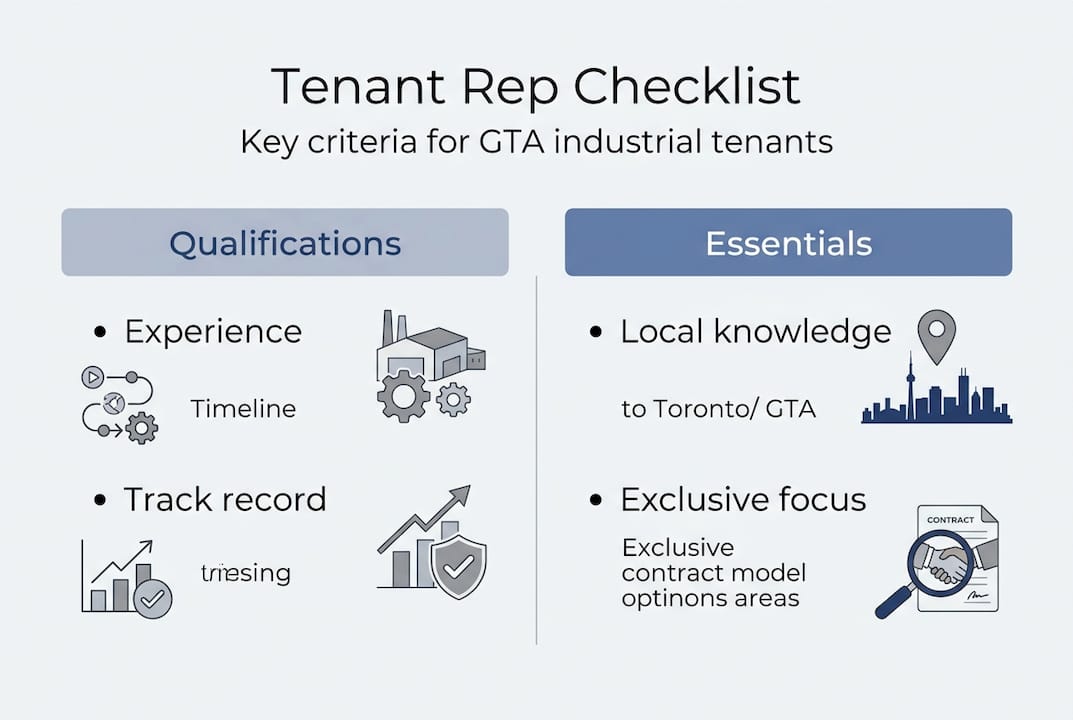
Experience and track record: Prioritise tenant reps with substantial experience in Toronto industrial real estate transactions. Experienced tenant reps with local market knowledge understand nuances that generic commercial brokers miss. Request examples of recent tenant representation assignments including property types, lease sizes, and negotiated terms. Ask for client references who can verify the rep's performance, responsiveness, and negotiating effectiveness.
Local market expertise: The GTA industrial market encompasses diverse submarkets from Mississauga logistics hubs to Vaughan manufacturing corridors to eastern GTA distribution centres. Your tenant rep should demonstrate intimate knowledge of your target areas including current vacancy rates, recent lease transactions, development pipelines, and infrastructure projects affecting property values. They should maintain active relationships with landlords and property managers in relevant submarkets.
Exclusive tenant representation: Verify that your prospective tenant rep operates under an exclusive tenant representation model rather than representing both tenants and landlords. Dual representation creates inherent conflicts of interest where brokers might prioritise landlord relationships or commission structures over tenant outcomes. Request confirmation that the rep will not represent the landlord in your transaction.
Professional credentials and affiliations: Look for tenant reps holding relevant professional designations and memberships in industry organisations. These credentials indicate commitment to ongoing education and adherence to professional standards. Verify licensing status with appropriate regulatory bodies to ensure compliance with Ontario real estate regulations.
Communication and responsiveness: Effective tenant representation requires frequent communication throughout the leasing process. Evaluate prospective reps on their responsiveness to initial inquiries, clarity of explanations, and willingness to address your questions. Establish expectations for communication frequency and preferred channels during the engagement.
- Verify the rep's exclusive focus on tenant representation to avoid conflicts
- Confirm experience with industrial properties similar to your requirements
- Review recent transaction examples and client testimonials
- Assess local market knowledge through specific submarket discussions
- Evaluate communication style and responsiveness during initial interactions
- Understand the representation agreement terms including duration and exclusivity
- Clarify fee structures and payment responsibilities
Pro Tip: Avoid tenant reps who also represent landlords in your target market. Even if they claim to maintain separate client interests, the reality of ongoing landlord relationships creates subtle pressures that can compromise your negotiating position. Exclusive tenant representation eliminates this concern entirely.
Understanding tenant rights in commercial leasing contexts helps you evaluate whether prospective tenant reps demonstrate appropriate advocacy for tenant interests. Quality reps proactively explain your rights and negotiate lease terms that protect those rights throughout the tenancy.
The representation agreement itself deserves careful review. Understand the agreement's duration, geographic scope, and termination provisions. Clarify whether the agreement grants exclusive representation rights or allows you to work with multiple reps simultaneously. Discuss compensation structures to understand how the rep gets paid and whether any fees might be passed to you.
Finally, assess cultural fit between your organisation and the tenant rep. You will work closely with this professional throughout the leasing process and potentially across multiple transactions over years. Choose someone whose communication style, work ethic, and business values align with your corporate culture.
Explore expert tenant representation services with Michael Law
Navigating Toronto's industrial real estate market requires specialised expertise that transforms complex leasing decisions into strategic advantages for your organisation. Michael Law brings extensive experience in commercial real estate services focused exclusively on the Greater Toronto Area's industrial sector. His tenant representation approach combines comprehensive market intelligence with proven negotiating strategies that deliver measurable value for corporate clients.

Whether you are seeking new industrial space, evaluating lease renewal options, or planning facility expansions, professional tenant representation ensures you make informed decisions backed by current market data and strategic insights. Explore available industrial property listings to understand current market opportunities, or connect with Michael Law directly to discuss how specialised tenant representation can support your organisation's real estate objectives in the GTA industrial market.
Frequently asked questions about tenant representation
What exactly is tenant representation in commercial real estate?
Tenant representation is a specialised brokerage service where real estate professionals advocate exclusively for companies seeking to lease commercial space. Unlike landlord brokers who represent property owners, tenant reps work solely on behalf of tenants to identify suitable properties, negotiate favourable lease terms, and protect tenant interests throughout the transaction process.
How do tenant representatives differ from landlord brokers?
Tenant representatives work exclusively for tenants and owe fiduciary duties to tenant clients, while landlord brokers represent property owners and prioritise landlord interests. This distinction eliminates conflicts of interest and ensures your representative focuses entirely on achieving the best possible outcomes for your organisation rather than balancing competing interests.
What role do tenant reps play in lease negotiations?
Tenant reps leverage market knowledge and negotiating expertise to secure favourable rental rates, tenant improvement allowances, flexible lease terms, and protective clauses. They analyse comparable lease transactions to establish appropriate pricing benchmarks, identify problematic lease provisions that require modification, and manage the negotiation process to achieve optimal terms while maintaining positive landlord relationships.
Who pays for tenant representation services?
In most commercial real estate transactions, landlords pay tenant representative commissions as part of standard brokerage practices. This means tenants typically receive professional representation at no direct cost, as landlord commission structures already account for both landlord and tenant broker compensation. Confirm fee arrangements with your tenant rep during initial discussions.
When should corporate tenants engage a tenant representative?
Engage a tenant representative as early as possible in your space planning process, ideally six to twelve months before your current lease expires or when you first identify space needs. Early engagement allows adequate time for comprehensive market research, property evaluation, and lease negotiation without time pressure that might compromise outcomes. Even exploratory discussions benefit from professional market insights.
How do tenant reps help with industrial property site selection?
Tenant reps evaluate industrial properties against your operational requirements including ceiling heights, loading dock configurations, power capacity, truck access, employee parking, and expansion potential. They assess location factors such as labour availability, transportation infrastructure, supplier proximity, and customer access. This comprehensive evaluation ensures selected properties support your operational efficiency and strategic objectives.