
TL;DR:
- Industrial rents in GTA have increased, making space optimization critical for operators and investors.
- Effective space use involves measuring cube utilization, maximizing density, and using digital twin simulations.
- Balancing operational flexibility with high utilization rates is essential to avoid inflexibility and maximize throughput.
Industrial rents across the Greater Toronto Area have climbed relentlessly, and vacancy rates have tightened to the point where finding even modestly sized warehouse space feels like a competitive sport. For logistics operators, manufacturers, and investors working within fixed square footages, the pressure to extract every usable metre from existing facilities has never been greater. This article delivers a structured, evidence-backed set of space optimisation strategies built specifically for GTA industrial users, from foundational metrics and racking upgrades to digital twins and slotting technology, so you can make smarter decisions without waiting for a new lease.
Table of Contents
- Understand space utilisation metrics: The foundation
- Maximise density with modern racking and automation
- Enhance picking and slotting for operational efficiency
- Leverage digital twins and simulation for layout validation
- Situational recommendations: Finding your fit
- What most GTA owners miss about space optimisation
- Get expert support for your GTA industrial space
- Frequently asked questions
Key Takeaways
| Point | Details |
|---|---|
| Benchmark your space | Measure cube utilisation and capacity to see how your facility compares to best-in-class metrics. |
| Upgrade with automation | Switching to automated racking can double throughput and dramatically boost space efficiency. |
| Optimise picking and slotting | Advanced slotting and cross-docking technologies expand pick positions and cut storage needs. |
| Validate with digital tools | Digital twins and AR simulations ensure layout accuracy and help prevent costly mistakes. |
| Adapt tactics for your needs | Use situational guidance to match optimisation strategies with your facility's constraints and goals. |
Understand space utilisation metrics: The foundation
Before you redesign a single racking bay or invest in automation, you need a clear vocabulary for measuring what you already have. Space optimisation without measurement is just rearranging furniture. Defining the right metrics upfront sets a measurable baseline and reveals exactly where your facility is bleeding capacity.
The most important concept here is cube utilisation, which measures how effectively a facility uses its full three-dimensional volume, not just its floor area. Many operators focus almost exclusively on square footage, ignoring the vertical space above their heads. A 50,000-square-foot facility with 30-foot clear heights has substantially more theoretical capacity than the floor plan suggests, but that capacity is only accessible with the right racking, equipment, and layout strategy.
Standard metrics worth tracking include:
- Cube utilisation rate: The percentage of total cubic volume actively occupied by inventory
- Aisle-to-storage ratio: The proportion of floor space dedicated to travel versus actual storage
- Pallet positions per square foot: A density measure that helps compare facilities of different sizes
- Dock-to-stock time: How quickly inbound product moves from receiving to a storage position
- Picking accuracy rate: The percentage of orders fulfilled without error, a key throughput indicator
The gap between typical and best-in-class performance is striking. Traditional pallet racking achieves only 22 to 27% space utilisation due to required aisle widths, flue space, racking structure volume, and pallet inefficiency running at roughly 70 to 75% cube. Automated Storage and Retrieval Systems (AS/RS) push that figure to 60 to 80%, largely by eliminating human-travel aisles. According to WERC 2025 DC Measures, best-in-class operations achieve average warehouse capacity utilisation at or above 90%, alongside top results for on-time shipments, picking accuracy, and dock-to-stock time.
Important distinction: Hitting 90% utilisation is not automatically desirable. Operating at the ceiling of your cube capacity leaves almost no buffer for seasonal peaks, inbound surges, or returns processing. The true goal is to understand your operational range and design for flexibility within a sustainable utilisation band, typically 75 to 85% for most GTA logistics and manufacturing users.
Tracking these metrics in efficient GTA industrial spaces will give you a defensible benchmark before any capital expenditure is approved. And if you want to understand where industrial property trends in 2026 are heading, those targets are shifting upward as land scarcity pushes more tenants to maximise the assets they have.
Maximise density with modern racking and automation
With metrics understood, it is time to compare the main solutions for optimising industrial spaces: traditional versus modern automated racking. This is where the real capital decisions live, and the right choice depends heavily on your throughput needs, product mix, lease term, and budget.
Traditional pallet racking remains the most common solution in GTA warehouses, and for good reason. It is relatively inexpensive to install, easy to reconfigure, and compatible with standard forklift equipment. Selective racking gives direct access to every pallet, which suits operations with diverse SKU counts or irregular replenishment cycles. The limitation is that 22 to 27% utilisation rate. Every aisle you need for forklift travel is space that holds no inventory.
Drive-in and push-back racking improve density significantly by reducing aisle count, but they introduce stock rotation challenges and require more disciplined inventory management. Double-deep racking splits the difference, roughly doubling storage depth behind each aisle position but requiring a double-reach truck and accepting limited direct access to every pallet.
Automated solutions operate on an entirely different logic. AS/RS and AMR technologies are essential tools for constrained spaces, and their return on investment is realised primarily through throughput gains rather than storage alone. The capital expenditure is higher, but so is the ceiling on performance.
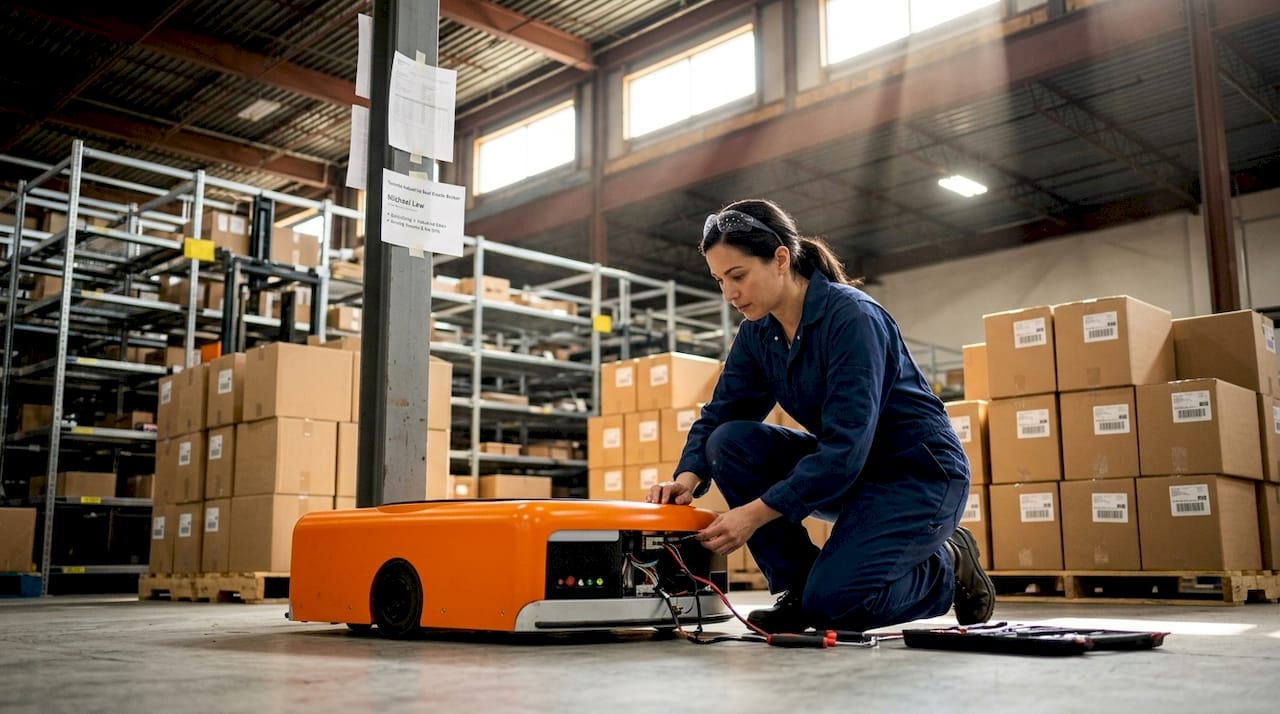
The numbers from real deployments are compelling. AutoStore cases show that Pietsch doubled throughput in 50% less space using 61,500 bins, while Rhenus achieved 13,100 bins per hour within just 8,000 square metres. These are not theoretical results; they are operational outcomes in live distribution environments.
| Racking type | Space utilisation | Capital cost | Flexibility | Best for |
|---|---|---|---|---|
| Selective pallet racking | 22 to 27% | Low | High | Mixed SKUs, short leases |
| Drive-in / push-back | 35 to 45% | Moderate | Medium | High-volume, low-SKU |
| Double-deep racking | 30 to 40% | Moderate | Medium | Pallet-in pallet-out flows |
| AS/RS (unit load) | 60 to 80% | High | Low | High-throughput, e-commerce |
| AutoStore grid | 70 to 80% | Very high | Medium | Dense small-item storage |
Key considerations before committing to automation:
- Minimum lease term: Automation infrastructure requires a long enough lease horizon, typically seven to ten years, to justify the capex
- Ceiling clearance: Many GTA facilities built before 2010 have clear heights under 28 feet, which limits certain AS/RS configurations
- Fire suppression: In-rack sprinklers and fire code compliance become more complex with high-density automated systems
- Scalability: Some systems like AutoStore are modular and can be expanded incrementally, which reduces initial risk
Pro Tip: When assessing ROI on automation, do not model storage gains alone. Model the labour cost reduction, the reduction in pick errors, and the throughput increase in units per hour. In GTA labour markets, where warehouse wages have risen sharply, the labour savings case is often stronger than the real estate case.
Reviewing industrial property upgrades that GTA owners have undertaken reveals a consistent pattern: the facilities that maximise GTA property returns are the ones where operational upgrades and lease strategy are aligned from the outset.
Enhance picking and slotting for operational efficiency
Once racking solutions are optimised, operational efficiency comes into play with picking, slotting, and strategic use of technology. Many GTA operators overlook this layer entirely, assuming that racking density is the whole answer. In practice, how you assign products to storage locations can be just as impactful as the racking type itself.
Slotting analysis is the systematic process of assigning each SKU to the storage location that minimises travel time and maximises picking density. This sounds straightforward, but most warehouses accumulate slotting decisions over years of reactive choices, and the result is usually a layout that feels logical to no one. A proper slotting study examines velocity (how often each SKU is picked), cube size, pick frequency, and seasonal variation, then reassigns locations accordingly.
The results are substantial. Slotting analysis expands pick positions by 400% and slot capacity by 140%, while supporting technology choices like low-level order pickers and double-deep reach trucks that further increase density. Cross-docking, where inbound product moves directly to outbound docks without entering storage, can reduce your storage footprint requirements meaningfully for high-velocity items.
Here is a practical sequence for implementing a slotting improvement programme:
- Export 90 days of pick data from your warehouse management system and classify every SKU by weekly pick frequency
- Segment your SKUs into A (top 20% by velocity), B (next 30%), and C (remaining 50%) tiers
- Map your current slot assignments and calculate average travel distance per pick for each tier
- Reassign A-tier SKUs to the golden zone, the area between knee and shoulder height in the primary pick aisle, to eliminate bending and climbing
- Evaluate technology fit by SKU type, including whether voice-directed picking, pick-to-light, or mobile scanning reduces errors and improves throughput in dense zones
- Model cross-docking eligibility for fast-turning items that could bypass racking entirely
| Picking method | Space impact | Error rate | Labour intensity | Best application |
|---|---|---|---|---|
| Manual selective | Neutral | Moderate | High | Low volume, mixed SKUs |
| Pick-to-light | High density | Low | Medium | High-velocity zones |
| Voice-directed | Neutral | Low | Medium | Cold storage, hands-free |
| Goods-to-person (AS/RS) | Very high density | Very low | Low | E-commerce fulfilment |
| Cross-docking | Space reduction | Low | Medium | High-turn, predictable flow |
Pro Tip: When choosing picking technology for a dense environment, prioritise systems that reduce forward pick locations rather than those that simply speed up the pick itself. Fewer forward pick locations means fewer aisles, which means more storage. Density is built into the design, not the device.
Reviewing a GTA tenant fit-out guide before committing to a layout redesign helps you align slotting decisions with your lease obligations. Understanding the types of industrial properties in Toronto also matters here, because clear heights, column spacing, and dock configurations vary significantly across property vintages and submarkets.
Leverage digital twins and simulation for layout validation
With hands-on operational tactics covered, digital technologies offer the next edge for industrial space optimisation. The risk with any major racking or automation investment is that you commit capital to a layout that looks good on paper but creates unexpected bottlenecks in practice. Digital twins eliminate much of that risk.
A digital twin is a dynamic, real-time virtual model of your physical facility. Unlike a static CAD drawing or a floor plan rendered in AutoCAD, a digital twin replicates actual operational flows, including the movement of forklifts, the timing of pick cycles, inbound and outbound dock scheduling, and inventory replenishment logic. You can run thousands of simulated scenarios in hours, a process that would take months to evaluate physically.
Augmented reality (AR) simulation takes this a step further by overlaying proposed layout changes onto live footage of your actual facility, letting your operations team walk through a new design before a single rack is moved. The accuracy of these tools is not theoretical.
Key benefits of digital twins and simulation in GTA industrial operations include:
- Bottleneck identification before capital is spent: Simulation reveals where forklifts will queue, where dock-door throughput will constrain inbound flows, and where aisle widths create conflict between picking and replenishment routes
- OEE improvement modelling: Overall Equipment Effectiveness (OEE) is the composite measure of availability, performance, and quality for manufacturing assets. Hybrid organisational models supported by digital tools have boosted OEE from 68% to 88%, a transformative gain for any production environment
- Layout validation for regulatory compliance: Simulations can model emergency egress, fire suppression coverage, and rack load distribution before construction begins
- Reduced commissioning time: When a layout is validated digitally first, physical installation proceeds faster and with fewer costly corrections
GTA-specific examples illustrate the real-world application well. Maple Leaf Foods achieved greater than 99% operational accuracy by implementing AR and digital twin technology in their manufacturing facilities. Northern Transformer used simulation to validate complex layout reconfigurations before committing to physical changes, avoiding costly mid-project adjustments. These are not Silicon Valley case studies; they are Ontario-based operations demonstrating that this technology is accessible and practical for GTA users today.
"Digital twins represent a shift from reactive troubleshooting to proactive design. For GTA operators working in constrained spaces, the ability to stress-test a layout virtually before signing off on a capex plan is not a luxury. It is risk management."
Connecting with real estate advisors who understand operational context is valuable at this stage, because the physical characteristics of a property, clear heights, column grids, dock positions, determine which digital twin models are actually feasible to implement.
Situational recommendations: Finding your fit
After learning about individual tactics, GTA tenants, owners, and investors must choose the right mix for their unique operational and financial situation. Not every strategy suits every facility or business model, and applying the wrong solution is costly in both capital and operational disruption.
High utilisation rates near 90% risk operational inflexibility, making it difficult to absorb seasonal surges, returns volumes, or rapid SKU expansion. The trade-offs between traditional and automated approaches in capex and labour are not one-size-fits-all, and GTA market conditions add another layer of complexity, particularly for tenants on shorter lease terms who need solutions that can move with them.
Common pitfalls to avoid in GTA industrial space optimisation:
- Over-automating in a facility you do not own: Significant AS/RS investment in a leased property without adequate lease term or removal rights creates stranded assets
- Chasing maximum density without modelling throughput: A facility that stores more but ships less efficiently loses money on both ends
- Ignoring column spacing: Many older GTA buildings have column grids that restrict standard racking configurations. Measure before you plan
- Neglecting dock capacity: Increasing storage density without increasing dock throughput creates inbound and outbound bottlenecks that negate the gains
- Skipping the baseline measurement step: Optimising without a measured baseline means you cannot confirm whether your investment worked
| Scenario | Recommended tactics | Caution |
|---|---|---|
| Short lease (under 3 years), moderate volume | Slotting analysis, selective racking, cross-docking | Avoid heavy automation capex |
| Long lease (7+ years), e-commerce fulfilment | AS/RS or AutoStore, digital twin validation, pick-to-light | Model throughput, not just density |
| Owner-user, manufacturing | Digital twin, OEE modelling, hybrid racking | Align capex with production cycles |
| Investor or landlord improving asset value | Dock upgrades, clear height improvements, sprinkler upgrades | Tenant compatibility matters |
| High-velocity 3PL operation | Cross-docking, AMRs, slotting optimisation | Labour model must support new tech |
Exploring why Toronto industrial real estate continues to attract capital even amid higher rents reinforces the point that well-optimised facilities command better lease terms, attract stronger tenants, and hold value more effectively through market cycles.
What most GTA owners miss about space optimisation
Most discussions about industrial space optimisation in the GTA circle the same ideas: add racking, go vertical, consider automation, reduce aisle widths. These are useful tactics. But there is a pattern of misunderstanding that costs operators and investors far more than the square footage they are trying to reclaim.
The first misunderstanding is treating utilisation as the ultimate goal. Pushing a facility to 90% capacity is not inherently good. At that level, there is almost no operational room to absorb variability. A single large inbound shipment, a spike in returns, or a promotion-driven demand surge can overwhelm the system. High utilisation risks inflexibility, and the traditional versus automated trade-offs in capex and labour must be evaluated against this reality, not against an idealised utilisation ceiling.
The second misunderstanding is conflating storage capacity with operational throughput. A warehouse that holds 20% more pallets but processes them 10% slower is not a win. Automation ROI is realised through throughput gains, not storage alone, and this distinction is critical when making the case to ownership or finance teams. The right question is not "how many more pallets can we fit?" It is "how many more orders can we ship per hour?"
The third misunderstanding is undervaluing adaptability. The GTA industrial market in 2026 is characterised by rapid shifts in tenant demand, evolving e-commerce fulfilment models, and ongoing uncertainty in supply chains. A facility that is brilliantly optimised for today's product mix but impossible to reconfigure in 18 months is a liability. The most durable optimisation strategy builds in deliberate flexibility, through modular racking, scalable automation, and layouts that can absorb change without a full redesign.
Our view is that the GTA operators who will outperform over the next five years are not the ones who chase the highest utilisation rate. They are the ones who build the most throughput-dense, adaptable, and measurably effective operations within their real estate footprint. That requires connecting space strategy with operational strategy, which is precisely why working with experienced GTA industrial real estate experts who understand both dimensions produces better outcomes than treating them separately.
Get expert support for your GTA industrial space
The strategies covered in this article, from cube utilisation benchmarking to digital twin validation, are most effective when they are matched to the right property in the right submarket with the right lease structure. Applying automation to a facility that cannot support the clear height, or committing to a long lease on a site that limits future flexibility, erodes the value of even the most sophisticated optimisation plan.
Michael Law Real Estate works with GTA tenants, owners, and investors to align space optimisation strategies with real estate decisions. Whether you are evaluating industrial real estate in Markham for a new distribution hub or searching available commercial property listings across the GTA's most active industrial corridors, the advisory process starts with understanding your operational requirements, not just your square footage needs. Reach out to explore how a tailored approach to your industrial space can reduce occupancy costs and improve throughput simultaneously.
Frequently asked questions
What is the average industrial space utilisation rate in GTA warehouses?
Traditional pallet racking typically achieves 22 to 27% space utilisation, while automated AS/RS systems can push that figure to 60 to 80% depending on configuration and product type.
How can warehouse slotting analysis improve space optimisation?
Slotting analysis expands pick positions by 400% and slot capacity by 140%, reducing travel time and wasted floor space while improving overall workflow without requiring additional square footage.
What role does automation play in optimising industrial space?
AMRs and AS/RS systems are essential tools for space-constrained GTA facilities, delivering ROI primarily through throughput improvements rather than storage gains alone.
Are digital twins and AR simulation valuable in industrial space layout planning?
Digital twins and AR simulation validate layouts before physical changes are made, achieving greater than 99% operational accuracy in GTA manufacturing environments and identifying bottlenecks that would otherwise only appear after costly construction.