
TL;DR:
- Facility consolidation in the GTA can lower costs and improve operational efficiency.
- Successful consolidation requires thorough readiness assessment, phased planning, process standardization, and expert support.
- Post-consolidation performance should be continuously monitored and optimized to sustain benefits.
Managing multiple industrial facilities across the GTA is expensive, complex, and increasingly unsustainable. Supply chain fragmentation, redundant overhead, and tight vacancy rates across Toronto's industrial corridors are forcing logistics, manufacturing, and e-commerce executives to rethink their real estate footprint. Facility consolidation offers a direct path to lower occupancy costs, streamlined operations, and stronger competitive positioning. This article walks you through how to assess readiness, build a phased roadmap, standardise processes, and validate results, giving GTA decision-makers a practical framework for executing consolidation with confidence.
Table of Contents
- Assessing readiness and prerequisites for consolidation
- Building the phased consolidation roadmap
- Standardising processes and integrating technology
- Validating results and optimising performance post-consolidation
- Our perspective: Hybrid models and expert-led change management
- Explore next steps with expert GTA facility advisors
- Frequently asked questions
Key Takeaways
| Point | Details |
|---|---|
| Assess readiness first | Evaluating facility suitability, organisational alignment, and resource gaps is the foundation for successful consolidation. |
| Phased rollout reduces risk | Implementing consolidation in stages minimises disruptions and enables controlled expansion across GTA operations. |
| Process before technology | Standardising operational processes and data governance must come before integrating new technology systems. |
| Optimise with data | Post-consolidation, track performance metrics, benchmark against industry data, and pursue continuous improvements. |
| Hybrid models work best | A balanced approach blending centralised and distributed facility operations supports both scale and responsiveness in the GTA. |
Assessing readiness and prerequisites for consolidation
Before committing resources to consolidation, you need an honest picture of where your organisation stands today. The GTA industrial market leaves little room for error. Vacancy rates sit at 4.6 to 4.8% with net rents reaching $18.45 per square foot, meaning poor timing or inadequate preparation can lock you into unfavourable terms for years. Understanding industrial spaces GTA vacancy patterns across submarkets like Mississauga, Brampton, and Vaughan is essential before you sign anything.
Readiness assessment starts with three core areas: stakeholder alignment, facility audit, and change management capacity. Stakeholder alignment means your operations, finance, and logistics leadership all agree on consolidation goals before any external steps are taken. A facility audit maps your current square footage, lease expiry dates, equipment locations, and throughput by site. Change management capacity means you have the internal or external resources to guide staff through the transition without productivity losses.
Key prerequisites to confirm before proceeding:
- Lease expiry windows that allow exit or renegotiation within 12 to 24 months
- Identified anchor facility capable of absorbing additional volume
- Documented inventory flow between current sites
- IT infrastructure that can support centralised operations
- Labour plan addressing headcount changes and retention
- Business continuity protocols for the transition period
A facility suitability comparison helps you decide which site becomes your consolidated hub. Use the table below as a starting framework:
| Criteria | Current site A | Current site B | Target consolidated site |
|---|---|---|---|
| Size (sq ft) | 45,000 | 30,000 | 70,000 |
| Lease term remaining | 18 months | 36 months | New term |
| Clear height (ft) | 24 | 22 | 32 |
| Dock doors | 6 | 4 | 14 |
| Location (submarket) | Etobicoke | Brampton | Mississauga |
| Monthly occupancy cost | $68,000 | $44,000 | $95,000 |
Tracking industrial real estate trends GTA helps you time your consolidation move to coincide with submarket softening or new supply entering the pipeline. Getting this timing right can be the difference between a favourable lease and a costly one.
Building the phased consolidation roadmap
Once readiness is confirmed, the next step is crafting a consolidation roadmap tailored for GTA operations. A phased approach is not just best practice, it is risk management. Phased implementation can deliver 15 to 30% cost reductions while ensuring smoother adoption across your workforce and supply chain partners.
A proven four-phase model works as follows:
- Foundation phase: Finalise the target facility, negotiate lease terms, and complete infrastructure upgrades including racking, dock levellers, and power capacity.
- Pilot phase: Migrate one product line or one customer account to the consolidated site. Monitor throughput, error rates, and labour productivity closely.
- Controlled expansion: Gradually transfer remaining operations, department by department, using lessons from the pilot to adjust workflows before full-scale transfer.
- Full integration: Decommission legacy sites, terminate or sublease remaining leases, and shift all systems and reporting to the consolidated location.
The choice between centralised and distributed models shapes your entire roadmap. Here is how they compare:
| Model | Strengths | Weaknesses | Best fit |
|---|---|---|---|
| Centralised | Lower overhead, unified management | Long delivery radius, single point of failure | High-volume, single-region distribution |
| Distributed | Fast local delivery, redundancy | Higher total cost, coordination complexity | Multi-region or time-sensitive fulfilment |
| Hybrid | Balanced cost and responsiveness | Requires strong systems and management | Most GTA mid-market operators |
Operational risks during this phase include system instability when migrating WMS platforms, process conflicts between teams from different sites, and temporary throughput drops during physical moves. Mitigate these by scheduling moves during low-demand periods and maintaining buffer stock.

Pro Tip: Work with a specialist in tenant fit-out planning GTA early in the foundation phase. Fit-out timelines in the GTA regularly run 12 to 20 weeks, and delays here cascade across every subsequent phase. An experienced industrial broker can flag fit-out constraints before you commit to a site.
Standardising processes and integrating technology
With a clear roadmap established, consolidators must ensure smooth process and technology integration. The most common mistake is rushing to converge IT systems before operations are actually aligned. Process standardisation, robust data governance, and coordinated resource allocation must come first. Technology should follow the process, not lead it.
For GTA manufacturers and logistics operators, process harmonisation typically involves mapping workflows from each legacy site and identifying conflicts. A Brampton distribution centre running a paper-based receiving process cannot simply be merged with a Markham facility using automated scanning without a deliberate transition plan. The process must be standardised first, then the technology layer is applied uniformly.
Steps for effective process harmonisation:
- Document current-state workflows at every legacy site
- Identify conflicting procedures and select the best-performing standard
- Pilot the harmonised process at the anchor facility before full rollout
- Train staff on the new standard before IT integration begins
- Establish multi-client synergy analysis frameworks if operating a 3PL model
Data governance is equally critical. Multi-site operations often carry duplicate SKU records, inconsistent supplier codes, and mismatched inventory counts. Cleaning this data before system migration prevents costly errors post-consolidation.
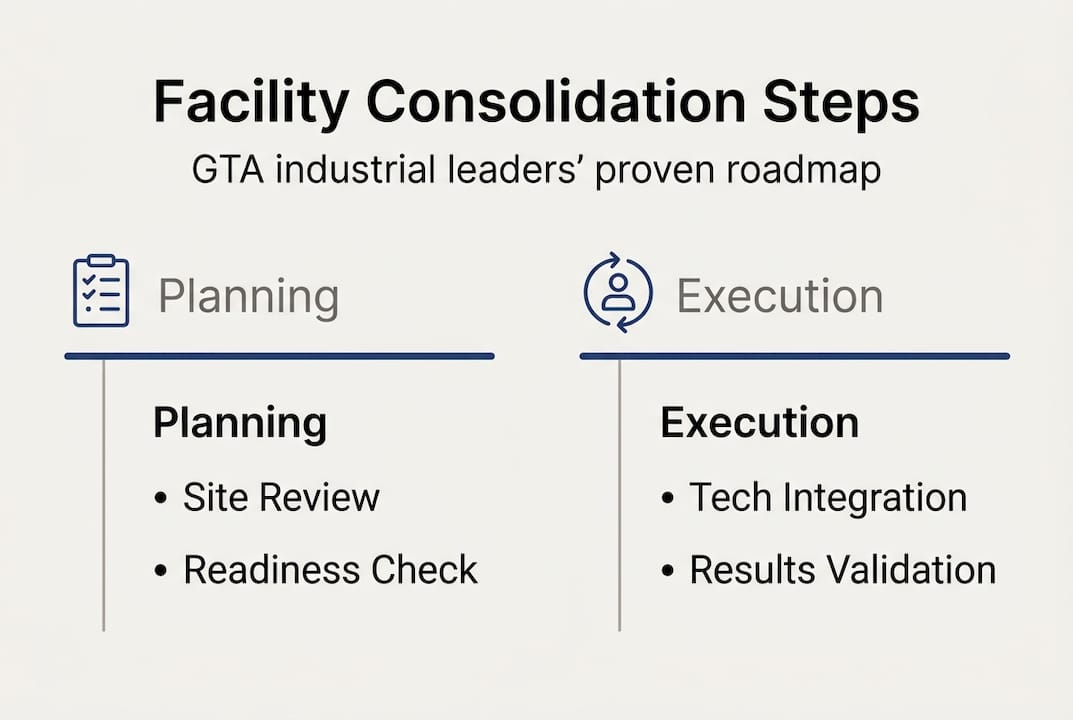
Resource allocation deserves specific attention. Research shows you should allocate 30 to 40% of consolidation resources to change management, not just technology and infrastructure. Most GTA firms underinvest here and pay for it in turnover and productivity losses.
Pro Tip: Assign a dedicated change management lead for the consolidation project. This person owns internal communications, training schedules, and staff feedback loops. Keeping employees informed reduces resistance and speeds adoption significantly.
| GTA archetype | Primary process challenge | Recommended standard |
|---|---|---|
| E-commerce fulfilment | Order accuracy, returns processing | Scan-based pick and pack with automated returns portal |
| Food-grade manufacturing | Traceability, sanitation compliance | Lot-controlled WMS with documented cleaning protocols |
| Third-party logistics | Multi-client SKU segregation | Client-specific slotting rules with shared labour pool |
Monitoring industrial property trends during this phase also helps you anticipate submarket shifts that could affect your consolidated facility's cost structure going forward.
Validating results and optimising performance post-consolidation
After you've standardised and integrated processes and technology, it's time to validate consolidation results and optimise. Validation is not a one-time audit. It is a continuous cycle that ensures your investment in consolidation actually delivers the outcomes you projected.
Start with a structured KPI tracking framework in the first 90 days post-consolidation:
- Cost per order or cost per unit shipped compared to pre-consolidation baseline
- Labour productivity measured in units per labour hour
- Inventory accuracy confirmed through cycle counts
- On-time delivery rate to customers and internal SLAs
- Facility utilisation rate expressed as a percentage of total capacity used
Real-world benchmarks demonstrate what is achievable. Frontline factory teams delivered $44 million in cost savings within 24 months through continuous improvement, with $100 million in EBITDA potential identified through footprint optimisation. These are not outliers. They reflect what disciplined execution produces.
"The companies that sustain consolidation gains are those that treat post-integration as the beginning of a continuous improvement programme, not the finish line."
On the real estate side, the numbers are equally compelling. Warehouse network consolidation has produced $5.9 million in real estate savings for firms like Varner, demonstrating that the financial case for consolidation extends well beyond operational efficiency.
For GTA operators, continuous improvement cycles should be tied to lease review dates. Every 12 months, revisit your facility utilisation data and assess whether your current footprint still matches your operational needs. Maximising GTA property returns requires active management, not passive occupation.
Risk management post-consolidation focuses on avoiding regression. Assign ownership of each KPI to a specific leader. Review post-merger risk mitigation frameworks to identify edge cases your organisation may face, particularly if the consolidation involved an acquisition or merger of previously separate entities.
Our perspective: Hybrid models and expert-led change management
Here is what the data and experience both confirm: the firms that succeed with GTA facility consolidation are not the ones with the most sophisticated technology. They are the ones that invest in people and process before platforms.
Centralised models maximise scale but risk long supply chains. Distributed models offer responsiveness but raise coordination costs. Hybrid models balance both, and for most mid-market GTA operators, a hybrid approach is the most resilient long-term structure. This means maintaining a primary consolidated hub while keeping a smaller satellite presence in high-demand corridors like Durham Region or Hamilton.
GTA-specific dynamics reinforce this. Congestion on the 401 and 427 corridors makes delivery time windows unpredictable. Partnering with 3PLs in strategic nodes can extend your reach without adding lease obligations. The firms we see struggle most are those that consolidate entirely to one location without accounting for last-mile complexity.
Change management remains the most underestimated investment in any consolidation. Allocating budget to training, communication, and leadership alignment is not a soft cost. It is the mechanism that converts a real estate strategy into an operational reality. An industrial real estate expert GTA can help you avoid the facility-selection mistakes that make change management even harder.
Explore next steps with expert GTA facility advisors
Facility consolidation in the GTA is one of the highest-leverage decisions a logistics or manufacturing executive can make. The strategies in this article give you a clear framework, but execution depends on having the right real estate intelligence and advisory support behind you.
Michael Law Real Estate provides GTA-wide industrial advisory services, from site selection and lease negotiation to market intelligence and fit-out planning. Whether you are evaluating industrial properties GTA for your consolidated hub or need a strategic second opinion on your current footprint, our team delivers the data and deal expertise to move with confidence. Connect with GTA facility advisors who specialise exclusively in industrial real estate across every major corridor in the region.
Frequently asked questions
What is the main benefit of consolidating industrial facilities?
Consolidation reduces overhead, improves operational efficiency, and unlocks significant real estate savings. Warehouse network consolidation has produced $5.9 million in real estate savings for firms that executed it well, particularly in high-rent markets like the GTA.
How can risks be managed during consolidation?
Phased implementation, robust change management, and staged platform strategies are the most effective risk controls. Post-merger integration risks are best mitigated with continuity safeguards built into each transition phase rather than addressed reactively.
What are common mistakes GTA firms make when consolidating?
The most frequent error is committing to technology integration before process harmonisation is complete. Process harmonisation over immediate tech convergence prevents the operational disruptions that derail consolidation timelines and erode projected savings.
What performance benchmarks should I use post-consolidation?
Track cost savings, EBITDA improvement, and labour productivity against your pre-consolidation baseline. Frontline teams have achieved $44 million in savings within 24 months, with $100 million in EBITDA potential through disciplined footprint optimisation.
How does GTA market context impact facility consolidation?
The GTA's 4.6 to 4.8% vacancy rate and rents at $18.45 per square foot create strong financial pressure to consolidate efficiently. Firms that act strategically on space reduction gain a meaningful cost advantage over competitors paying for redundant square footage.