

TL;DR:
- Signing a commercial lease in the GTA requires thorough preparation, including understanding lease structures like Triple Net agreements and verifying zoning and building conditions. Proper due diligence on site specifics, lease terms, and landlord commitments is essential to avoid costly disputes and unfavorable clauses. Effective negotiation relies on detailed offers, market knowledge, and clear documentation to secure favorable lease terms and minimize risks.
Signing a commercial lease for a warehouse or manufacturing space in the Greater Toronto Area is one of the most consequential financial decisions a business will make. Yet many tenants walk into negotiations underprepared, and many property owners leave value on the table by relying on outdated templates. A missed clause here, an unverified zoning condition there, and suddenly you're locked into a five-year obligation that costs far more than it should. This guide gives you a clear, step-by-step roadmap through every phase of the GTA industrial lease process, from foundational concepts to final signature, so you can negotiate with real confidence.
Table of Contents
- Understanding GTA commercial lease basics
- Preparation essentials: What to verify before you negotiate
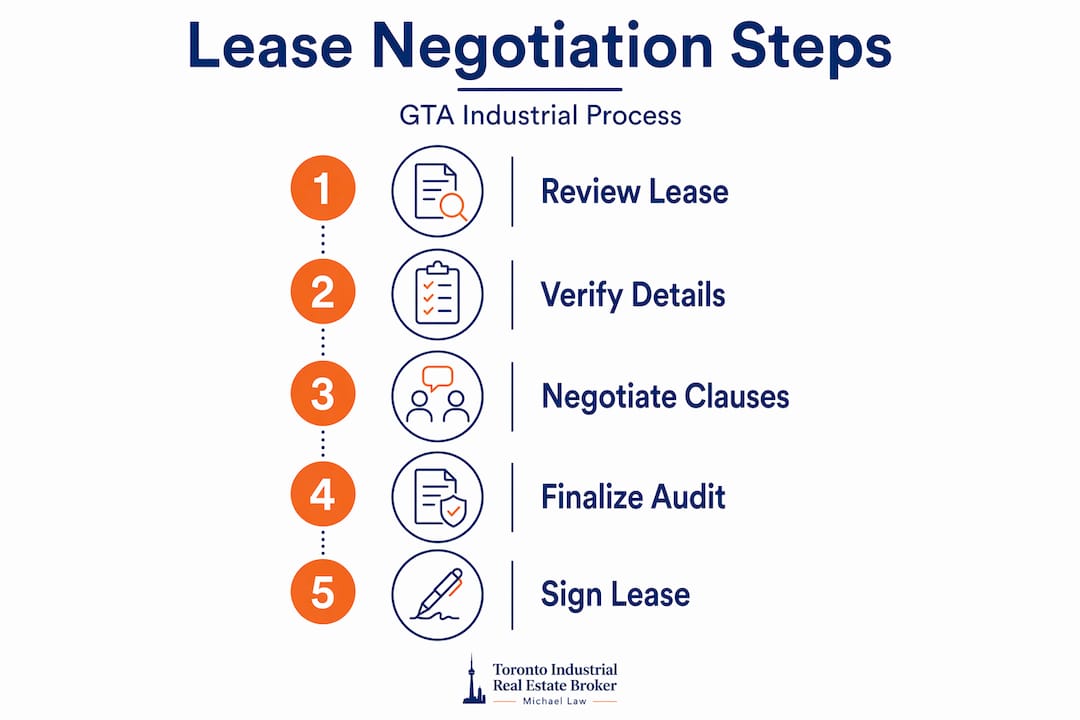
- Key steps to a successful lease negotiation
- Advanced clauses and common pitfalls
- Verification and closing: Audit, review, and finalize
- Why most commercial lease negotiations fail in the GTA and how to stand out
- Take your next step in GTA commercial leasing
- Frequently asked questions
Key Takeaways
| Point | Details |
|---|---|
| Know GTA lease norms | Understanding lease types, term lengths, and escalation standards is key to successful negotiations. |
| Complete your due diligence | Verifying zoning, property condition, and roles up-front avoids expensive surprises. |
| Leverage negotiation levers | Use market vacancy and rent escalation knowledge to secure better terms. |
| Clarify every clause | Avoid vague language around work, CAM, and guarantees—be specific in the lease. |
| Audit and finalise with care | Scrutinise financials and lease language before signing to ensure a strong result. |
Understanding GTA commercial lease basics
Before you can negotiate effectively, you need to understand the rules of the game. GTA industrial leases follow specific conventions that differ meaningfully from office or retail leases, and misreading those conventions is one of the fastest ways to end up in a costly dispute.
The dominant structure in this market is the Triple Net lease. Understanding triple net leases in the GTA is non-negotiable preparation for any tenant or owner. In a Triple Net arrangement, the tenant pays base rent plus their proportionate share of property taxes, building insurance, and operating costs. For landlords, this structure is attractive because it transfers most variable expenses to the tenant. For tenants, it means the sticker rent is never the full cost picture. If you want a deeper breakdown of the mechanics, reviewing what is a net lease will clarify how the numbers actually stack up.
As a general rule, GTA industrial leases run for 5 to 10 years, with annual rent escalations typically falling between 2% and 5%. Landlords favour longer terms for income stability; tenants often push for shorter terms with renewal options to preserve flexibility.
Here is a summary of the principal components you will encounter in a typical GTA industrial lease:
| Component | Typical range or structure |
|---|---|
| Lease term | 5 to 10 years |
| Base rent | Negotiated per sq. ft., net of operating costs |
| Annual escalation | 2% to 5% per year |
| Property taxes | Tenant pays proportionate share (NNN) |
| Building insurance | Tenant pays proportionate share (NNN) |
| Common Area Maintenance (CAM) | Tenant pays proportionate share (NNN) |
| Tenant improvement allowance | Negotiated; varies by market conditions |
| Rent-free period | Negotiated; typically 1 to 6 months |
Key terms every GTA industrial tenant and owner should understand before sitting down to negotiate:
- Base rent: The net rent per square foot before operating costs are added
- Additional rent: The sum of taxes, insurance, and CAM charges layered on top of base rent
- Tenant Improvement (TI) allowance: Landlord-funded dollars allocated for tenant fit-out
- Escalation clause: The contractual mechanism for annual rent increases
- Renewal option: The tenant's right to extend the lease at pre-agreed terms
Understanding these terms is not just academic. When a landlord quotes you "$14.50 net," the actual occupancy cost after additional rent in many GTA submarkets can push total costs to $20 per square foot or higher. Know what you are actually comparing.
Preparation essentials: What to verify before you negotiate
Once you understand the lease structure, preparation is everything. Skipping due diligence is the single most common reason industrial lease negotiations go sideways. A thorough industrial leasing due diligence process protects both tenants and owners from expensive surprises after the ink dries.
Here is a numbered checklist of essential steps before you sit down to negotiate:
- Conduct a thorough site visit. Walk the building with a critical eye. Check ceiling clearances, dock doors, drive-in access, column spacing, and floor load capacity. For manufacturing users, confirm that the power supply (amperage and voltage) meets your operational requirements.
- Verify zoning compliance. Confirm the property is zoned for your intended use. Manufacturing, outdoor storage, and certain logistics operations each carry specific zoning requirements that vary across municipalities in the GTA.
- Assess building condition. Identify the age and condition of the roof, HVAC systems, and structural elements. Understand who is responsible for capital repairs before you negotiate.
- Clarify Landlord's Work versus Tenant's Work. This distinction is critical. Landlord's Work and Tenant's Work must be clearly defined and documented before negotiations begin. Ambiguity here routinely leads to costly disputes mid-tenancy.
- Review the existing lease or draft Offer to Lease (OTL). Have a commercial real estate lawyer review any document before you sign. An OTL sets the framework for the full lease and should capture all your priorities, including rent, term, TI allowance, and permitted use.
- Audit any CAM estimates provided. Ask the landlord for the previous year's actual CAM reconciliation statement. Estimates provided at the start of a tenancy are often lower than actual costs.
Tenant and owner beware: Skipping due diligence on zoning, building condition, or the Landlord's Work scope is not a time-saving shortcut. It is an invitation to significant financial liability and operational disruption.
Pro Tip: For manufacturing tenants specifically, verify that the building's electrical infrastructure supports your machinery load before negotiating any other term. Retrofitting power capacity after lease execution can cost tens of thousands of dollars and may not even be feasible in older buildings.
Key steps to a successful lease negotiation
Armed with due diligence and a clear picture of the property, you can now approach the negotiation itself with structure. A disciplined process, starting with a well-drafted Offer to Lease, makes the difference between a deal that serves your interests and one that merely gets you into a space.
Follow these steps for a structured, effective negotiation:
- Draft a detailed Offer to Lease (OTL). The OTL is your opening position. As outlined in commercial lease agreements Ontario, the OTL should specify rent, lease term, TI allowance, rent-free period, permitted use, and any conditions precedent. Do not leave key points for "the formal lease." If it matters, it goes in the OTL.
- Anchor on rent and escalations. Base rent is the most obvious lever, but escalation rates compound significantly over a 7- or 10-year term. Negotiating a 2% annual escalation versus a 3% escalation on a 20,000 sq. ft. space can represent hundreds of thousands of dollars over the lease term.
- Negotiate tenant inducements. Tenant improvement allowances and rent-free periods are standard tools in GTA industrial negotiations. In a softer market, landlords may offer $10 to $30 per sq. ft. in TI allowance and several months of free rent to secure a quality tenant. Understanding the advantages of brokers in this process is important: an experienced broker knows current market norms and will push for inducements you might not know to ask for.
- Use market vacancy as leverage. When vacancy rates rise in a specific GTA submarket, tenants gain negotiating power. Track vacancy data in Mississauga, Brampton, Vaughan, and other nodes before you make your first offer.
- Understand your escalation options. Fixed annual increases, Consumer Price Index (CPI) adjustments, and step-rent structures each carry different risk profiles. Review rent escalation in industrial leases to understand which structure suits your business model.
The following table illustrates typical responsibility splits in GTA industrial leases:
| Expense category | Landlord responsibility | Tenant responsibility |
|---|---|---|
| Structural repairs (roof, foundation) | Typically landlord | Varies by lease |
| HVAC maintenance | Varies | Often tenant (NNN) |
| Property taxes | Passes through to tenant | Pays proportionate share |
| Building insurance | Passes through to tenant | Pays proportionate share |
| Interior maintenance | Tenant | Tenant |
| CAM (parking, landscaping) | Administers | Pays proportionate share |
| Capital replacements | Often landlord | Negotiated |
Pro Tip: When reviewing GTA rent strategies, pay close attention to how escalation clauses interact with renewal options. A below-market renewal rate means nothing if the escalation clause has already pushed your rent well above market before the renewal period begins.
Advanced clauses and common pitfalls
Even well-prepared negotiators can stumble on nuanced lease clauses. These provisions rarely make headlines, but they can define the entire experience of occupying a GTA industrial property.
Key advanced clauses to scrutinise carefully:
- Subletting and assignment rights. Your business circumstances will change over a multi-year lease term. Ensure the lease gives you workable rights to sublet or assign the space. Overly restrictive subletting provisions can trap you in a space that no longer fits your operations. Reviewing industrial subleasing concepts before you sign is time well spent.
- Personal guarantee scope. Landlords routinely request personal guarantees from principals of smaller corporations. Negotiate the scope carefully. A guarantee limited to 12 to 24 months of rent is far more reasonable than an unlimited guarantee covering the full lease term. As noted in guidance for Vaughan industrial tenants, avoiding overly restrictive personal guarantees is a key protection to negotiate upfront.
- Capital repair liability. Clarify who pays for major capital items like roof replacement or HVAC overhaul. Some leases push these costs onto tenants through the CAM structure. If you are signing a long-term lease on an older building, this clause can represent significant unbudgeted expense.
- CAM audit rights. Negotiate the explicit right to audit CAM charges annually. Landlords sometimes include costs in CAM that are not legitimately passed through to tenants. An annual audit right gives you the ability to catch and recover overbilling.
- Permitted use clause. Make this clause as broad as reasonably possible. A narrowly defined permitted use can prevent you from adapting your operations without landlord consent, which creates unnecessary friction and potential lease breach exposure.
For tenants seeking large spaces, the market dynamics shift meaningfully. In a softening GTA market, tenants occupying over 200,000 sq. ft. can negotiate greater concessions from landlords, including larger TI packages, extended rent-free periods, and more flexible escalation structures. Large-block tenants represent significant, long-term income for landlords, and that leverage should be used.
Pro Tip: Always document exactly what constitutes Landlord's Work and Tenant's Work in a detailed schedule attached to the lease. Verbal agreements and email exchanges are not enforceable once the lease is signed. Every commitment must appear in the written document.
Verification and closing: Audit, review, and finalize
Reaching agreement on terms is not the finish line. The period between agreed terms and final signature is where details get lost and disputes are born. Rigorous verification at this stage protects both parties.
Follow this closing checklist before you sign:
- Commission a full legal review. Have a commercial real estate lawyer compare the final lease against the agreed OTL. Every term you negotiated must appear accurately in the final document.
- Audit the CAM estimate and reconciliation. Before signing, request the landlord's most recent CAM reconciliation and compare it against the estimate provided. As highlighted in guidance for GTA industrial tenants, auditing CAM and handling subletting and assignment provisions explicitly are two of the most important protections a tenant can secure.
- Confirm all Landlord's Work commitments. Verify that every item of Landlord's Work is documented in a schedule, with completion timelines and a clear remedy if the work is not finished by the possession date.
- Review possession and commencement dates. Confirm the rent commencement date, the possession date, and any conditions that must be satisfied before the lease becomes binding. Ambiguity in these dates can trigger rent obligations before your space is ready to occupy.
- Verify insurance requirements. Confirm your insurance broker has reviewed the lease's insurance provisions and that your policy will meet the requirements from day one of possession.
What's not in the lease won't be enforceable. Put every key point in writing, no matter how clearly it was agreed verbally.
Timelines matter here. Allow at least two to three weeks for legal review and final negotiation of the formal lease document. Rushing this stage to meet an artificial deadline is a false economy that can cost far more in disputes down the road.
Why most commercial lease negotiations fail in the GTA and how to stand out

After years of working through industrial lease transactions across the GTA, the pattern of failure is remarkably consistent. It is rarely about one catastrophic mistake. It is about a series of small, avoidable gaps that compound into costly outcomes.
The most common failure mode is not poor negotiation tactics. It is poor preparation. Tenants who skip the zoning check, accept CAM estimates without scrutiny, or sign an OTL without legal review are not negotiating from a position of strength. They are hoping the landlord is being fair. Hope is not a strategy in a market as competitive as the GTA.
The second failure mode is misreading market conditions. The GTA industrial market has moved through dramatic cycles. Tenants who negotiated leases in 2021 and 2022 at the peak of the market locked in rents that now look expensive. Conversely, owners who held firm on asking rents in a softening submarket watched quality tenants walk away. Knowing how to read vacancy trends, absorption data, and submarket-specific conditions is what separates advisors who create real value from those who simply process paperwork.
The non-obvious tactic that experienced negotiators use is relationship-building with the landlord's team. Deals in the GTA industrial market are often won or lost on trust and timeline certainty. A tenant who demonstrates financial credibility, operational clarity, and responsiveness during the OTL process often secures better terms than a higher-offer tenant who creates uncertainty. Landlords price risk. Reduce their perceived risk, and you improve your negotiating position.
Working with an advisor who brings industrial real estate expertise specific to the GTA changes deal outcomes in ways that are hard to quantify but easy to see in the final lease terms. The right advisor knows which landlords are motivated, which submarkets are softening, and which clauses are genuinely negotiable versus which are standard boilerplate. That knowledge is not available in a generic lease template.
Take your next step in GTA commercial leasing
Navigating a GTA industrial lease negotiation is far more manageable when you have the right support. Whether you are a corporate tenant searching for your next warehouse, a manufacturer evaluating a relocation, or a property owner preparing to lease a vacant bay, the steps in this guide give you a strong foundation.

Michael Law Real Estate provides hands-on advisory across all major GTA industrial nodes, from Mississauga and Brampton to Vaughan, Markham, and the Durham Region. Explore GTA industrial properties to see what's active in your target submarket, or browse available GTA commercial properties for current listings. If you are focused on a specific corridor, the Burlington industrial listings page is a good starting point for that market. Reach out directly to discuss your leasing goals and get market-specific guidance tailored to your situation.
Frequently asked questions
What is a Triple Net (NNN) lease and why is it common in the GTA?
A Triple Net lease requires tenants to pay property taxes, building insurance, and maintenance costs in addition to base rent, and it is the preferred structure for GTA industrial properties because it gives landlords predictable net income while passing variable operating costs to tenants.
Which lease terms are typically negotiable in industrial GTA leases?
Key negotiable terms include base rent, lease length, annual escalations, tenant improvement allowances, rent-free periods, and responsibility for maintenance or capital works, as outlined in standard GTA lease guidance.
Why should tenants audit Common Area Maintenance (CAM) charges?
Auditing CAM charges annually prevents overbilling and ensures only legitimate property expenses are passed through to tenants, which can represent meaningful savings over a multi-year lease term.
How can larger tenants leverage market conditions?
In a softening GTA market, tenants seeking over 200,000 sq. ft. can negotiate greater concessions from landlords, including larger TI allowances, extended rent-free periods, and more flexible escalation terms.
What's the biggest pitfall in GTA commercial lease negotiation?
Failing to document every agreed term in the written lease is the most common and costly mistake. Verbal commitments and email exchanges are not enforceable once the formal lease is executed.