

TL;DR:
- Many GTA industrial tenants and owners underestimate the variability in triple net lease costs, risking significant unexpected expenses.
- Effective lease negotiation requires understanding market benchmarks, clear expense allocation, caps, and audit rights to mitigate risks.
Even experienced industrial property owners and corporate tenants in the Greater Toronto Area regularly misread triple net leases, and that misreading costs real money. The term gets thrown around loosely in every deal, yet the gap between what people assume it means and what the lease actually requires can translate into tens of thousands of dollars in unexpected annual costs. This guide breaks down exactly how triple net leases work, what the current GTA market data tells us about realistic occupancy costs, and which negotiation levers give you the most protection regardless of which side of the table you sit on.
Table of Contents
- Defining triple net leases and how they work
- How triple net leases are structured in the GTA
- Key negotiation points: Caps, exclusions, and risk management
- Absolute NNN (bondable) and lease variations
- What most guides miss about triple net leases in the GTA
- Find the right GTA industrial lease for you
- Frequently asked questions
Key Takeaways
| Point | Details |
|---|---|
| Triple net basics | Tenants pay base rent plus property taxes, insurance, and building maintenance in typical NNN leases. |
| Market rates matter | GTA NNN base rents range from $15 to $18 per square foot, and additional rents average $5 per square foot. |
| Negotiation is essential | Securing caps and exclusions on operating costs protects tenants from unexpected expense spikes. |
| Lease variations | Absolute (bondable) NNN leases shift all responsibilities, including structure, to tenants. |
| Legal clarity reduces risk | Well-defined allocation and reconciliation clauses help prevent costly disputes in Ontario. |
Defining triple net leases and how they work
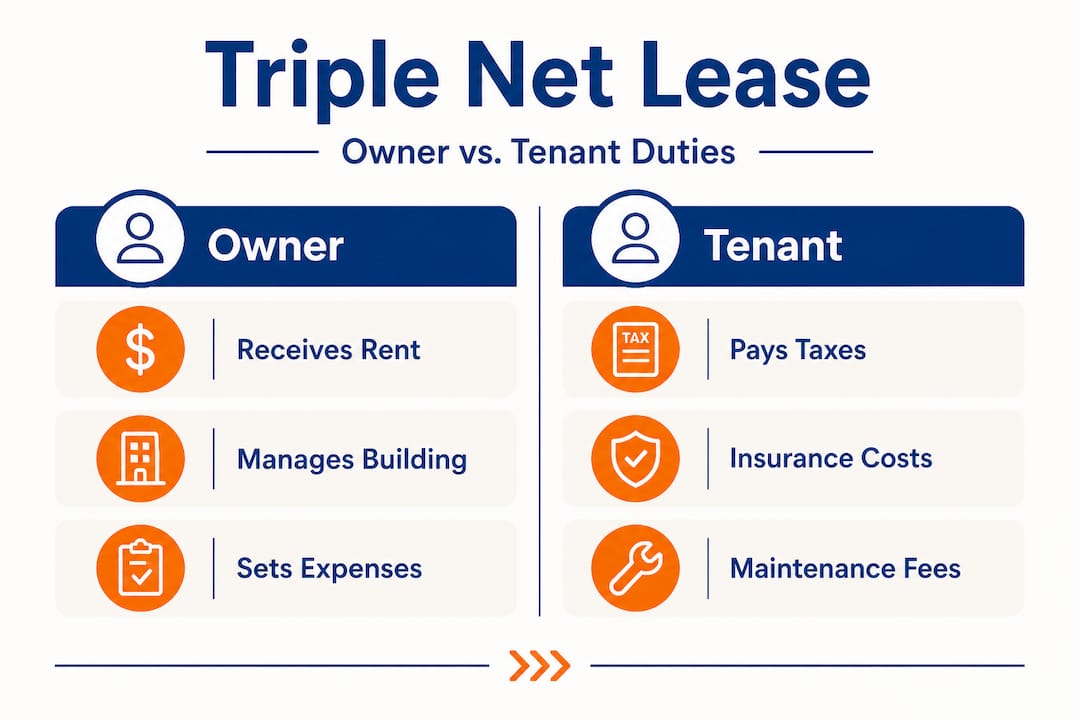
Triple net leases are everywhere in GTA industrial real estate, yet the definition still trips people up. At its core, a triple net lease is a commercial lease where the tenant pays base rent plus property taxes, building insurance, and maintenance or common area maintenance (CAM) costs. Those three cost categories are the "three nets." Every dollar above base rent falls onto the tenant's plate, which is why understanding the mechanics matters so much before you sign anything.
To put this in concrete terms, imagine you lease a 20,000 square foot warehouse in Brampton. The landlord quotes you a base rent of $16 per square foot (PSF) per year. Sounds straightforward. But under a triple net structure, you will also pay your proportionate share of property taxes on the building, the landlord's insurance premiums for the structure, and all maintenance costs for shared or common areas. That additional rent can easily add another $5 to $7 PSF on top, pushing your true occupancy cost to $21 or more PSF annually.
This is a fundamentally different financial reality than a gross lease, where the landlord wraps most operating expenses into a single, all-inclusive rent figure. Under a gross lease, the landlord carries the risk of cost increases. Under an NNN structure, that risk transfers almost entirely to the tenant.
How the mechanics actually play out month to month
Expense estimates are typically made monthly with year-end true-up reconciliation based on actual costs, which is common in multi-tenant properties pro-rated by gross leasable area (GLA). In plain language: the landlord estimates what taxes, insurance, and maintenance will cost for the year, divides that by twelve, and invoices you monthly. At year end, actual costs are tallied. If the landlord spent more than estimated, you owe the difference. If less, you get a credit.
That year-end reconciliation, often called the "true-up," is one of the most dispute-prone moments in any NNN lease. Tenants who do not scrutinise the year-end statement carefully often pay for costs they were never responsible for. Understanding net leases in the GTA context is essential because local landlords frequently bundle costs into CAM that tenants should push back on.
Here is a quick breakdown of the three expense categories and what they typically include:
Property taxes: Municipal and education taxes levied on the building and land, allocated to tenants based on their proportion of the total building area.
Building insurance: The landlord's insurance premiums for the structure itself, fire, general liability, and sometimes flood coverage, again allocated proportionately.
Maintenance and CAM: Landscaping, snow removal, parking lot repairs, security, building management fees, and shared utilities. This is the most variable and often the most contentious category.
| Lease type | Who pays operating expenses | Base rent level | Tenant cost predictability |
|---|---|---|---|
| Gross lease | Landlord | Higher | High |
| Modified gross lease | Shared, negotiated | Moderate | Moderate |
| Net (single net) | Tenant pays taxes | Moderate-low | Moderate |
| Double net (NN) | Tenant pays taxes and insurance | Lower | Lower |
| Triple net (NNN) | Tenant pays all three | Lowest base | Lowest |
Pro Tip: Before signing, ask the landlord to provide the last two years of actual operating expense statements for the property. Comparing estimated versus actual figures tells you exactly how accurate (or inflated) their estimates tend to be.
How triple net leases are structured in the GTA
The GTA industrial market runs almost exclusively on NNN lease structures. It is the market standard, not the exception. What changes from deal to deal is the specific allocation of costs, the base rent level, and how much room exists for negotiation based on current market conditions.
GTA industrial NNN base rents average $15 to $18 PSF, with specific examples such as $15.25 PSF for a Highway 401 warehouse in 2026 and $16.57 PSF recorded in Q3 2025, while vacancy sits at 3.2 to 4.5% and additional rents run approximately $5 PSF. Those numbers are important context. Add that $5 PSF in additional rent and your total occupancy cost lands between $20 and $23 PSF, depending on location and building quality.
Why does location matter so much? Because GTA submarket rent differences are significant. A warehouse near the Highway 427 and 401 interchange in Toronto's west end commands a premium over a comparable building in Oshawa or Hamilton. The gap can be $3 to $5 PSF in base rent alone, which over a five-year lease term on 30,000 square feet represents $450,000 to $750,000 in total additional cost. These are not rounding errors. They are strategic decisions.
Vacancy rates between 3.2% and 4.5% across GTA submarkets signal a market that is tight but not as extreme as the sub-2% vacancy seen in 2022 and early 2023. That modest loosening gives tenants slightly more leverage than they had a few years ago, but landlords still hold the stronger hand in prime corridors like Mississauga, Brampton, and Vaughan. In secondary markets such as Hamilton, Burlington, or parts of Durham Region, tenants can negotiate more aggressively on both base rent and additional rent caps.
What tenants are actually expected to pay directly
Under a typical GTA NNN industrial lease, tenants pay the following directly or through pro-rated landlord invoices:
Municipal realty taxes: Often the largest single component of additional rent, especially as assessed values in the GTA have risen sharply over the past decade.
Structural insurance: Premiums have climbed considerably post-pandemic due to supply chain costs affecting rebuild valuations.
Property management fees: Many landlords add a management fee of 5% to 15% of the operating expenses as a recoverable cost, which is worth scrutinising closely.

Parking lot and exterior maintenance: In cold GTA winters, snow removal and de-icing costs for large industrial yards can be surprisingly significant.
HVAC maintenance: In many GTA NNN leases, tenants are responsible for maintaining and replacing rooftop HVAC units, which can involve capital costs of $15,000 to $40,000 per unit.
Checking GTA industrial lease benchmarks for your specific submarket and building class gives you a credible baseline to compare what a landlord is proposing versus what the market actually supports.
Key negotiation points: Caps, exclusions, and risk management
Understanding what a triple net lease costs is the first step. Negotiating favourable terms is where the real work happens. Both owners and tenants have legitimate interests, and the best NNN leases balance those interests clearly rather than leaving grey areas that end up in dispute.
Here are the most important negotiating points to address before you execute any GTA NNN lease:
-
CAM expense caps: Push for an annual cap on controllable operating expense increases, typically 3% to 5% per year. Taxes and insurance are often excluded from caps since they are genuinely outside the landlord's control, but management fees, maintenance contracts, and landscaping costs should be subject to a hard annual ceiling.
-
Exclusions list: Negotiate a specific list of costs that cannot be included in CAM charges. These commonly include capital improvements that benefit the landlord's asset value, leasing commissions for other tenants, legal costs related to other leases, and costs covered by insurance proceeds.
-
Tax allocation method: This is frequently overlooked and frequently disputed. The method used to allocate realty taxes among tenants in a multi-tenant building must be clearly defined and consistently applied.
-
Audit rights: Your lease should give you the right to audit the landlord's operating expense records within a defined window after receiving the annual reconciliation statement, typically 12 months.
-
Base year gross-up: In multi-tenant buildings, make sure operating expenses are grossed up to 100% occupancy in the base year calculation, so you are not penalised for the landlord's vacant space.
-
HVAC responsibility: Clarify upfront whether you are responsible for HVAC replacement or just maintenance. Replacement is a capital cost that can be structured as a landlord obligation with tenant reimbursement over the lease term.
Landlords see NNN as risk-free cash flow; tenants view it as high-risk unless well-negotiated with exclusions and caps, while gross leases are more predictable for tenants but come with higher base rent. Both perspectives are legitimate, which is why the negotiation matters so much.
On the tax allocation question specifically, Ontario courts have signalled clearly that inconsistent allocation methods have been ruled unfair where tax disputes required consistent, reasonable methods across tenants in the same building. This is not a theoretical risk. It has been litigated in Ontario, and the result has direct implications for how you should word the tax allocation clause in your lease.
Practical insight: A landlord who uses the assessed value method to allocate taxes to one tenant but uses a GLA-based method for another is creating legal exposure. Require that the lease specifies a single allocation method applied uniformly to all tenants for the entire lease term.
Reviewing best rent negotiation strategies for GTA industrial properties gives you a fuller toolkit for both initial lease execution and renewals. Keeping an eye on current lease trend analysis is equally important, because leverage shifts with market conditions and a strategy that worked in 2022 may not reflect what is negotiable in 2026. Partnering with someone who can work with a GTA lease expert puts market intelligence directly in your corner.
Pro Tip: Always request detailed year-end reconciliation statements with backup documentation for every line item. Your audit rights are only valuable if you actually exercise them. Budget for a third-party review of the first year's reconciliation to establish a pattern and catch any systemic overcharges early.
Absolute NNN (bondable) and lease variations
Standard triple net leases are the norm in GTA industrial deals, but a more extreme version called the absolute NNN or bondable lease surfaces in certain transactions, particularly those involving single-tenant buildings with credit-quality tenants.
An absolute NNN lease transfers all costs including structural repairs to the tenant, and is most common with creditworthy tenants. This means the tenant takes on responsibility not just for taxes, insurance, and CAM, but also for roof replacement, structural repairs, and potentially even the building envelope. The landlord receives a truly passive income stream with no management obligations whatsoever.
When does an absolute NNN make sense? And when should you walk away?
Situations where absolute NNN can work for tenants:
- You are a large, credit-rated corporation that wants maximum control over building quality and maintenance timing
- The base rent discount relative to a standard NNN lease is significant enough to justify the additional risk
- You have a long lease term (ten or more years) that gives you time to amortise any capital expenditure on roof or structure
- You plan to occupy the building as a quasi-owner and want operational autonomy
- The building is relatively new (under ten years) with predictable capital needs
Situations where tenants should resist absolute NNN terms:
- The building is older and structural or roof capital expenditures may be imminent
- Your lease term is short (under seven years), leaving you exposed to capital costs you cannot fully amortise
- You lack the internal facilities management resources to handle structural maintenance properly
- The landlord is unwilling to disclose a building condition assessment before you commit
From an owner's perspective, absolute NNN leases are most valuable in sale-leaseback transactions and single-tenant investment sales where a clean, predictable income stream commands a lower cap rate (and therefore a higher sale price). Investors and REITs pay a premium for the certainty.
Other variations worth recognising in the GTA market include modified gross leases, where some expenses are wrapped into base rent and others are passed through, and net leases with defined expense pools that limit what can be recovered. Reviewing examples of GTA lease types across different building classes helps you contextualise what structure is standard for the type of space you are pursuing.
What most guides miss about triple net leases in the GTA
Most articles about NNN leases stop at the definition and maybe a list of negotiation tips. The real gap is this: the practical headaches arise not from misunderstanding what the three nets are, but from underestimating how much variation exists in how those costs are calculated, allocated, and reconciled in actual GTA leases. The words "triple net" do not describe a standardised document. They describe a starting point for a negotiation.
Here is what industry insiders consistently observe. Tenants focus intensely on base rent during negotiations and treat additional rent as a footnote. Yet in the current GTA market, additional rent of $5 PSF or more is not unusual. On a 25,000 square foot space, that is $125,000 per year in costs that never got serious scrutiny. Over a five-year term, you are talking about $625,000 in expenses where the exact scope was left vague in the lease language. That is not a footnote. That is a material financial exposure.
The tax allocation issue is particularly relevant right now. GTA assessed values have shifted considerably in recent years, and not all buildings have been reassessed uniformly. This means a landlord using one allocation method may be passing through a disproportionate share of the tax increase to certain tenants while others on different floors or in different wings pay less. Without a clearly defined, consistently applied method written into your lease, you have limited recourse.
The true-up process is also under-discussed. Most tenants receive a year-end reconciliation statement with a bottom-line number. They pay it. Almost no one audits it in the first year. That passivity is expensive over time, because errors and questionable line items compound annually. Landlords are not necessarily acting in bad faith; management companies operate with imperfect systems, and charges do get applied to the wrong tenant. The remedy is routine scrutiny, not suspicion.
The 2026 industrial leasing trends across the GTA show a market that has moderated from the extreme tightness of 2021 to 2023. Vacancy is rising modestly. Some submarkets offer genuine concessions for the first time in years. Tenants who pair that market intelligence with strong lease language are in the best position they have been in since the pandemic era reshaped this market. The opportunity is real, but it requires preparation rather than reactive negotiation.
Succeeding with an NNN lease means treating it as three separate problems: the financial problem (are your total occupancy costs competitive for this submarket?), the legal problem (are expense allocations defined precisely and in a way that is enforceable?), and the market problem (what leverage do conditions in this specific corridor give you right now?). Most people only work on one of those three dimensions. The best outcomes come from addressing all three simultaneously.
Find the right GTA industrial lease for you
Navigating triple net leases in the GTA requires more than a checklist. It requires current market data, familiarity with how different landlords structure their expense recovery, and the negotiation experience to push back effectively on terms that do not reflect market norms.

Michael Law Real Estate brings specialised industrial leasing expertise across all major GTA corridors, from Mississauga and Brampton to Durham Region and Hamilton. Whether you are a tenant evaluating a new lease, an owner reviewing your current rent structure, or an investor assessing acquisition targets, having an advisor who works exclusively in industrial real estate changes the quality of your decision. Explore Burlington industrial lease options and Hamilton industrial listings, or browse the full list of industrial properties to see what is currently available across the GTA market.
Frequently asked questions
What are the three nets in a triple net lease?
They are property taxes, building insurance, and maintenance or common area maintenance (CAM) paid by the tenant in addition to base rent. These three expense categories define an NNN lease and distinguish it from gross or modified gross lease structures.
How is additional rent calculated under a triple net lease in the GTA?
Additional rent is often estimated monthly with a year-end true-up based on actual taxes, insurance, and maintenance costs, sometimes pro-rated by the tenant's share of the total building area. Discrepancies between estimates and actuals are settled at year end through a reconciliation process.
Can a triple net lease include roof and structural repairs?
In an absolute or bondable NNN lease, tenants may be responsible for all costs, including roof and structural repairs. This absolute NNN structure is more common with creditworthy single tenants and carries significant long-term capital risk if the building is ageing.
What should tenants negotiate in a GTA triple net lease?
Tenants should seek expense caps, clear exclusions, and detailed allocation methods to reduce cost uncertainty and avoid legal disputes. Ontario courts have found that inconsistent tax allocation methods can be ruled unfair, making precise lease language a legal as well as financial priority.