

TL;DR:
- Industrial site selection impacts long-term supply chain efficiency and expansion capacity.
- Evaluation involves economic, logistical, labor, site-specific, and business climate factors.
- Combining analytical tools with human judgment is essential to avoid costly location mistakes.
Choosing where to locate your industrial facility is one of the most consequential decisions your organisation will make, yet many corporate leaders treat it as a simple real estate search. It is not. The right site shapes your supply chain efficiency, labour access, regulatory exposure, and long-term expansion capacity. Get it wrong and you are locked into a location that quietly erodes your margins for years. This guide breaks down the full scope of industrial site selection, from core evaluation criteria and proven analytical frameworks to the role of AI and the GTA-specific realities that no algorithm can fully capture.
Table of Contents
- What is industrial site selection?
- Core factors: Economic, logistical, labour, and site specifics
- Methods and technology: From frameworks to AI in site selection
- Balancing models with human judgement: What the experts say
- Our perspective: The often-overlooked truths about industrial site selection
- Take the next step to the right site
- Frequently asked questions
Key Takeaways
| Point | Details |
|---|---|
| Beyond location | Effective industrial site selection is holistic, weighing logistics, labour, and long-term regulatory outlook. |
| Embrace tech and judgement | Models and AI enable faster, more robust screening but must be paired with local expertise. |
| GTA specifics matter | Unique market, workforce, and municipal factors in the GTA demand nuanced decisions. |
| Growth over incentives | Prioritise sites that support future expansion, not just immediate financial incentives. |
What is industrial site selection?
Industrial site selection is the systematic process of evaluating and comparing potential locations for manufacturing, warehousing, logistics, or distribution facilities. It goes far beyond browsing available listings. The goal is to identify a location that optimises long-term operational performance, not just one that fits the immediate budget.
For GTA decision-makers, the stakes are particularly high. The region sits at the centre of Canada's most active industrial corridor, with access to over 9 million consumers, three international border crossings, and a dense network of highways and intermodal hubs. That density creates opportunity, but it also creates competition for quality sites.
Industrial real estate benefits are well documented, but capturing them depends entirely on choosing the right location. A poorly selected site can negate every operational advantage the asset class offers.
As a baseline, site selection evaluates access to incentives, taxes, logistics infrastructure, labour supply, and local regulations. That is five distinct domains, each with its own complexity.
Several myths still circulate among decision-makers that lead to costly mistakes:
- "Just pick the cheapest land" — Low acquisition cost often signals poor access, weak labour markets, or hidden remediation costs.
- "Site selection only matters for large companies" — Even mid-size logistics and manufacturing firms face compounding inefficiencies from a poor location choice.
- "We can fix zoning later" — Zoning adjustments are slow, expensive, and never guaranteed.
- "Incentives are the deciding factor" — Incentives change. Infrastructure and labour pools do not.
Site selection is not a one-time transaction. It is a strategic commitment that shapes every operational decision for the life of the facility.
Core factors: Economic, logistical, labour, and site specifics
Once you understand what site selection involves, the next step is knowing which criteria carry the most weight. Evaluation criteria fall into five primary categories: economic factors, logistical access, labour availability, site-specific conditions, and business climate.
Economic factors include municipal tax rates, provincial incentives, proximity to raw material suppliers, and total occupancy cost. In the GTA, these vary significantly across municipalities. Vaughan and Brampton, for example, have historically offered competitive development charges compared to core Toronto sites.
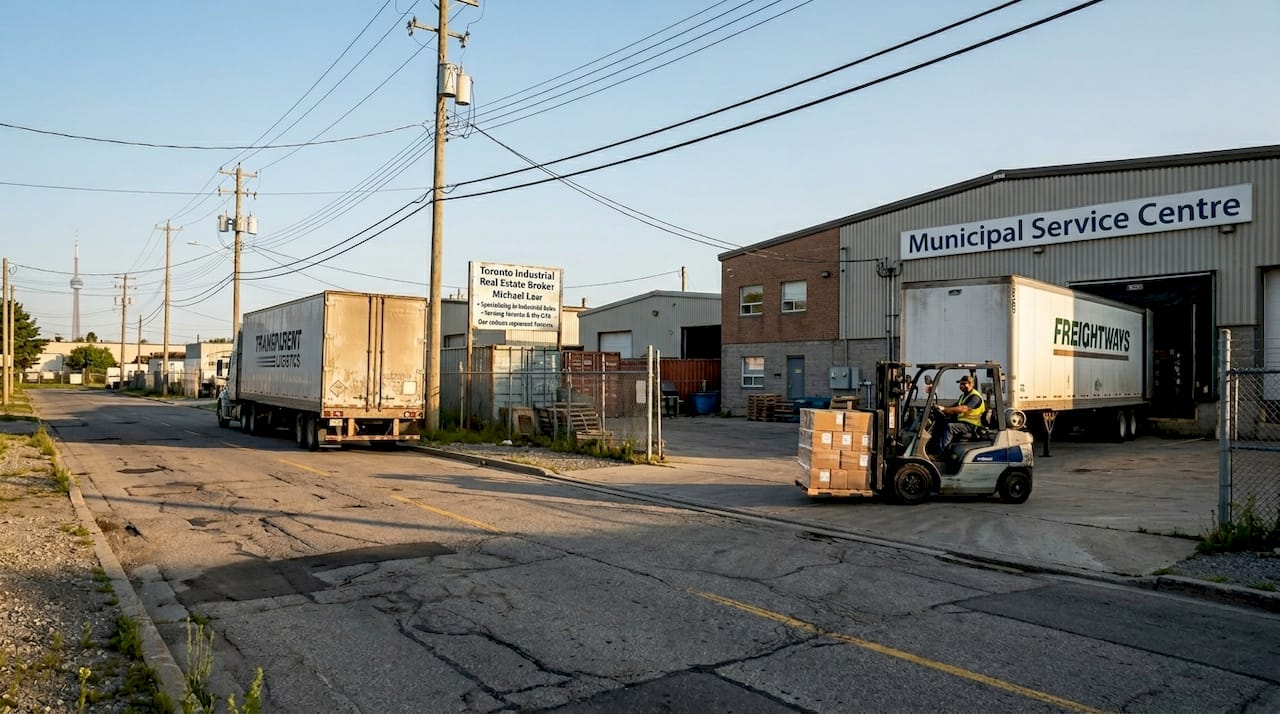
Logistical access is often the deciding factor for industrial property tenants in e-commerce, third-party logistics, and manufacturing. Highway 400, 401, 410, and 427 corridors dominate site searches for this reason. Proximity to Pearson International Airport adds another layer of value for time-sensitive freight.
Labour is where many site decisions quietly fail. A site may look perfect on paper but sit in a catchment area with limited transit access or insufficient skilled trades. Wage benchmarks and commute patterns matter as much as raw population numbers.
Site-specific elements cover parcel size, clear height, column spacing, dock configurations, and environmental history. Brownfield sites require remediation assessments that can add months and significant cost to a project timeline. Understanding the different industrial property types available in the GTA helps narrow the field early.
| Factor | Mississauga | Scarborough | Vaughan |
|---|---|---|---|
| Highway access | Excellent (401/427/410) | Good (401/DVP) | Good (400/407) |
| Labour pool | Large, diverse | Dense, transit-served | Growing suburban |
| Average net rent (2026) | High | Moderate | Moderate to high |
| Development charges | Moderate | Lower | Competitive |
| Zoning flexibility | Moderate | Variable | Improving |
Pro Tip: Municipal incentives can tilt a close decision, but they should never override foundational requirements like highway access or labour availability. Incentives expire. Supply chain inefficiencies compound.
Hidden challenges that often surface late in the process include:
- Brownfield remediation requirements discovered during due diligence
- Zoning classifications that exclude your specific use type
- Local bylaws restricting operating hours or truck traffic
- Utility capacity gaps for heavy power or water-intensive operations
Methods and technology: From frameworks to AI in site selection
Knowing what to evaluate is only half the challenge. The other half is how to synthesise dozens of variables into a defensible, rational decision. This is where analytical frameworks and technology tools become essential.
Advanced methodologies include Multi-Criteria Decision-Making (MCDM) approaches such as AHP (Analytic Hierarchy Process), ANP, and ELECTRE, as well as mathematical programming, Geographic Information Systems (GIS), and AI/ML platforms.
| Tool | Strengths | Weaknesses | Best use case |
|---|---|---|---|
| MCDM/AHP | Structured, transparent, auditable | Can oversimplify complex trade-offs | Scoring and ranking shortlisted sites |
| GIS | Spatial visualisation, proximity mapping | Requires quality data inputs | Mapping access, demographics, utilities |
| AI/ML | Predictive analytics, pattern recognition | Fails on incomplete or political data | Forecasting rent trends, absorption rates |
Three steps to integrate technology into your site selection process:
- Define your weighted criteria first. Before opening any software, agree internally on which factors matter most. Technology amplifies your priorities; it does not set them.
- Use GIS to eliminate, not just compare. Spatial mapping is most powerful as a filter. Remove sites that fail on access or demographics before detailed scoring begins.
- Validate model outputs with field visits. No model captures the feel of a neighbourhood, the condition of surrounding infrastructure, or the responsiveness of a local planning department.
For teams planning industrial relocations, these tools can dramatically reduce the shortlisting timeline. Keeping an eye on 2026 industrial real estate trends also helps calibrate which submarkets are gaining momentum. Increasingly, ESG considerations are being folded into site scoring models as well.
Pro Tip: Even the best AI platform cannot replace a conversation with the local planning department. Always validate model outputs with on-the-ground intelligence before committing to a shortlist.
Balancing models with human judgement: What the experts say
There is a temptation, particularly among data-driven organisations, to let the model make the decision. The research is clear that this approach carries real risk.
Traditional OR and MCDM methods are sufficient for structured data but tend to oversimplify reality. GIS adds spatial nuance, and AI excels in prediction, but AI fails on unstructured risks like politics and utilities, making human judgement essential.
What does that mean in practice? A GIS model might score a Brampton site highly based on highway proximity and land cost. But it will not flag that the municipality is processing a zoning amendment that could restrict future expansion. It will not know that a competing occupier is negotiating for the adjacent parcel. It will not sense that the local councillor is under pressure to limit industrial intensification in that ward.
These are the soft variables that experienced advisors surface through relationships and local presence. Working with a knowledgeable real estate advisor ensures these blind spots are addressed before you sign a lease or close a purchase.
A practical checklist for knowing when to lean on data versus human insight:
- Use data when comparing measurable variables: rent, clear height, distance to highway, labour catchment radius.
- Use human judgement when assessing political risk, community acceptance, landlord flexibility, or future infrastructure plans.
- Use both when evaluating environmental history, permitting timelines, or expansion potential.
The most costly site selection errors we see are not from bad data. They come from treating a model output as a final answer rather than a starting point for deeper investigation.
Our perspective: The often-overlooked truths about industrial site selection
Here is what most site selection guides will not tell you: the majority of GTA decision-makers who struggle with their location choice did not lack data. They lacked the right questions.
We see it consistently. A logistics operator selects a Mississauga site because the incentive package looks attractive and the asking rent is competitive. Two years in, they are fighting congestion on a secondary road that was never flagged, and the municipality has paused approvals for the expansion they planned. The numbers looked right. The site was wrong.
Futureproofing deserves far more weight than it typically receives. Zoning stability, municipal growth plans, and the flexibility of the physical asset to accommodate changing operational needs matter more over a 10-year horizon than a one-time incentive cheque.
Community acceptance is another factor that rarely appears in a scoring model but can stall a project for years. Municipalities respond to residents. If your operation generates significant truck traffic or noise, the local political environment around that site matters.
The best industrial site decisions we have seen in the GTA come from teams who consult experienced industrial real estate experts early, before the shortlist is even formed. That early input shapes the criteria, not just the final scoring.
Take the next step to the right site
Selecting the right industrial site in the GTA requires more than a checklist. It requires hyper-local market intelligence, deep knowledge of municipal planning dynamics, and the negotiating experience to secure terms that protect your long-term interests.

At Michael Law Real Estate, we specialise in guiding logistics operators, manufacturers, and corporate occupiers through every stage of the site selection process, from submarket analysis to lease execution. Whether you are ready to browse available GTA industrial properties or want to speak with an industrial site specialist about your specific requirements, we are here to help you make a confident, well-informed decision.
Frequently asked questions
What is industrial site selection in real estate?
Industrial site selection is the process of evaluating and choosing optimal locations for manufacturing, logistics, or warehouse facilities based on strategic and operational needs. It considers incentives, taxes, logistics, labour supply, and local regulations simultaneously.
Which factors are most important when selecting an industrial site in the GTA?
Site decisions in the GTA typically prioritise highway and transit access, skilled labour availability, tax and incentive structures, and zoning or environmental compliance. Key evaluation criteria span economic, logistical, labour, site-specific, and business climate dimensions.
How do modern technologies like AI support site selection?
AI and GIS tools streamline data analysis and demand forecasting, but they require human judgement for factors like local politics, regulatory shifts, and community context. AI excels in prediction but falls short on incomplete or unstructured risks.
Can incentives alone justify a site choice?
No. While incentives reduce upfront costs, choosing a site solely on that basis often creates logistical or talent challenges that outweigh the savings. Economic incentives are one of several primary location criteria, not the primary one.