

Many investors assume selling an industrial property in the Greater Toronto Area is as simple as listing it and waiting for offers. The reality is far more complex. Investment sales require understanding detailed valuation methods, market dynamics, and strategic positioning to maximise returns. Whether you're considering selling your warehouse near Highway 401 or evaluating acquisition opportunities in Mississauga, knowing how investment sales work separates savvy investors from those leaving money on the table. This guide clarifies the core principles, valuation approaches, and expert strategies that drive successful industrial investment sales in the GTA.
Table of Contents
- Key takeaways
- Understanding investment sales in GTA industrial real estate
- The sales comparison approach and its role in GTA industrial markets
- Combining sales comparison with income metrics for clearer valuation
- How market conditions and expert brokers impact GTA industrial investment sales
- Expert support for your GTA industrial investment sales
- What is investment sales in real estate FAQ
Key Takeaways
| Point | Details |
|---|---|
| Sales Comparison Method | The Sales Comparison Approach uses 3 to 6 recent comparables adjusted for location, size and condition to value GTA industrial assets. |
| Comparables criteria | Selecting comparables requires proximity to highways, building size and property condition to ensure accurate adjustments. |
| Income metrics merge | Merging NOI and yield analysis with price comparisons yields clearer value assessments for industrial properties. |
| Broker partnerships | Working with specialised industrial brokers can improve market intelligence and buyer reach, influencing sale outcomes. |
| Market conditions | An active market with limited distressed sales helps keep pricing firm for sellers and investors. |
Understanding investment sales in GTA industrial real estate
Investment sales refer to transactions of income producing commercial properties, distinct from property development or leasing. For industrial assets in the Greater Toronto Area, these transactions centre on evaluating cash flow potential, strategic location advantages, and evolving market trends. Unlike residential sales that focus primarily on comparable pricing, industrial investment sales require analysing rental income streams, operating expenses, and tenant quality.
The process involves several key players working in concert. Sellers typically own income generating warehouses, distribution centres, or manufacturing facilities. Buyers range from institutional investors seeking stable returns to private equity groups pursuing value add opportunities. Brokers specialising in industrial real estate facilitate these transactions by providing market intelligence, identifying qualified buyers, and negotiating terms. Each party brings specific expertise that shapes the final sale outcome.
Understanding this process is crucial for maximising returns. Industrial properties near major transportation corridors like Highway 401 or 400 command premium valuations due to logistics advantages. Investors who grasp valuation methodologies can identify underpriced assets or position their properties to attract higher offers. The GTA industrial market operates with distinct characteristics compared to office or retail sectors, including longer lease terms, triple net structures, and tenant improvement considerations.
Working with Michael Law commercial real estate specialists ensures you navigate these complexities effectively. Industrial investment sales require understanding zoning regulations, environmental assessments, and market timing. Properties with strong tenant covenants and favourable lease structures achieve better valuations. Investors who master these fundamentals gain competitive advantages whether buying or selling in the GTA's dynamic industrial landscape.
The sales comparison approach and its role in GTA industrial markets
The Sales Comparison Approach forms the foundation of most GTA industrial valuations. This method involves analysing 3 to 6 recent comparables adjusted for differences in location, size, and condition. Appraisers and brokers select comparable sales from the past 6 to 12 months to reflect current market conditions. The approach works particularly well in active markets like the GTA where sufficient transaction data exists.

Selecting appropriate comparables requires careful attention to specific criteria. Proximity to major highways such as 401 or 400 significantly impacts value due to logistics efficiency. Building size matters because larger facilities often trade at lower per square foot prices due to economies of scale. Property condition affects value through deferred maintenance costs and functional obsolescence. Clear ceiling heights, modern loading docks, and adequate parking also influence comparability.
The adjustment process follows a systematic methodology:
- Identify the comparable sale's actual transaction price
- Add value for superior features your subject property possesses
- Subtract value for inferior features the comparable property lacks
- Calculate the adjusted price per square foot
- Apply the adjusted rate to your subject property's size
- Reconcile multiple comparables to establish a value range
Here's how adjustments typically work in GTA industrial markets:
| Factor | Comparable property | Your property | Adjustment |
|---|---|---|---|
| Sale price | $8,500,000 | Subject | Baseline |
| Building size | 85,000 sq ft | 90,000 sq ft | +$250,000 |
| Highway access | 2 km to 401 | Direct 401 access | +$400,000 |
| Ceiling height | 24 feet | 28 feet | +$150,000 |
| Adjusted value | $9,300,000 |
Challenges specific to the GTA industrial market include limited distressed sales and active pricing competition. When few properties sell under duress, establishing floor values becomes difficult. The region's strong logistics demand keeps pricing firm, which benefits sellers but requires buyers to justify premium valuations. Working with Michael Law commercial real estate professionals who track these comparables daily provides access to off market transactions and nuanced adjustment factors.
Pro Tip: Request detailed adjustment worksheets from your broker showing exactly how each comparable was modified. This transparency reveals whether the valuation accounts for your property's unique advantages like superior truck access or recent capital improvements.
Combining sales comparison with income metrics for clearer valuation
While Sales Comparison Approach provides market based valuations, combining it with income metrics reveals the complete value picture especially for value add properties. Net operating income represents annual rental revenue minus operating expenses like property taxes, insurance, and maintenance. This figure excludes debt service and capital expenditures, focusing purely on property level performance.
Yield on cost calculates the ratio of NOI to total property acquisition cost including purchase price and capital improvements. A property acquired for $10,000,000 generating $700,000 in NOI produces a 7% yield on cost. This metric helps investors compare returns across different asset classes and markets. In the GTA industrial sector, yields typically range from 5% to 8% depending on location quality and tenant strength.
Combining these approaches matters because Sales Comparison Approach reflects what buyers recently paid, while income metrics show what the property actually produces. A warehouse might appraise at $12,000,000 based on comparables but generate weak NOI due to below market rents. Conversely, a property with strong tenants and recent rent increases might justify premium pricing despite lower comparable sales.
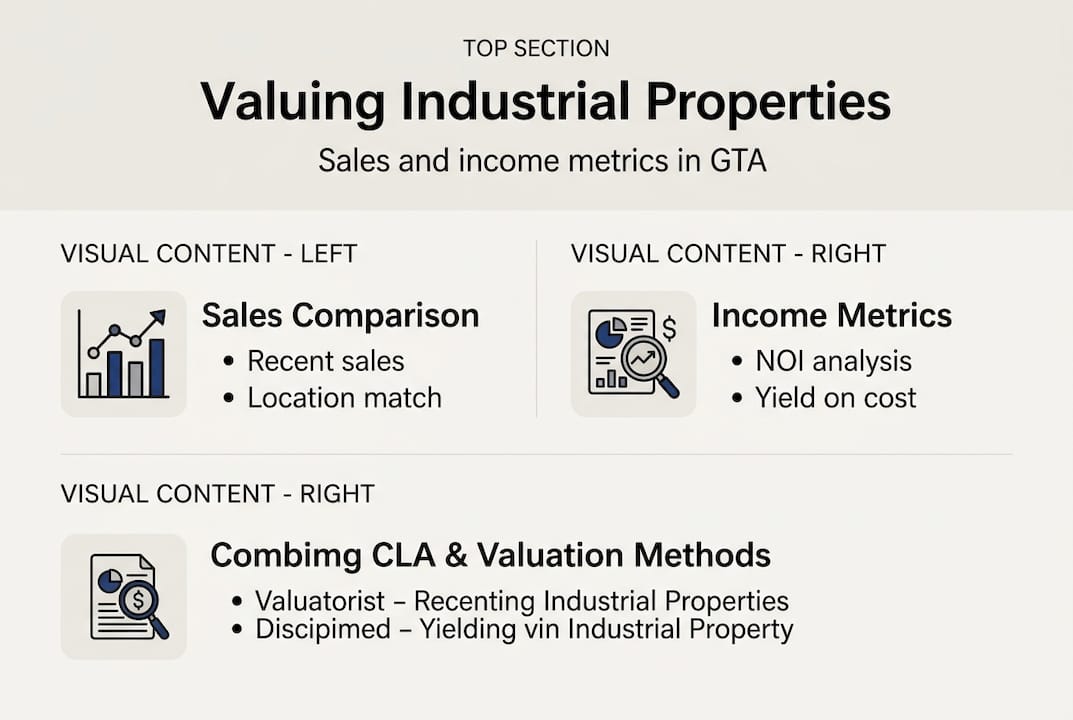
This dual analysis proves critical for value add industrial properties seeking repositioning or rent increases. Investors targeting these opportunities need to understand both current market value and potential stabilised value after improvements. A property trading at $100 per square foot with 6% yield might justify $120 per square foot if renovations and lease renewals can push yield to 7.5%.
Investors should track these essential income metrics:
- Net operating income to assess property level cash flow performance
- Capitalisation rate showing relationship between NOI and property value
- Cash on cash return measuring annual cash flow against equity invested
- Debt service coverage ratio indicating ability to meet mortgage obligations
- Internal rate of return projecting total returns over the holding period
Working with Michael Law commercial real estate advisors ensures you analyse both market comparables and income potential. Industrial properties with triple net leases to creditworthy tenants command premium valuations because buyers can underwrite stable cash flows. Properties with lease rollover risk or deferred maintenance require deeper analysis to justify pricing.
Pro Tip: Calculate your property's yield on cost using both current NOI and projected stabilised NOI after planned improvements. This shows potential buyers the value creation opportunity and justifies premium pricing based on future income potential rather than just historical performance.
How market conditions and expert brokers impact GTA industrial investment sales
The Greater Toronto Area industrial market operates with distinct dynamics that shape investment sales outcomes. Current conditions feature active trading, limited distressed sales, and strong demand driven by the logistics sector's continued expansion. E commerce growth sustains need for distribution facilities near major population centres. This demand keeps pricing firm and creates competitive bidding for well located assets.
Early engagement with brokers who specialise in industrial investment sales provides significant advantages. These professionals maintain databases of recent comparables including off market transactions that don't appear in public records. They understand subtle valuation factors like soil conditions, power capacity, and municipal development plans that affect property value. Their networks connect sellers with qualified buyers actively seeking specific property types.
Broker insights help identify optimal comparables and strategic timing for listing properties. Markets fluctuate based on interest rate changes, economic cycles, and sector specific trends. Selling during peak demand periods when multiple buyers compete generates better pricing than distressed sales during downturns. Experienced brokers recognise these windows and advise clients accordingly.
Macro factors significantly influence investor returns and market activity. Interest rate changes affect financing costs and cap rate expectations. When rates decrease, investors can afford higher property prices while maintaining target returns. Recent rate cuts have boosted investor returns by reducing debt service costs. Supply and demand balance also matters as limited new industrial development in the GTA constrains supply while logistics demand grows.
Key market influencers shaping GTA industrial investment sales include:
- Highway proximity to 401, 400, and 407 corridors affecting logistics efficiency
- Interest rate trends impacting financing costs and cap rate expectations
- Supply and demand balance between available properties and buyer competition
- Tenant quality and lease terms providing income stability and growth potential
- Municipal zoning and development policies enabling property improvements
"Partner with specialised brokers early to access premium comps and value; prioritise assets near key highways like 401 and 400; rate cuts can boost investor returns."
Working with Michael Law commercial real estate professionals who monitor these factors daily ensures you position properties strategically. Industrial assets benefit from trends like nearshoring manufacturing and last mile delivery growth. Understanding which market segments show strongest demand helps sellers highlight relevant property features and attract premium buyers.
The GTA's constrained land supply near major highways creates scarcity value for well located industrial properties. Investors who recognise this dynamic can justify premium pricing based on replacement cost and competitive positioning. Properties offering expansion potential or development rights command additional value as buyers seek long term growth opportunities.
Expert support for your GTA industrial investment sales
Navigating the complexities of industrial investment sales in the Greater Toronto Area requires deep market knowledge and strategic expertise. Michael Law brings extensive experience in GTA industrial transactions, providing clients with tailored insights that maximise property values and accelerate sale timelines. His understanding of valuation methodologies, comparable selection, and buyer motivations ensures your property reaches the right investors at optimal pricing.

Whether you're selling a warehouse in Brampton, a distribution centre in Mississauga, or a manufacturing facility in Vaughan, specialised support makes the difference between acceptable and exceptional outcomes. Explore available commercial real estate properties to understand current market positioning or review comprehensive commercial real estate services designed for industrial investors. Contact Michael Law commercial real estate today for a personalised consultation that transforms your investment sales strategy and delivers premium results in the competitive GTA industrial market.
What is investment sales in real estate FAQ
What distinguishes investment sales from other commercial real estate deals?
Investment sales focus specifically on income producing properties where buyers evaluate cash flow potential and returns. Unlike development deals centred on construction or leasing transactions focused on tenant placement, investment sales analyse rental income, operating expenses, and property appreciation potential to determine value.
How do I choose the right comparables for valuation?
Select 3 to 6 recent sales within the past 6 to 12 months matching your property's location, size, and condition. Prioritise comparables near the same highway corridors with similar ceiling heights and loading configurations. Adjust for differences in property features to establish accurate value ranges.
Why is partnering with brokers important in GTA industrial sales?
Specialised brokers access off market comparables and maintain networks of active buyers seeking specific property types. They provide market timing insights, identify optimal listing strategies, and negotiate terms that maximise sale proceeds while managing transaction complexities efficiently.
What income metrics should I track beyond sales comparison?
Monitor net operating income showing property level cash flow, capitalisation rates indicating value relationships, and yield on cost measuring returns against acquisition costs. Track cash on cash returns and debt service coverage ratios to assess financing sustainability and investment performance comprehensively.
How do market conditions affect industrial property sales in GTA?
Active markets with strong logistics demand and limited distressed sales keep pricing firm and create competitive bidding. Interest rate changes influence financing costs and cap rate expectations. Supply constraints near major highways generate scarcity value for well located properties, benefiting sellers through premium valuations.
What role does location play in GTA industrial investment sales?
Proximity to Highways 401, 400, and 407 significantly impacts property values due to logistics efficiency and tenant appeal. Properties with direct highway access command premium pricing as distribution and manufacturing tenants prioritise transportation connectivity for supply chain optimisation and reduced operating costs.