
TL;DR:
- GTA industrial market remains strong due to essential supply chain functions and e-commerce growth.
- Disciplined investors prioritize cash flow, tenant strength, and location over appreciation.
- Risks include overpaying, tenant default, and ignoring asset obsolescence, requiring careful asset selection.
While office towers sit half-empty and retail landlords scramble to fill space, the GTA industrial market keeps defying the slowdown narrative. GTA industrial investment in 2025 is tracking as the third-strongest year on record, with activity and pricing holding firm even as other asset classes retreat. For investors, tenants, and businesses operating across the Greater Toronto Area, this raises an important question: what exactly is driving this resilience, and how do you position yourself to benefit from it rather than get caught flat-footed by it? This article breaks down what resilience actually means in the context of GTA industrial property, the forces sustaining demand, how disciplined investors are thinking, and where the real risks and opportunities sit heading into 2026.
Table of Contents
- Understanding resilience in the GTA industrial market
- Why GTA industrial property remains in high demand
- The investor mindset: Why cash flow discipline matters
- Risks, limitations, and opportunities for the future
- What most GTA investors get wrong about industrial resilience
- Explore GTA industrial property opportunities with expert guidance
- Frequently asked questions
Key Takeaways
| Point | Details |
|---|---|
| GTA market resilience | Despite economic headwinds, GTA industrial property maintains high activity and stable pricing. |
| Cash flow focus | Successful investors now prioritise cash flow discipline and quality tenants. |
| Not all assets equal | Location, asset class, and tenant profile determine true resilience. |
| Balanced risk approach | Understanding both demand drivers and market risks leads to smarter investments. |
Understanding resilience in the GTA industrial market
Resilience in real estate is not simply about prices staying high. It is about a market continuing to function, transact, and attract capital even when broader economic conditions create headwinds. For GTA industrial property specifically, resilience shows up in three measurable ways: consistent transaction volume, stable pricing relative to peak, and sustained tenant demand even during periods of uncertainty.
The numbers tell a clear story. Industrial investment in the GTA hit $1.74B year-to-date in 2025, already surpassing the prior year's total. That is not a market in retreat. That is a market where buyers and sellers are still finding common ground, deals are clearing, and capital continues to flow toward this asset class with conviction.
What underpins this strength? A few key structural factors:
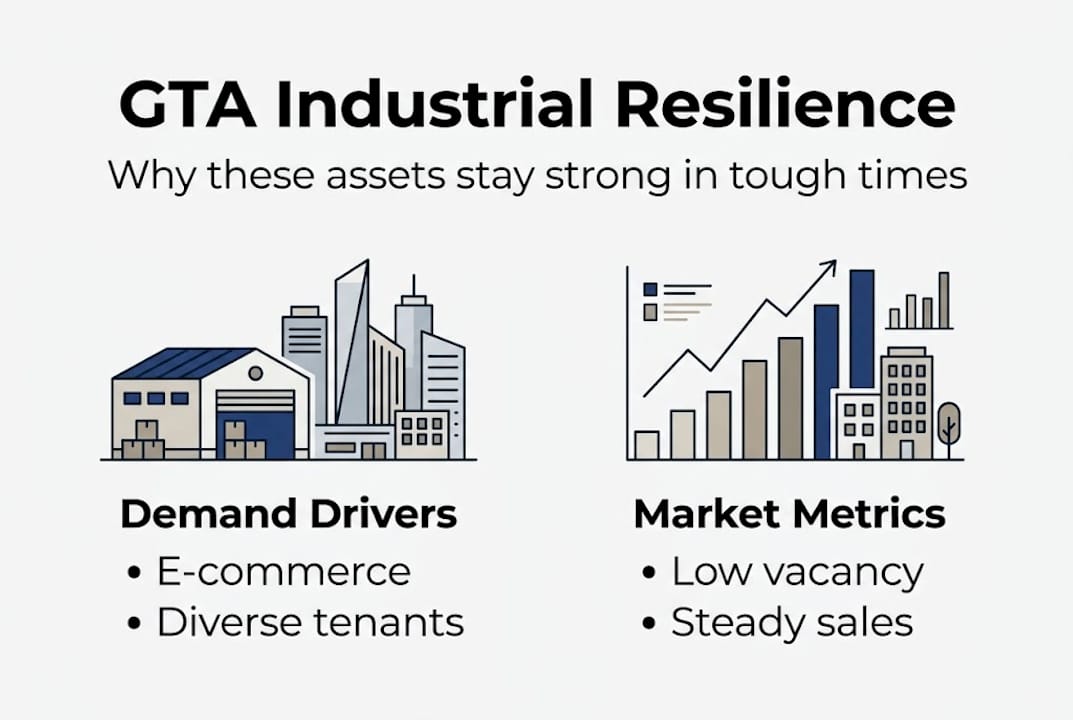
- Essential supply chain function: Industrial properties house the logistics, warehousing, and manufacturing operations that keep the economy moving. This is not discretionary space.
- E-commerce growth: Online retail continues to drive demand for last-mile fulfilment centres across the GTA, particularly in Mississauga, Brampton, and the eastern Durham Region nodes.
- Limited land and zoning constraints: The GTA has strict controls on industrial land conversion, which keeps supply tight and vacancy rates from spiking even during soft periods.
- Proximity to population: With over six million people in the Greater Toronto Area, industrial users need to be close. That proximity premium does not disappear during downturns.
For GTA investors, understanding the benefits of industrial real estate in Toronto goes beyond headline cap rates. It is about recognising that this asset class serves a function the economy cannot do without, and that functional necessity translates directly into income stability.
Those who stay on top of industrial market trends for GTA investors will tell you that the data consistently outperforms the headlines. Media narratives about real estate softening rarely distinguish between office, retail, and industrial. Treating them as a monolith is a costly mistake.
Pro Tip: When evaluating any GTA industrial investment, ground your analysis in transaction data, vacancy trends, and absorption rates rather than broad economic sentiment. The industrial story in this market is routinely more positive than the general real estate narrative suggests.
Why GTA industrial property remains in high demand
Demand for GTA industrial space does not rest on a single pillar. It is supported by several long-term structural tailwinds that make this market fundamentally different from other Canadian cities and other property types.
The first tailwind is e-commerce. Online shopping has permanently changed how goods move from supplier to consumer, and that shift requires significantly more warehouse and distribution space than traditional retail models. The second is nearshoring. As global supply chains become less predictable, Canadian businesses are pulling manufacturing and distribution closer to home, which increases demand for functional industrial space across the GTA corridor.
The third factor is the sheer diversity of users. GTA industrial buildings do not rely on a single sector. Logistics operators, food processors, pharmaceutical manufacturers, tech hardware firms, and construction suppliers all compete for the same space. That diversity insulates the market from sector-specific downturns in a way that, say, a retail strip anchored by one brand cannot replicate.
Pricing data reinforces this picture. The average sale price in 2025 YTD was $275 per square foot, roughly 7% below 2023's peak yet still historically strong by any long-term measure. A modest correction from a record high is not a sign of weakness; it is a sign of a market normalising while maintaining its structural floor.
To understand what types of properties are performing best, it helps to look at the full spectrum of types of GTA industrial properties available across the region.
| Market | Avg. sale price (2025 YTD) | Vacancy rate | Transaction volume |
|---|---|---|---|
| GTA | $275/sf | ~2.5% | Very high |
| Ottawa | ~$180/sf | ~4.1% | Moderate |
| Montreal | ~$165/sf | ~3.8% | Moderate |
| Calgary | ~$200/sf | ~5.2% | Moderate |
| Vancouver | ~$310/sf | ~2.1% | High |
The GTA sits near the top of this comparison on nearly every metric. Tight vacancy, strong pricing, and high transaction volume place it alongside Vancouver as one of Canada's two premier industrial markets. For investors focused on liquidity, there is no substitute for a market where buyers are active and deals move.
For a closer look at how space is actually being absorbed across the region, real-world examples of GTA industrial spaces illustrate how even submarkets with recent vacancy upticks are seeing leasing activity recover faster than expected.
The investor mindset: Why cash flow discipline matters
The investors who have navigated the GTA industrial market most successfully in 2025 share a common trait: they are not chasing appreciation stories. They are buying cash flow.

This is a meaningful shift from the 2021 and 2022 environment, when cap rate compression and rapid rent escalation made almost any industrial purchase look smart in hindsight. Today's market rewards discipline. Cash flow is increasingly central, with investors preferring modern, well-located Class A assets over speculative plays in secondary locations with weak tenancy.
What does disciplined underwriting look like in practice? Here are the key steps sophisticated buyers are following:
- Analyse the tenant covenant: Is the tenant financially strong? What is their industry? A logistics firm serving essential retail is a very different risk profile from a single-location startup.
- Scrutinise lease terms: Remaining lease length, rent escalation clauses, and renewal options all directly affect income stability and asset value.
- Assess functional quality: Clear height, truck court depth, power capacity, and loading configuration determine how many future tenants could use the space if the current one leaves.
- Evaluate location within the GTA: A Mississauga building near Highway 401 is structurally more liquid than a property in a secondary industrial node with limited access.
- Model conservatively: Underwrite to current market rents, not peak assumptions. Resilience means your investment holds up in a flat or declining rent environment.
The comparison between Class A and Class B or C industrial assets is worth examining closely.
| Factor | Class A | Class B/C |
|---|---|---|
| Clear height | 28ft+ | Under 24ft |
| Lease stability | Long-term, credit tenants | Shorter terms, varied quality |
| Liquidity | High buyer demand | More limited pool |
| Rental growth potential | Strong | Moderate to flat |
| Repositioning risk | Low | Higher |
Class B and C assets are not automatically bad investments, but they require more active management and carry higher re-leasing risk. For investors prioritising resilience, Class A in a proven GTA submarket is the lower-volatility choice.
Staying current on why monitoring industrial property trends matters is what separates investors who react to the market from those who anticipate it. For those ready to go further, a detailed look at industrial investment sales in the GTA provides a solid framework for evaluating specific deals.
Pro Tip: Asset selection is the single biggest lever you control. A mediocre asset in a great location will outperform a great asset in a mediocre location every time, and proactive management extends that advantage over the long term.
Risks, limitations, and opportunities for the future
Resilience does not mean risk-free. Any honest assessment of the GTA industrial market has to include the forces that could undermine returns if left unexamined.
The most significant risk right now is overpaying. With cap rates compressed and competition for quality assets intense, buyers who stretch their underwriting assumptions can find themselves in a difficult position if rents plateau or interest rates remain elevated. Paying a premium for an asset assumes the premium is justified by the income it produces. When it is not, the margin for error is thin.
Tenant risk is the second major consideration. A building is only as resilient as the business occupying it. Liquidity and location are key factors in the current market, but a strong location does not protect you from a tenant who defaults or downsizes significantly before lease expiry.
Regulatory changes add another layer of uncertainty. Zoning amendments, development levies, and environmental compliance requirements all have the potential to affect asset values and operating costs, particularly for older industrial properties that may require capital investment to remain compliant or competitive.
"Discipline and selectivity are now more important than ever in the GTA industrial market. The broad tailwinds are real, but the gap between well-chosen assets and poorly-chosen ones is widening. Investors who do their homework on location, tenancy, and functional quality will be rewarded; those who rely on the asset class label alone will be disappointed."
There are, however, genuine opportunities for those who approach the market carefully:
- Asset upgrading: Older Class B industrial buildings in strong locations can be repositioned through targeted capital improvements, such as increasing clear height, upgrading power, or modernising loading facilities, to attract stronger tenants and command higher rents.
- Tenant mix diversification: Properties with multiple tenants across different sectors are inherently more resilient than single-tenant assets, because one vacancy does not eliminate all income.
- Data-driven management: Owners who track market rents, monitor lease expirations proactively, and engage with tenants early on renewals consistently outperform those who take a passive approach.
For owners exploring how to strengthen their assets, a review of industrial property upgrade strategies offers practical guidance on where capital investment delivers the highest return.
What most GTA investors get wrong about industrial resilience
Here is the uncomfortable truth: most investors who cite "industrial resilience" as their thesis have not actually stress-tested what they own or what they are buying. They are relying on a sector-level narrative to justify an asset-level decision, and those are very different things.
The GTA industrial market as a whole is resilient. But Class A scarcity, disciplined cash flow focus, and liquidity are what create actual resilience at the individual asset level. A poorly located, functionally obsolete building with a short-term tenant does not become resilient simply because it carries the label "industrial."
We have seen this play out repeatedly. An investor acquires a dated property in a secondary submarket, reassured by the strong GTA industrial narrative, only to discover that re-leasing takes far longer than anticipated and that the buyer pool at resale is narrower than expected. The broad market story masked an asset-specific problem.
The smarter approach is to treat the market tailwind as a floor, not a ceiling. It protects you from catastrophic loss in a well-chosen asset, but it does not substitute for rigorous selection. Location within the GTA matters enormously. A Brampton or Mississauga asset near a major highway interchange commands a different risk profile than a property tucked into a congested inner-suburb with limited truck access.
Building genuine relationships with tenants and local market experts is also underrated. Tenants who feel valued and engaged are far less likely to quietly plan a departure without giving you time to respond. Local advisors surface opportunities and risks that do not appear in any data report. For a grounded, data-backed perspective on current market conditions, the market analysis from Michael Law offers insights that go beyond the surface-level headlines.
Pro Tip: Before committing to any GTA industrial acquisition, visit the submarket in person, speak with active tenants in the area, and pressure-test your assumptions with a broker who specialises exclusively in industrial. Generic advice rarely survives contact with local reality.
Explore GTA industrial property opportunities with expert guidance
The GTA industrial market offers some of the strongest fundamentals in Canadian real estate, but navigating it well requires more than market optimism. It requires knowing which locations carry real liquidity, which asset classes suit your investment goals, and how to structure deals that hold up when conditions shift.

At Michael Law Real Estate, we work exclusively in the GTA industrial sector, advising investors, tenants, and owner-users across Mississauga, Brampton, Vaughan, Markham, and the full Durham Region corridor. Whether you are looking to acquire a cash-flowing asset, optimise an existing lease, or identify the right space for your operations, we bring institutional-grade market intelligence to every engagement. Browse current GTA industrial listings to see what is available right now, or speak with an industrial real estate expert to get tailored advice for your specific situation.
Frequently asked questions
Why are industrial properties considered more resilient than office or retail?
Industrial properties meet essential demand from logistics and e-commerce, keeping vacancy low and ensuring steady cash flow even during market downturns. Unlike office or retail, the industrial sector continued robust investment in 2025 while other asset classes showed declines.
What does 'cash flow is king' mean for GTA industrial investors?
It means investors now prioritise assets with secure, reliable income over speculative growth, focusing on quality tenants and stable leases. GTA investors demonstrate disciplined underwriting and focus on modern, cash-flowing assets rather than properties reliant on rent escalation alone.
Are all GTA industrial assets equally resilient?
No; Class A, well-located properties offer stronger resilience due to liquidity and tenant demand compared to less central, older assets. Not all industrial is equally resilient, and Class A scarcity combined with location are critical differentiators.
What risks should I watch for when investing in GTA industrial real estate?
Key risks include overpaying in a compressed cap rate environment, relying on weak tenants, and ignoring functional obsolescence in older buildings. Liquidity, location, and disciplined buying are what separate sustainable assets from risky ones in this market.
Recommended
- Maximise returns on GTA industrial property: proven strategies
- GTA industrial broker advantages: 5 key benefits in 2026
- Examples of industrial property tenants for GTA owners
- Better leases: why industrial property trends matter in 2026
- Master essential industry terms for real estate investors – ClosersLeague Blog