

TL;DR:
- Finding modern industrial space in the GTA is increasingly difficult due to extremely low vacancy rates and high demand for quality facilities. The market favors well-located, high-spec assets, which command premium rents and low cap rates, while older buildings face obsolescence risks. Strategic capital improvements, location insights, and partnering with local experts are crucial for successful investment or occupancy decisions.
Finding modern industrial space in the Greater Toronto Area has never been more difficult, even with a modest wave of new supply hitting the market. Vacancy rates sit at 3.2 to 4.0% across the GTA as of early 2026, and functional availability for truly modern facilities is even tighter. Whether you are a corporate tenant scouting your next distribution hub or an investor looking to acquire an income-producing asset, the decisions you make in this environment have enormous long-term consequences. This guide cuts through the noise and gives you the frameworks, data, and perspective to act confidently.
Table of Contents
- Toronto industrial market landscape: Key facts and figures
- Types of Toronto industrial properties: What to look for
- Buy or lease? Framework for Toronto industrial users and investors
- Investment strategies: Direct ownership, REITs, and value-add
- What most guides miss about Toronto industrial real estate
- Partner with local experts for your next Toronto industrial property move
- Frequently asked questions
Key Takeaways
| Point | Details |
|---|---|
| Ultra-low vacancy challenge | Modern Toronto industrial space is in short supply, intensifying competition for top sites. |
| Choose asset type wisely | Understanding functional differences in building classes and specs is critical to long-term value. |
| Buy vs. lease framework | Long holds favour buying for wealth-building; leasing wins for flexibility or uncertain needs. |
| Tailored strategies win | Align investment approach—direct, REIT, or value-add—with your financial goals and risk tolerance. |
| Expert guidance matters | Working with experienced GTA industrial real estate professionals delivers better outcomes in a tight market. |
Toronto industrial market landscape: Key facts and figures
The GTA industrial market is one of the most supply-constrained commercial real estate environments in North America. Overall vacancy rates hover between 3.2 and 4.0% as of early 2026, but that headline figure masks a sharper reality: functional vacancy for modern specifications, meaning clear heights of 28 feet and above with adequate truck courts and upgraded power, is meaningfully lower. Availability rates sit in the 4.3 to 6.6% range, swollen by new supply that is often pre-leased or earmarked before construction completes.
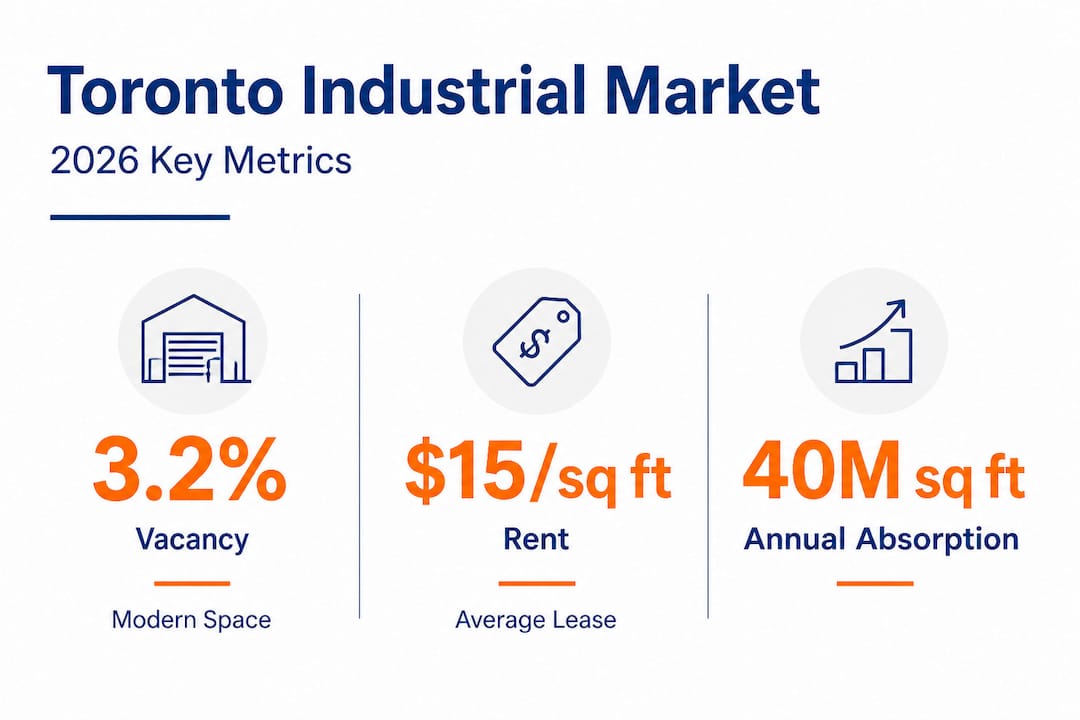
What do those numbers feel like on the ground? It means that when a quality block of space comes to market, multiple qualified tenants and investors are often competing simultaneously. Deals move fast, rent reversion at renewal is aggressive, and landlords hold significant leverage. Tracking industrial property trends is not optional in this environment; it is a basic operational necessity.
Key market metrics at a glance
| Metric | 2026 estimate |
|---|---|
| Overall GTA industrial vacancy | 3.2% to 4.0% |
| Availability rate (including new supply) | 4.3% to 6.6% |
| Average net asking rent (Class A, GTA-wide) | $17 to $22 per sq ft |
| Cap rates (stabilised Class A) | 4.5% to 5.5% |
| Average sale price per sq ft (Class A) | $350 to $500+ |
| New supply delivered (2025 to 2026 pipeline) | 15 to 20 million sq ft GTA-wide |
Cap rates have compressed considerably over the past decade and remain historically low, which tells you two things. First, institutional and private capital continues to view industrial as a reliable long-term store of value. Second, yield-on-cost calculations for new development and value-add acquisitions require sharper underwriting than ever before. You can find a broader picture of 2026 investor insights and how these figures are shaping deal structures across the region.
"Even with significant new supply entering the GTA pipeline, net absorption continues to outpace deliveries in the modern specification segment. The mismatch between demand for functionally superior space and the available quality inventory remains the defining tension in this market."
What defines a Class A industrial asset in the GTA?
Not all industrial properties are created equal. In the current market, sophisticated tenants and investors sharply distinguish between assets that will command premium rents and those that will slowly lose relevance. The features that separate Class A from everything else include:
- Clear height of 28 feet or greater (32 to 36 feet preferred for modern logistics)
- Adequate truck court depth (minimum 120 feet, 130 to 140 feet ideal for 53-foot trailers)
- Heavy power supply (400 amps three-phase at a minimum; 800 to 1,200 amps for cold storage or advanced manufacturing)
- ESFR sprinkler systems (Early Suppression Fast Response, the standard for high-rack warehousing)
- Cross-dock or rear-load configuration suited to the intended use
- LED lighting and modern HVAC with sustainability provisions
- Surface or shared grade-level parking to accommodate driver pools and fleet
You can study how these attributes play out across actual GTA industrial space examples to understand what functional superiority looks like in different submarkets from Mississauga to Markham.
Types of Toronto industrial properties: What to look for
Understanding the categories of industrial real estate helps you align your operational needs or investment thesis with the right asset type. The broad spectrum runs from modern Class A logistics facilities to aging multi-tenant industrial condominiums, and each segment carries distinct risk and return characteristics.
Class A versus Class B/C: A side-by-side look
| Feature | Class A | Class B/C |
|---|---|---|
| Clear height | 28 ft to 36 ft | 16 ft to 24 ft |
| Truck court depth | 120 ft to 140 ft | 60 ft to 100 ft |
| Power supply | 800A to 1,200A | 200A to 400A |
| Sprinkler system | ESFR | In-rack or wet pipe |
| Lease rate premium | High | Moderate to low |
| Functional obsolescence risk | Low | High |
| Investor demand | Very high | Moderate |
| Best fit | Modern logistics, e-commerce, 3PL | Light manufacturing, service trade |
Functional obsolescence in older stock, meaning low clear heights under 28 feet, poor truck access, and inadequate power, is a growing concern in the GTA as tenant requirements continue to escalate. Flight to quality is real, and it accelerates when tenants have renewal options that allow them to relocate to newer buildings at competitive rents. Knowing which assets carry obsolescence risk protects you from acquiring or leasing into a value trap.
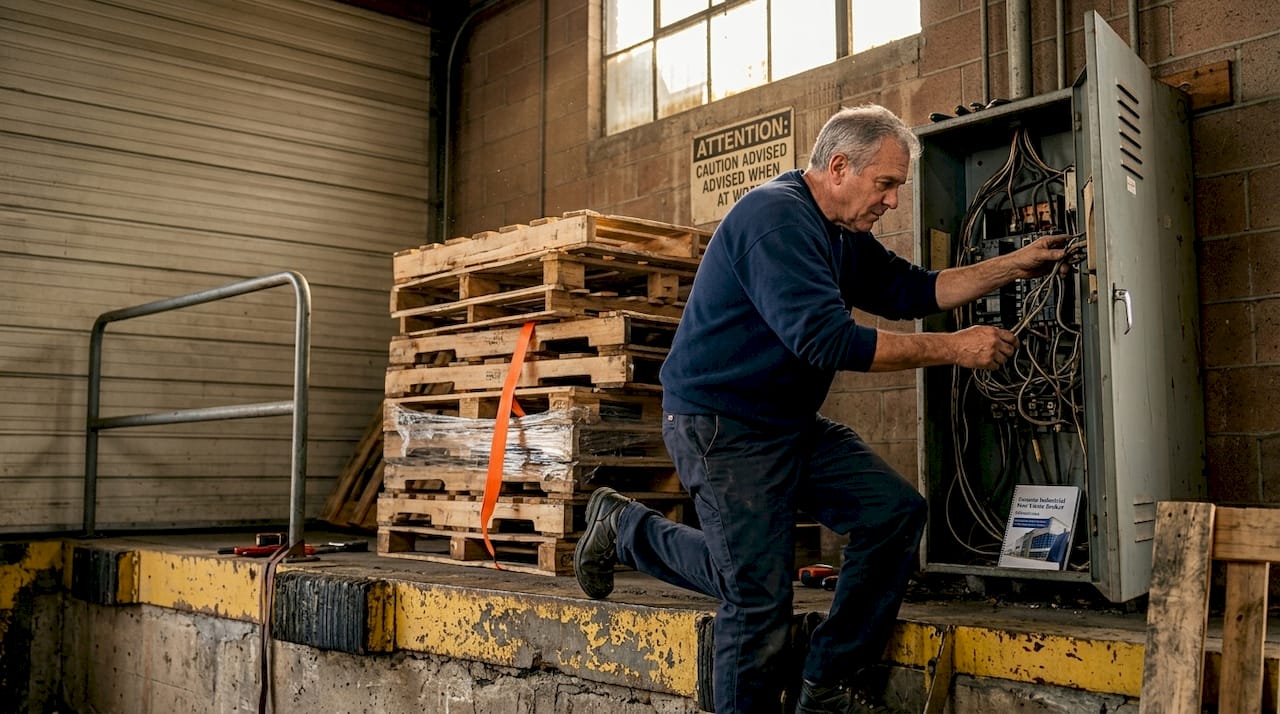
For a deeper breakdown of asset categories across Toronto's submarkets, the full overview of industrial property types covers everything from stacked industrial concepts to large-bay distribution centres.
How to qualify a building's long-term operational value
Before committing to any industrial asset, run through this evaluation sequence:
- Confirm clear height and structural grid. Measure actual clear height at the lowest obstruction, not at the peak. Column spacing should accommodate modern racking layouts without costly workarounds.
- Audit the electrical service. Request the utility account history and any electrical permits. Insufficient power is one of the costliest problems to fix post-occupancy.
- Assess truck court geometry. Walk the full court and simulate turns with trailer templates. Poor court geometry is a productivity killer that no lease incentive package can fully compensate for.
- Review zoning and permitted uses. Confirm the official plan designation allows your specific use, particularly for anything involving retail components, outdoor storage, or regulated materials.
- Inspect the roof and building envelope. Large-bay roofs are expensive to replace. Know the remaining useful life of the membrane before negotiating your deal.
- Check proximity to highway interchanges and labour pools. Operational logistics costs are shaped heavily by last-mile access and your ability to recruit and retain workers.
Pro Tip: Older buildings in established industrial nodes often carry hidden operational advantages that newer suburban facilities cannot replicate. These include superior highway interchange access developed over decades of infrastructure investment, established subcontractor networks, and mature utility infrastructure. A 1990s building with 24-foot clear height in a core Mississauga node may outperform a brand-new 30-foot clear building in a secondary location simply because of its addressable labour market and freight access.
Understanding the highest-demand submarkets helps you weigh location premiums against building specification trade-offs with much greater precision.
Buy or lease? Framework for Toronto industrial users and investors
This is the question that shapes everything else. And it does not have a universal answer. The right decision depends on your time horizon, capital structure, operational flexibility needs, and appetite for real estate as a core holding.
When buying makes sense
Buying favours a long hold, generally a minimum of 10 years, where the equity build and land appreciation outweigh the opportunity cost of capital tied to real property. In a supply-constrained market like the GTA, ownership effectively locks in your occupancy cost in a rising-rent environment. You are no longer at the mercy of a landlord's renewal expectations.
The buy versus lease analysis for corporate users hinges on several factors: lease offers flexibility but builds no equity, while purchase builds real wealth in a supply-constrained environment where land values trend upward. The fixed-cost nature of ownership also simplifies long-range budgeting.
A quick DSCR check
Debt Service Coverage Ratio, or DSCR, is the simplest first-pass tool for evaluating whether acquisition financing makes sense. Divide your net operating income (rent you would otherwise pay, less operating expenses if owner-occupied) by your annual debt service (mortgage principal plus interest). A DSCR above 1.25 gives you meaningful cushion; below 1.0 means the property does not cash-flow at current prices, and you need a compelling appreciation thesis to justify the purchase.
Buy vs. lease trade-off summary
| Factor | Buying | Leasing |
|---|---|---|
| Equity accumulation | Yes, strong in GTA land market | None |
| Occupancy cost certainty | High (fixed-rate debt) | Low (rents reset at renewal) |
| Capital deployment | Large upfront | Preserved for operations |
| Flexibility to relocate | Low | High |
| Customisation control | Full | Limited by lease terms |
| Balance sheet impact | Capitalised asset | Off-balance-sheet (IFRS 16 nuances apply) |
| Best for | Long-hold operators, investors | Growing or evolving operations |
Advantages of buying:
- Eliminates exposure to rent escalation in a tight market
- Builds intergenerational wealth for family-owned businesses
- Unlocks modification and expansion rights without landlord approval
- Offers depreciation and interest deductions for qualifying businesses
Advantages of leasing:
- Capital stays available for core business investment
- Ability to right-size space at renewal without selling an asset
- No exposure to capital repairs or roof replacement cycles
- Faster market entry, particularly when purpose-built supply is limited
Reviewing rent assessment strategies before entering any lease negotiation will sharpen your understanding of where market rents truly sit versus landlord asking rates.
Pro Tip: Sale-leaseback structures deserve serious consideration for owner-users who want to unlock embedded equity without relocating. You sell the building to an investor, lease it back at market rates, and redeploy the sale proceeds into your core business or other investments. In a market where industrial land values have appreciated sharply, the capital released can materially outpace the future rent cost on a net present value basis.
Investment strategies: Direct ownership, REITs, and value-add
For investors, the Toronto industrial market offers multiple access points. Each comes with a meaningfully different risk and return profile, operational burden, and capital requirement.
Comparing the main strategies
| Strategy | Control | Liquidity | Returns | Capital required | Complexity |
|---|---|---|---|---|---|
| Direct ownership | Very high | Low | High (value-add potential) | High | High |
| REITs | None | Very high | Moderate (dividend-driven) | Low | Low |
| Value-add acquisition | High | Low to moderate | Very high (if executed) | Moderate to high | Very high |
Direct ownership provides control, value-add execution, and tax structuring benefits that no REIT structure can replicate. REITs, by contrast, offer broad diversification and daily liquidity, which is particularly valuable for investors who want industrial exposure without property management obligations. Industrial assets account for roughly 45% of CRE allocation among sophisticated investors, reflecting the sector's structural tailwinds against office softening.
Evaluating which strategy fits your profile
- Define your return requirement. Direct ownership targets unlevered yields of 5.0 to 7.0%+ on value-add plays; REIT distributions typically deliver 3.5 to 5.0% annually with lower volatility.
- Assess your liquidity tolerance. Industrial buildings can take 6 to 12 months to transact in a normalised market. If capital flexibility matters, partial REIT exposure hedges that illiquidity.
- Identify your operating capacity. Value-add deals require hands-on asset management: lease-up, capital improvement oversight, tenant relations. Institutional operators with full teams are better positioned than passive investors.
- Size your equity base. Direct GTA industrial acquisitions in the $5M to $20M range are the most competitive. Below $5M, industrial condos and small-bay strata offer accessible entry points.
- Consider your tax situation. Depreciation recapture, capital gains treatment, and HST on commercial transactions all influence after-tax returns significantly.
Why industrial keeps outperforming
The structural case for industrial over office and retail is well established. GTA industrial absorption trends show that demand continues to recover and grow, driven by e-commerce penetration, nearshoring of manufacturing, and growing cold-chain logistics requirements. Office vacancy in Toronto's downtown core, meanwhile, remains elevated, and retail faces ongoing disruption.
There are also compelling reasons to explore the industrial asset benefits specific to the GTA context, where land scarcity, infrastructure investment, and population-driven consumption growth underpin long-term demand in ways that most other asset classes simply cannot match.
Emerging value drivers investors should monitor:
- ESG premiums: Buildings with green certifications (LEED, BOMA BEST) and solar-ready infrastructure are beginning to command lease and sale premiums. ESG considerations are moving from optional to expected in institutional capital conversations.
- Power infrastructure: As electric vehicle fleet adoption grows, tenants increasingly prioritise sites with transformer capacity for large-scale charging installations.
- Cold-chain and pharma: High-specialisation uses are driving above-market rents for purpose-built facilities, representing an outsized return opportunity for developers and value-add buyers.
What most guides miss about Toronto industrial real estate
Most market guides focus on the numbers: vacancy rates, cap rates, rent per square foot. Those metrics matter enormously. But the decisions that generate outsized returns or prevent costly mistakes rarely come down to the headline figures. They come down to execution details that only become visible once you are deep in a deal or an occupancy.
The most common misconception we encounter is the assumption that older industrial stock will simply hold its value or command competitive rents without capital investment. It will not. A building with 20-foot clear height in a mature Etobicoke node is not competing with new Class A supply in Brampton; it is competing with every other 20-foot building in that submarket, and tenants are becoming more sophisticated about functional fit every year. Assuming appreciation will bail out a functionally inferior asset is a form of market complacency.
Capital improvement timing matters more than market timing. Investors who spend on roof replacement, power upgrades, and truck court resurfacing before lease renewal negotiations preserve leverage. Those who defer capital investment lose tenants to better-maintained buildings and then spend more to attract replacement tenants at lower rents. The math on proactive capital spending almost always works in your favour in a tight market.
Operational inefficiencies are the silent value destroyers most buyers and tenants underweight during due diligence. A building with poor column spacing forces inefficient rack layouts, which reduces storage capacity, which raises per-unit occupancy cost, which makes the business case for staying at renewal weaker. These compounding effects are rarely modelled in acquisition underwriting, and they are almost never discussed in standard listing materials.
Pro Tip: Build a diligence checklist that goes beyond the standard property condition report. Include operational simulations: test traffic flow for your truck and staff volumes, measure real clear height at multiple points, run electrical load calculations against your current and projected equipment. Most buyers and tenants skip these steps and discover the gaps after signing.
There is also a market psychology dynamic worth naming directly. The flight-to-quality narrative creates herd behaviour that can push pricing on premium assets to levels that fully price in optimistic assumptions, while leaving genuine value in well-located second-generation buildings that require modest capital and thoughtful repositioning. The investors who understand trends and risks in industrial real estate at a granular level are the ones who can see through the crowd and find conviction where others see uncertainty.
Partner with local experts for your next Toronto industrial property move
Navigating the GTA industrial market in 2026 requires more than market awareness. It requires boots-on-the-ground expertise, access to off-market opportunities, and the analytical rigour to structure transactions that hold up under scrutiny.
Michael Law Real Estate, affiliated with Lennard Commercial Realty, brings that combination to every client engagement. Whether you are searching through Toronto industrial property listings for your next acquisition or evaluating a lease renewal, we provide institutional-grade analysis without the institutional overhead. Our coverage spans the full GTA, including specialised knowledge of Markham industrial real estate and every other major submarket from Hamilton to Oshawa. From buy-versus-lease modelling to tenant representation and investment sales advisory, we help you move from uncertainty to conviction.
Frequently asked questions
What is the current vacancy rate for Toronto industrial properties in 2026?
Vacancy rates sit at 3.2 to 4.0% across the GTA as of early 2026, with functional vacancy for modern, high-clear facilities even tighter than those headline figures suggest.
Is it better to buy or lease an industrial property in the GTA?
Buying favours long-term wealth and occupancy cost certainty for operators planning to hold for 10 or more years; leasing offers flexibility and preserves capital for businesses whose space requirements may shift.
What features make an industrial property Class A in Toronto?
Class A specifications include clear heights of 28 feet or greater, adequate truck court depth of 120 feet or more, heavy three-phase power, and ESFR sprinkler systems suited to modern warehousing and logistics operations.
How do tariffs and trade risks impact Toronto industrial property value?
Tariffs and trade tensions can slow net absorption, which raises the importance of investing in well-located, highway-adjacent, power-ready assets that remain attractive to a broad range of tenants regardless of trade conditions.
Are green certifications or ESG upgrades important for Toronto industrial assets?
ESG and green financing premiums are emerging as measurable value drivers, particularly for institutional owners and tenants whose corporate sustainability commitments influence real estate decision-making at the portfolio level.