

TL;DR:
- Choosing an optimal site is a critical, multi-stage decision that directly influences operational efficiency and long-term growth.
- In the GTA, understanding local infrastructure, zoning, topography, and market trends is essential to avoid costly mistakes and ensure project viability.
Choosing the wrong location for an industrial or logistics facility is not a recoverable mistake. It locks you into years of operational friction, inflated costs, and missed growth potential. Yet most business owners treat site selection as a real estate search rather than a strategic decision. The site selection process is a structured, multi-stage discipline that weighs dozens of interconnected variables, from power grid capacity to workforce proximity to topography, before committing a single dollar to a location. In the GTA's competitive industrial market, where supply is constrained and land is finite, getting this process right in 2026 matters more than ever.
Table of Contents
- Key takeaways
- What is the site selection process and why it matters
- The seven-stage site selection process
- Technology and data analytics in modern site selection
- Site-specific considerations for GTA industrial facilities
- Best practices for managing the site selection process
- My perspective on site selection in the GTA market
- Work with Mlawrealestate on your next site decision
- FAQ
Key takeaways
| Point | Details |
|---|---|
| Site selection is multi-stage | The process spans at least seven phases, from defining operational requirements to post-occupancy validation. |
| Power is the first filter | Grid capacity and interconnection timelines now function as the primary screening gate for energy-intensive industrial users. |
| Technology speeds up analysis | Modern site selection software compresses weeks of evaluation into hours by processing multiple data layers simultaneously. |
| Topography affects your budget | Sites with significant grade changes add millions to construction costs and delay timelines before operations begin. |
| Local expertise matters | GTA-specific regulatory, zoning, and infrastructure factors require market knowledge that generic processes cannot replicate. |
What is the site selection process and why it matters
The site selection process is a structured methodology for identifying, evaluating, and choosing the optimal location for a business facility based on defined operational, financial, and strategic criteria. For industrial and logistics users, it goes well beyond finding available square footage. It is a systematic analysis of whether a specific site can support your operations today and ten years from now.
At its core, site selection criteria for industrial facilities fall into several distinct categories:
- Transportation access: Proximity to major highways (400-series in Ontario), intermodal terminals, rail lines, and port facilities directly affects freight costs and delivery timelines.
- Power availability: Adequate electrical capacity and reasonable interconnection timelines are non-negotiable for manufacturing, cold storage, and logistics automation.
- Workforce supply: Access to skilled trades, logistics workers, and management talent within a commutable radius shapes your long-term hiring capacity.
- Zoning and land use: Municipally designated employment lands, permitted uses, and setback requirements determine what you can legally build and operate.
- Topography and site conditions: Grade, soil bearing capacity, and drainage affect construction costs, timeline, and long-term facility performance.
- Environmental conditions: Legacy contamination, flood plain mapping, and provincial regulatory requirements all influence feasibility and cost.
- Growth potential: Can the site accommodate a facility expansion in five years without triggering a full relocation?
In the GTA specifically, these criteria play out against a backdrop of extremely limited industrial land supply. Municipalities like Brampton, Vaughan, and Mississauga are running low on serviced, build-ready employment land. That scarcity means sites that check most but not all of these boxes still get serious consideration. Understanding the relative weight of each criterion for your specific operation is what separates a sound site selection decision from a costly compromise.
Quantitative measures such as distance to the nearest 400-series interchange, available power in megawatts, and construction cost per square foot sit alongside qualitative factors like municipal responsiveness and community relations. Both sets of data belong in your analysis. Treating site selection as primarily a financial modelling exercise, or purely an intuitive judgement call, produces suboptimal outcomes either way.
The seven-stage site selection process
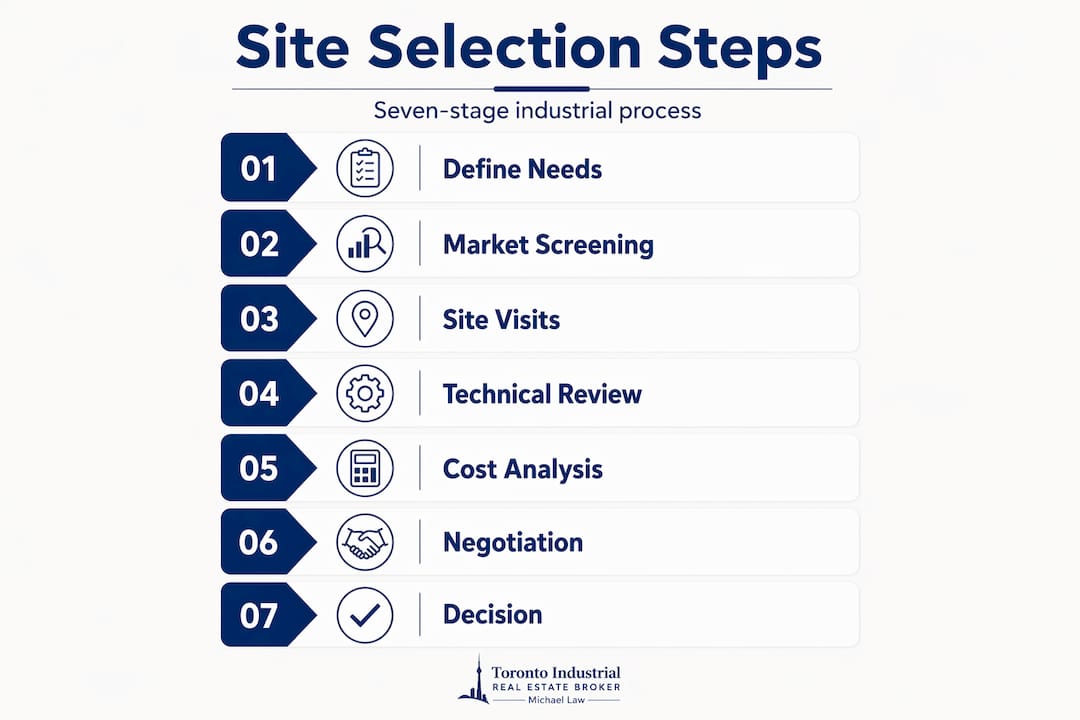
Site selection projects typically unfold in three broad phases: initial broad screening, detailed review with site visits, and final selection with ROI analysis and incentive negotiation. Within that arc, a seven-stage framework organises the work from the first strategic conversation to post-occupancy performance review.
Here is how each stage functions in practice for an industrial or logistics user in the GTA:
-
Define the growth mandate. Establish why you need a new or different site. Is it capacity expansion, market proximity, lease expiry, or a supply chain realignment? The mandate dictates every subsequent decision and prevents scope creep later in the process.
-
Set technical non-negotiables. Before screening a single property, document the requirements that cannot be compromised. Minimum clear height, power load requirements, truck court depth, rail access, and maximum distance from a specific distribution hub all belong here. These filters eliminate unsuitable sites early and cheaply.
-
Conduct macro-level market screening. Evaluate broad geographies based on labour market data, transportation infrastructure, tax and incentive programmes, and utility capacity. In the GTA context, this means comparing submarkets like the Highway 410 corridor in Brampton against the Highway 7 corridor in Markham or the East Durham nodes in Ajax and Whitby.
-
Identify and shortlist candidate sites. Apply your non-negotiables and macro filters to generate a shortlist of three to six properties. At this stage, you are working primarily with available data, aerial imagery, and broker intelligence, not site visits.
-
Conduct detailed comparative analysis. Pull environmental reports, zoning confirmations, utility capacity letters, and traffic studies on shortlisted sites. Build side-by-side cost models that include land or lease cost, construction or fit-out budget, operating costs, and incentives.
-
Complete site visits and stakeholder engagement. Visit every shortlisted property with your engineering, operations, and finance leads. Meet with municipal planning staff and utility providers. Nothing in a data room replaces the intelligence gathered by walking a site and asking direct questions of the people who control its approvals.
-
Finalise, negotiate, and validate. Select your preferred site, negotiate lease or purchase terms, and complete final due diligence. After occupancy, measure actual performance against your original projections to sharpen future decisions.
Pro Tip: Build your technical non-negotiables list before you engage with any broker or listing. The market will always present attractive options that almost meet your requirements. A predefined list of absolutes protects you from being persuaded into a site that creates operational problems three years after you move in.
Common pitfalls at this stage include over-weighting lease rate at the expense of total occupancy cost, skipping environmental screening on attractive sites, and compressing the stakeholder engagement phase when timelines get tight. All three create expensive problems downstream.

Technology and data analytics in modern site selection
The way site location analysis is conducted has changed materially in the last three years. Advanced site selection software now compresses site evaluation from weeks to hours by simultaneously processing complex data layers that previously required separate manual research. For decision-makers managing time-sensitive transactions in a competitive market, this shift is consequential.
The key technologies driving this change include:
- Geographic Information Systems (GIS): Spatial mapping of zoning boundaries, infrastructure corridors, flood plains, and demographic data in a single visual interface.
- GeoAI and predictive modelling: GeoAI tools forecast long-term market and growth trends to assess whether a site will still serve your operational needs in ten or fifteen years.
- Environmental data platforms: Automated screening of historical land use, contamination registries, and provincial environmental databases reduces early-stage due diligence time.
- Labour market analytics: Real-time access to commute shed analysis, wage benchmarking, and workforce availability data by submarket.
- Infrastructure capacity layers: Utility provider data integrated into GIS platforms to flag power constraints before engaging engineering consultants.
The power question deserves specific attention. Grid capacity and interconnection timelines have become the primary screening criteria for energy-intensive industrial users. Large industrial projects, particularly those incorporating automation, cold chain systems, or on-site data infrastructure, need reliable load capacity well before they need a lease rate.
Pro Tip: Set power load requirements as a hard filter in any digital screening tool before looking at a single property listing. Sites that cannot deliver your required load within your project timeline should be removed from consideration immediately, regardless of how attractive the location or price appears.
One caution about technology-led site selection: automation surfaces options it cannot fully evaluate. Defining strict technical non-negotiables before running any software analysis prevents the process from generating a long list of technically filtered but operationally unsuitable candidates. The tool accelerates analysis. Your judgement defines what the tool is looking for.
Site-specific considerations for GTA industrial facilities
The GTA presents a specific set of site conditions that generic site selection methods do not fully account for. Understanding these local factors is the difference between a site that performs well in a model and one that performs well in operation.
The table below compares the key site evaluation factors against their practical implications for industrial users in this market:
| Site factor | What to evaluate | GTA-specific risk |
|---|---|---|
| Power availability | Available load in MW, substation proximity, interconnection timeline | Hydro One capacity constraints in several western GTA nodes |
| Topography | Grade changes, cut-and-fill requirements, drainage patterns | Cost and schedule impact; topography significantly affects construction budgets |
| Encroachment risk | Proximity to residential areas, intensification overlays | Satellite image analysis is critical to identify future noise and restriction risk |
| Zoning and permissions | Employment land designation, permitted ICI uses, setbacks | Municipal official plan updates creating uncertainty in some nodes |
| Environmental conditions | Phase I/II ESA status, flood mapping, heritage overlays | Brownfield sites in the 400-series corridors require careful early screening |
| Growth modelling | Expansion land available, lease flexibility, municipal growth plans | GeoAI forecasting helps model which submarkets will remain viable for industrial use through 2035 |
The encroachment issue is particularly relevant in the GTA right now. Residential intensification pressure around established employment lands in Mississauga and north Toronto is real and accelerating. A site that is currently buffered from residential uses may face complaints, noise by-laws, and operational restrictions within five to seven years if the surrounding area rezones. Reviewing provincial and municipal planning documents as part of your site location analysis is not optional. It is a basic risk management step that many occupiers skip until they are already in the building.
Power demand for large industrial projects can range from 200 MW to 600 MW for the most energy-intensive uses, which makes the availability of grid capacity a decisive factor before any other analysis begins. Even for mid-sized logistics facilities with 5 to 10 MW requirements, understanding Hydro One's interconnection queue and timeline for your target submarket is work that must happen in Phase 1, not Phase 3.
Best practices for managing the site selection process
Site selection is unique to each firm and project. Smaller companies often manage the process with an internal executive team, while major industrial users and developers engage specialised consultants for complex or large-scale projects. The right approach depends on your team's capacity, the complexity of your requirements, and the stakes involved.
Regardless of whether you manage the process in-house or retain outside advisors, the following practices consistently produce better outcomes:
-
Assemble a cross-functional team early. Operations, finance, legal, and HR all have legitimate input on site requirements. Waiting to involve them until a preferred site has been identified creates conflict and delays. Bring them into the mandate definition phase.
-
Engage municipalities before you need them. Planning and economic development staff in Brampton, Vaughan, and Hamilton, for example, respond differently to companies that have done their homework than to cold inquiries at the permit stage. Early conversations about servicing capacity, permit timelines, and development charge expectations shape your cost modelling before you commit.
-
Negotiate incentives as part of the site package. Development charge deferrals, property tax incentive programmes, and provincial investment attraction tools are negotiable. They belong in your site comparison model as a line item, not as an afterthought once a site is selected.
-
Model the total occupancy cost, not the headline rate. For industrial facilities in the GTA, the gap between net rent and total occupancy cost, including realty taxes, utilities, and maintenance obligations, can be 40% or more of the headline figure. Comparing sites on rent per square foot alone is analytically insufficient.
-
Avoid the sunk cost fallacy. When detailed due diligence reveals a disqualifying issue on your preferred site, the right decision is to move to the next candidate. Teams that have invested significant time and political capital in a preferred option sometimes rationalise past problems rather than abandoning a flawed site. This is one of the most common and expensive errors in the site selection process.
For GTA industrial projects, working with an advisor who has deep commercial due diligence experience in this specific market dramatically reduces the time and risk embedded in Phases 1 through 3 of the process.
My perspective on site selection in the GTA market
In my experience, the single most consistent mistake I see from business owners entering the GTA industrial market is treating site selection as a search function rather than a decision framework. They engage with properties before they have defined their requirements with any rigour. The market shows them what is available, and they adjust their criteria to fit. That is backwards, and it produces compromised outcomes.
I have seen companies lease facilities in nodes that looked strong on paper, only to discover that utility capacity could not support their planned automation investment, or that the municipality's intensification plans would put residential development directly adjacent to their loading docks within three years. Both of those issues are discoverable in Phase 1 if you know what questions to ask.
My strong view is that power and infrastructure assessment should happen before any financial modelling begins. The cost of a professional infrastructure review at the shortlisting stage is minimal compared to the cost of discovering a disqualifying grid constraint after you have negotiated a lease.
I also think the market intelligence dimension of site selection is undervalued. Understanding which GTA submarkets are gaining or losing industrial property resilience over the next decade shapes where a ten-year site commitment actually makes sense. A site in a submarket with strong fundamentals today but structural supply constraints and rezoning pressure next cycle is a different kind of risk than it appears at signing.
The companies that do this well treat site selection as a capital allocation decision. They bring the same analytical discipline to choosing a location as they would to acquiring equipment or evaluating a merger. That level of rigour consistently produces better long-term outcomes.
— Michael
Work with Mlawrealestate on your next site decision
Mlawrealestate specialises in industrial site selection and tenant representation across every major GTA corridor, from Mississauga and Brampton in the west to Markham, Pickering, and Oshawa in the east. If you are working through the site selection process for a logistics, warehousing, or manufacturing facility, the team brings transaction experience, proprietary GTA market intelligence, and direct relationships with municipal planning offices across the region.
Browse available GTA industrial listings or connect directly with Michael through his advisory profile at Lennard Commercial Realty to discuss your site requirements. Whether you are at the mandate definition stage or narrowing down a shortlist, getting the right advisory support early makes the process faster and the outcome stronger.
FAQ
What is the site selection process?
The site selection process is a structured, multi-stage method for identifying and evaluating locations for a business facility based on operational, financial, and strategic criteria. For industrial users, it typically spans seven stages from growth mandate definition through to post-occupancy performance validation.
What are the key site selection criteria for industrial facilities?
Core criteria include transportation access, power and utility availability, workforce supply, zoning and land use permissions, topography and soil conditions, environmental status, and long-term growth potential. In the GTA, grid capacity and proximity to major highway corridors carry particular weight.
How long does the site selection process take?
Timeline varies by project complexity, but most industrial site selections in the GTA range from three to twelve months. Advanced site selection software can compress early-stage screening significantly, but stakeholder engagement, due diligence, and negotiations require adequate time regardless of technology.
When should a company hire a site selection consultant?
Larger or more complex projects, particularly those involving significant power requirements, brownfield conditions, or multi-site comparisons across different municipalities, benefit from specialised advisory support. Smaller firms with straightforward requirements often manage the process with an internal executive team supported by a knowledgeable local broker.
What is the biggest risk in the site selection process?
The most common and costly risk is committing to a site before completing rigorous infrastructure and environmental screening. Discovering that a site cannot support your power requirements or faces encroachment from residential rezoning after signing a long-term lease is both expensive and operationally disruptive.