

TL;DR:
- Skipping property due diligence often leads to costly mistakes, as it is essential for verifying property risks.
- In GTA industrial real estate, thorough assessments of legal, physical, environmental, and regulatory aspects are crucial before closing.
Skipping property due diligence is one of the most expensive mistakes an investor can make, yet it happens far more often than you would expect. Many buyers treat it as a formality rather than what it actually is: a structured investigation that either confirms your assumptions or exposes the risks hiding beneath a deal. Understanding what is property due diligence means understanding where your real protection lies in any transaction. This guide breaks down every layer of the process, with a specific focus on GTA industrial real estate where the stakes, and the complexities, are higher than most asset classes.
Table of Contents
- Key takeaways
- What property due diligence means in real estate
- Key components of the due diligence process
- Property condition assessments for industrial real estate
- Using due diligence findings to negotiate
- Timelines, legal considerations, and common pitfalls
- My perspective on due diligence in GTA industrial deals
- Work with a GTA industrial real estate expert
- FAQ
Key takeaways
| Point | Details |
|---|---|
| Due diligence is a process, not a moment | It covers legal, physical, financial, and regulatory reviews between offer acceptance and closing. |
| Industrial properties need specialist assessments | Commercial Property Condition Assessments go far beyond residential inspections and follow formal standards. |
| Findings directly affect deal terms | Discovered issues can justify price renegotiation, credit requests, or contract termination. |
| Zoning and environmental compliance are non-negotiable | GTA municipalities have specific industrial zoning rules that must be confirmed before any acquisition. |
| Local expertise shortens your risk window | Working with GTA-specific advisors reduces the chance of missing market, legal, or physical red flags. |
What property due diligence means in real estate
Property due diligence is the set of reasonable steps a buyer takes to investigate a property before closing, covering legal, financial, physical, and market considerations. It is not a single inspection or a title search in isolation. It is a layered verification process that runs through every material aspect of a property before you commit your capital.
Timing matters here. Due diligence typically begins after an offer has been accepted and runs through a contractual window before the closing date. Think of it as a structured verification period, not a single moment, but a process where every assumption in your offer gets tested against reality. This is the window where you confirm what the seller has represented and uncover what they have not.
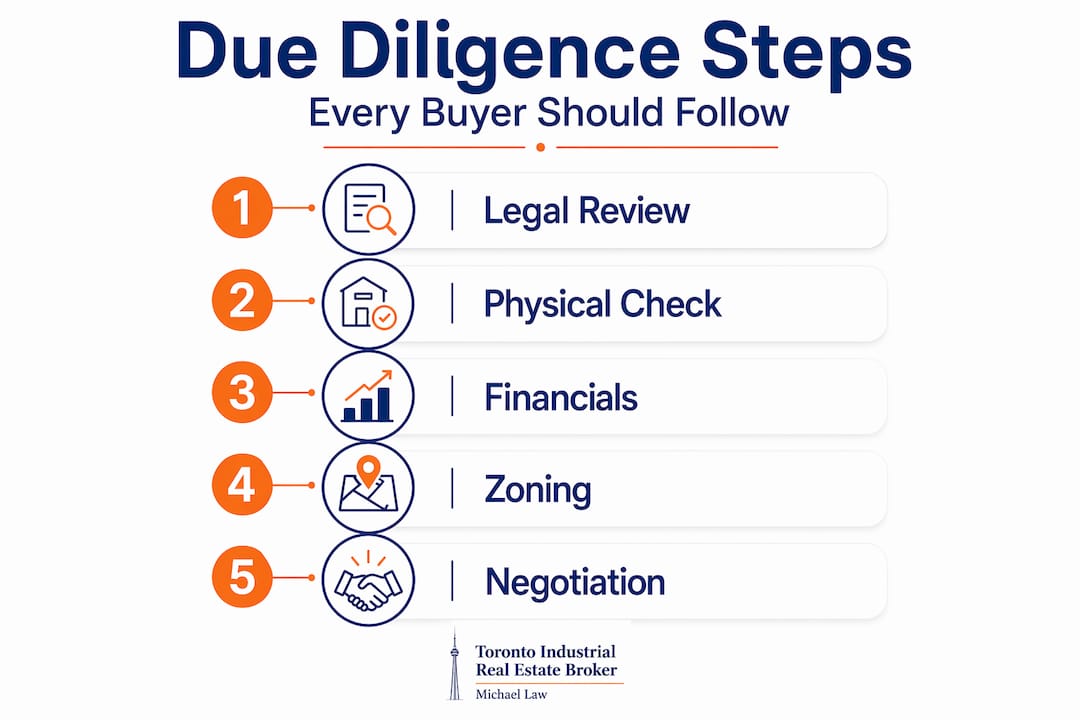
The scope of due diligence in commercial and industrial real estate is considerably broader than what most people associate with buying a home. Residential buyers deal with home inspections, title searches, and a few regulatory checks. Industrial buyers are contending with environmental site assessments, complex zoning frameworks, multi-tenant lease reviews, building system evaluations, and detailed financial underwriting. Each of these streams is capable of changing your position on the deal.
Here is what a thorough due diligence process addresses for GTA industrial buyers:
- Legal and title review: Confirms clear ownership, identifies liens, mortgages, and encumbrances
- Physical condition assessment: Evaluates structural integrity, mechanical systems, roofing, and building envelope
- Environmental review: Phase I and Phase II Environmental Site Assessments to identify contamination or compliance issues
- Zoning and regulatory compliance: Verifies permitted industrial uses and confirms no outstanding orders or violations
- Financial and lease review: Analyses existing leases, rental income, operating costs, and tenant covenant strength
- Market analysis: Benchmarks pricing, vacancy, and absorption rates for the specific GTA submarket
Pro Tip: Start assembling your due diligence team before your offer is accepted. Pre-identifying your environmental consultant, commercial lawyer, and property condition assessor means you lose zero time once the clock starts on your due diligence period.
Key components of the due diligence process
A reliable property due diligence checklist starts with title and legal document review. This means confirming the seller actually holds clear title, and identifying any registered liens, mortgages, easements, or restrictive covenants that affect what you can do with the property. An easement for a utility corridor running through a warehouse yard, for example, can limit future expansion plans and affect the property's market value.
Zoning compliance deserves its own focused review in the GTA context. Industrial zoning classifications vary across Toronto, Mississauga, Brampton, Vaughan, and the Durham Region municipalities. A property zoned for light industrial use in one municipality may not permit the same occupancy or operational intensity as one zoned heavy industrial in another. Understanding industrial zoning in the GTA is a non-negotiable step in any real estate due diligence process.
Environmental review is where many investors underestimate the depth of investigation required. Phase I assessments review historical land use records and conduct site reconnaissance to identify recognised environmental conditions. If Phase I findings raise concerns, a Phase II assessment involves actual soil and groundwater sampling. For industrial properties in older GTA nodes like the inner Toronto industrial belt or parts of Hamilton, legacy contamination from prior uses is not uncommon.
The financial review component deserves equal rigour. For income-producing industrial properties, this means examining existing lease agreements in detail:
- Confirm lease expiry dates and any renewal or termination options held by tenants
- Review tenant covenant strength, including credit history and business stability
- Examine gross rent versus net rent structures and what operating costs are recoverable
- Validate actual operating expenses against the seller's representations
- Assess rent levels against current market rates to understand whether the property is under or over-rented
- Review any outstanding capital expenditure obligations or landlord commitments embedded in leases
| Review area | What you are checking | Why it matters |
|---|---|---|
| Title and legal | Ownership, liens, easements, encumbrances | Protects against acquiring clouded title or hidden obligations |
| Physical condition | Structure, roof, HVAC, electrical, plumbing | Identifies repair costs and capital reserve requirements |
| Environmental | Phase I/II ESAs, regulatory compliance | Avoids acquiring contaminated land with costly remediation obligations |
| Zoning and regulatory | Permitted use, building code compliance, orders | Confirms the property supports intended operations |
| Financial and leases | Rental income, expenses, lease terms, tenant strength | Validates investment underwriting assumptions |
Pro Tip: Request the last three years of operating expense statements from the vendor. Sellers sometimes quote normalised or partial-year figures. Reviewing actuals over multiple years reveals patterns in maintenance spending, vacancy, and capital repairs that a single year snapshot will hide.
Property condition assessments for industrial real estate
Residential buyers get home inspections. Industrial buyers need something categorically different: a Property Condition Assessment conducted by a qualified building consultant following recognised commercial standards such as ASTM E2018.
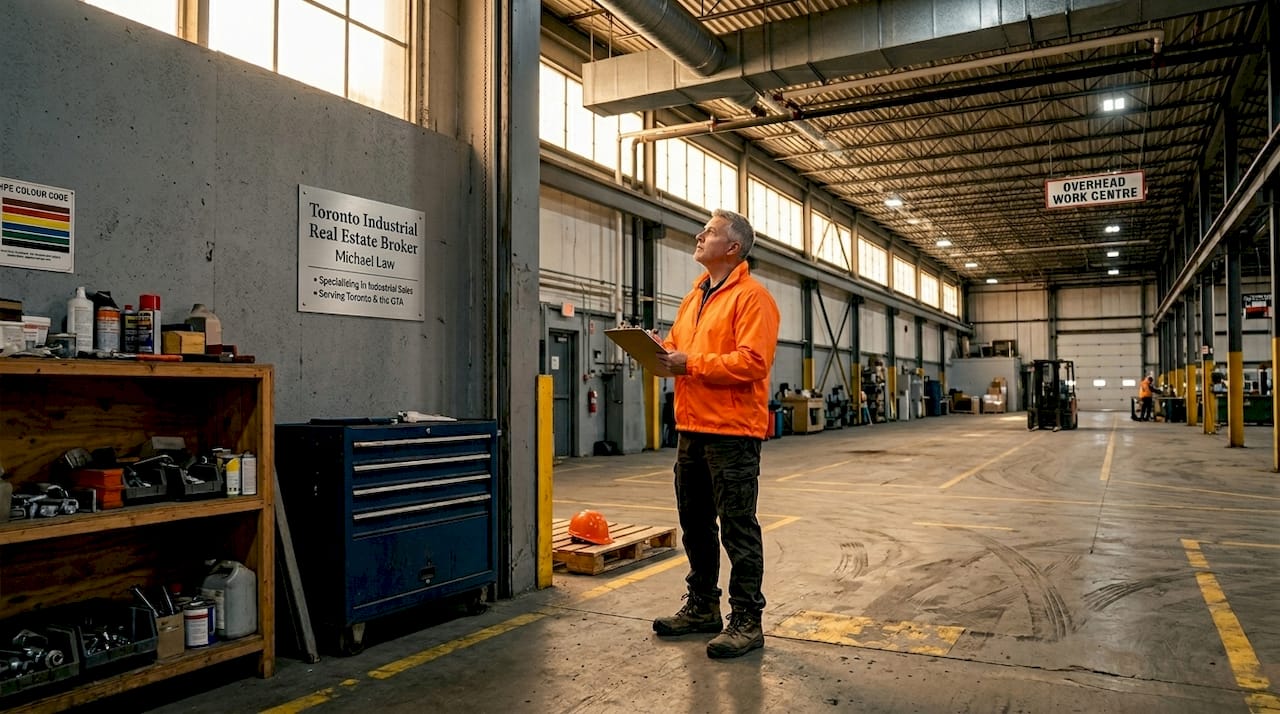
A PCA is not simply a walkthrough with a checklist. It is a systematic evaluation of all major building components, typically covering at minimum 10% of total floor area, with documented deficiency reporting and projected capital expenditure schedules. For a 100,000 square foot distribution facility in Brampton, that means a professional reviewing roofing assemblies, building envelope, structural framing, loading dock equipment, fire suppression systems, electrical distribution panels, HVAC units, and site features including paving and drainage.
The findings produce two outputs that drive investment decisions. The first is an immediate repair list: deficiencies requiring attention now, often within the first year of ownership. The second is a long-term capital expenditure reserve table, typically projected over 10 to 12 years, which tells you how much you need to budget annually to maintain the asset in good working order.
What PCAs actually uncover in industrial properties is often sobering. Roofing systems at end of life on large-format warehouses can represent $2 million to $5 million in replacement costs. Aging electrical infrastructure that cannot support modern logistics operations requiring high-amperage power feeds is a common finding in older GTA industrial stock. Fire suppression systems that do not meet current code requirements for high-rack storage are another frequent issue.
Commercial PCAs are indispensable in industrial real estate due diligence because building systems in logistics and manufacturing facilities are substantially more complex than in any residential asset. A qualified engineer reviewing mechanical and electrical systems will catch issues that a generalist inspector simply is not equipped to identify.
- Engage a licensed professional engineer for structural and mechanical reviews
- Ensure your PCA firm has specific experience with industrial and commercial buildings, not residential backgrounds
- Request that the PCA scope includes loading dock equipment, truck court drainage, and site lighting
- Confirm the assessor's standard of care aligns with ASTM E2018 requirements
- Share PCA findings directly with your lender, as most institutional lenders require a formal PCA before financing
Pro Tip: Ask your PCA provider for an opinion on the remaining useful life of the roof and HVAC systems specifically. These two components represent the largest unplanned capital events in industrial buildings, and a clear life expectancy estimate gives you negotiating leverage with the vendor.
Using due diligence findings to negotiate
Due diligence findings are not just a report card on the property. They are a negotiating tool. Buyers can use findings to renegotiate purchase price, request vendor credits, adjust capital expenditure planning, or in cases of material undisclosed issues, exit the transaction entirely.
Here is how to translate due diligence findings into concrete deal outcomes:
- Quantify everything first. Before going back to the vendor, attach actual cost estimates to every deficiency the PCA and environmental review identified. Verbal descriptions of "aging roof" mean nothing in a negotiation. A contractor's quote for $1.8 million in roofing replacement speaks for itself.
- Prioritise material versus minor issues. Not every finding justifies a price reduction. Focus your negotiation on items that materially affect the property's income, occupancy, or future capital requirements. A cracked parking lot seal coat is not the same lever as a non-compliant fire suppression system.
- Request vendor credits over price reductions where possible. A purchase price reduction reduces your acquisition cost but may also reduce your financing basis. A vendor credit at closing applied to identified capital repairs often produces a cleaner financial outcome for both parties.
- Integrate findings into your updated financial model. Revise your cash flow projections to reflect actual capital expenditure requirements discovered in due diligence. This updated underwriting tells you whether the deal still makes financial sense at the agreed price or at a renegotiated one. Market analysis should run in parallel to confirm your revised assumptions hold against current GTA submarket benchmarks.
- Know your contingency deadline. The due diligence contingency clause in your purchase agreement specifies the exact date and time by which you must either waive, exercise, or extend the condition. Missing this deadline can mean your condition is automatically waived, leaving you legally bound to close regardless of what you found.
Managing the timeline actively is important. In GTA industrial transactions, due diligence periods typically run 15 to 30 days for smaller assets, with larger or more complex properties sometimes requiring 45 to 60 days. Coordinating your legal counsel, environmental consultants, building engineers, and financial advisors to work in parallel rather than sequentially is the difference between completing a thorough review and running out of time.
Timelines, legal considerations, and common pitfalls
Due diligence periods in real estate generally run 7 to 14 days for residential transactions, but commercial and industrial deals routinely require more time given the complexity of assessments involved. In the GTA industrial market, buyers and their legal counsel should negotiate a realistic timeline upfront rather than accepting a compressed period under competitive pressure.
| Transaction type | Typical due diligence period | Key drivers of timeline |
|---|---|---|
| Small industrial (under $5M) | 15 to 25 days | PCA, title review, zoning confirmation |
| Mid-size industrial ($5M to $20M) | 25 to 45 days | Phase I ESA, lease review, financing condition |
| Large industrial or portfolio ($20M+) | 45 to 90 days | Phase II ESA, multi-tenant lease review, lender requirements |
Legal protections built into due diligence contingencies are significant. A properly drafted condition precedent in your offer to purchase gives you the right to terminate the agreement without penalty if your due diligence review is unsatisfactory. Legal reviews also protect against title fraud, misrepresentations, and hidden legal encumbrances that could affect your ownership or use of the property.
Common mistakes to avoid in the GTA industrial market:
- Applying residential inspection standards to industrial buildings. A general home inspector reviewing a 50,000 square foot warehouse is not providing adequate due diligence. The scope, expertise, and reporting standards are entirely different.
- Skipping the environmental review on older industrial properties. Properties in established GTA industrial corridors, particularly those with prior manufacturing or chemical storage uses, carry real environmental risk that Phase I assessments are designed to surface.
- Accepting vendor-provided inspection reports without independent verification. Vendor disclosure reports are a starting point, not a substitute for your own independent assessment.
- Neglecting zoning confirmation. Assumed zoning compliance and confirmed zoning compliance are two different things. Municipalities can have site-specific zoning exceptions, holding zones, or conditions attached to prior approvals that are not obvious from a basic zoning map review.
- Compressing the timeline to win a competitive bid. A short due diligence period might make your offer more attractive, but it increases the probability of missing something material. The cost of a thorough review is trivial compared to the cost of an undiscovered issue post-closing.
My perspective on due diligence in GTA industrial deals
I have worked through enough GTA industrial transactions to say with confidence that the quality of your due diligence is almost always more predictive of investment outcome than the quality of your original underwriting. You can model a deal beautifully on paper, but if you accept a compressed due diligence period and rush your PCA or skip your environmental review, you are essentially betting that nothing material is hiding in the property.
In my experience, the deals where investors get hurt are rarely the obvious ones. They are the properties that looked clean, priced at market, with a seemingly stable tenant, where a Phase II environmental assessment revealed legacy contamination from a prior owner's industrial operation. Or a warehouse where deferred maintenance on the roof was not visible during a winter site visit and became a six-figure problem in spring.
What I consistently see among successful GTA industrial investors is that they treat due diligence as an investment in decision quality, not a cost to minimise. They engage experienced local professionals who understand the specific risk profile of GTA industrial assets. They read the PCA report instead of filing it. They use findings as leverage rather than letting them sit in a binder. And they are willing to walk away from a deal that fails the review, knowing that protecting capital is more important than closing any single transaction.
The property acquisition process in the GTA industrial market moves quickly and the competition for quality assets is real. But speed never justifies shallow due diligence. The most expensive properties in this market are not the ones with high asking prices. They are the ones where buyers cut corners on their review and discovered the real cost after closing.
— Michael
Work with a GTA industrial real estate expert
Navigating property due diligence in the GTA industrial market requires more than a checklist. It requires local expertise, established professional networks, and the ability to interpret findings within the context of current market conditions.

Mlawrealestate, through Michael Law at Lennard Commercial Realty, brings deep transactional experience across every major GTA industrial corridor, from Mississauga and Brampton to Vaughan, Markham, and the Durham Region. Whether you are acquiring your first industrial asset or expanding an existing portfolio, the due diligence phase is where the most important decisions get made. Having an advisor who knows the local market, understands the risk profile of GTA industrial stock, and has the professional network to assemble the right due diligence team makes a material difference in outcomes. Browse current GTA industrial listings and connect with Michael directly to discuss how thorough due diligence support can reduce risk and improve your investment confidence across the GTA's most active industrial nodes.
FAQ
What is property due diligence in real estate?
Property due diligence is the structured investigation a buyer conducts between offer acceptance and closing, covering legal, physical, financial, and regulatory assessments to verify the property's condition and confirm all material facts before committing to purchase.
How long does due diligence take for GTA industrial properties?
Due diligence periods for GTA industrial transactions typically run 15 to 45 days for mid-size assets, though larger or more complex deals may require up to 90 days to complete environmental, physical, and financial reviews adequately.
What is the difference between a home inspection and a commercial PCA?
A residential home inspection is a general visual review, while a commercial Property Condition Assessment follows formal standards such as ASTM E2018, covers a broader range of complex building systems, and produces capital expenditure projections that lenders and investors rely on for underwriting decisions.
Can due diligence findings cancel a real estate deal?
Yes. A properly drafted due diligence condition in a purchase agreement gives the buyer the right to terminate the transaction without penalty if the review reveals material issues that make the deal unsatisfactory on the agreed terms.
Why is zoning confirmation important in GTA industrial due diligence?
GTA municipalities have varied and site-specific industrial zoning classifications. Confirming zoning compliance before acquiring an industrial property protects against discovering post-closing that the intended use is not permitted or that outstanding municipal orders affect the property's operation.