

TL;DR:
- "User sale" in industrial real estate typically refers to either a property sold directly by the owner without an agent or a business acquiring property for its own operational use. Understanding the specific scenario is crucial, as it influences valuation, negotiation, and due diligence processes. Engaging experienced local advisors ensures clarity, mitigates risks, and supports strategic decision-making in the competitive GTA market.
If your company is searching for industrial property in the Greater Toronto Area and you've come across the phrase "user sale," you're not alone in wondering exactly what it means. The term isn't a standard industry label, and that ambiguity creates real risk for businesses trying to make high-stakes property decisions. This guide cuts through the confusion by explaining the two scenarios that "user sale" most commonly describes, outlining the practical steps involved in each, and helping you approach your next industrial acquisition or disposition with the clarity and confidence it deserves.
Table of Contents
- Demystifying 'user sale': what it really means
- For sale by owner (FSBO): the seller-managed process
- Owner-user sale: buying for direct business use
- Key challenges and best practices in user-driven industrial sales
- A fresh perspective: why the language of real estate matters for your strategy
- Work with industrial real estate experts for clarity and results
- Frequently asked questions
Key Takeaways
| Point | Details |
|---|---|
| User sale is not standard | The term 'user sale' is informal and used inconsistently in commercial real estate. |
| Two main meanings | 'User sale' usually means either a seller-managed (FSBO) deal or an owner buying for their own use. |
| FSBO demands expertise | Handling an industrial sale without an agent puts all responsibilities and risks on the business owner. |
| Owner-user deals offer strategic benefits | Purchasing for direct business use can provide stability and control for GTA companies. |
| Expert advice mitigates risk | Professional guidance helps businesses succeed with user-driven sales while avoiding costly mistakes. |
Demystifying 'user sale': what it really means
The phrase "user sale" shows up frequently in conversations about industrial real estate, but it carries no single, universally agreed-upon definition. When businesses in Mississauga, Brampton, or Vaughan encounter it, they're often left piecing together the meaning from context. That guesswork can lead to costly misalignments between what a seller intends and what a buyer expects.
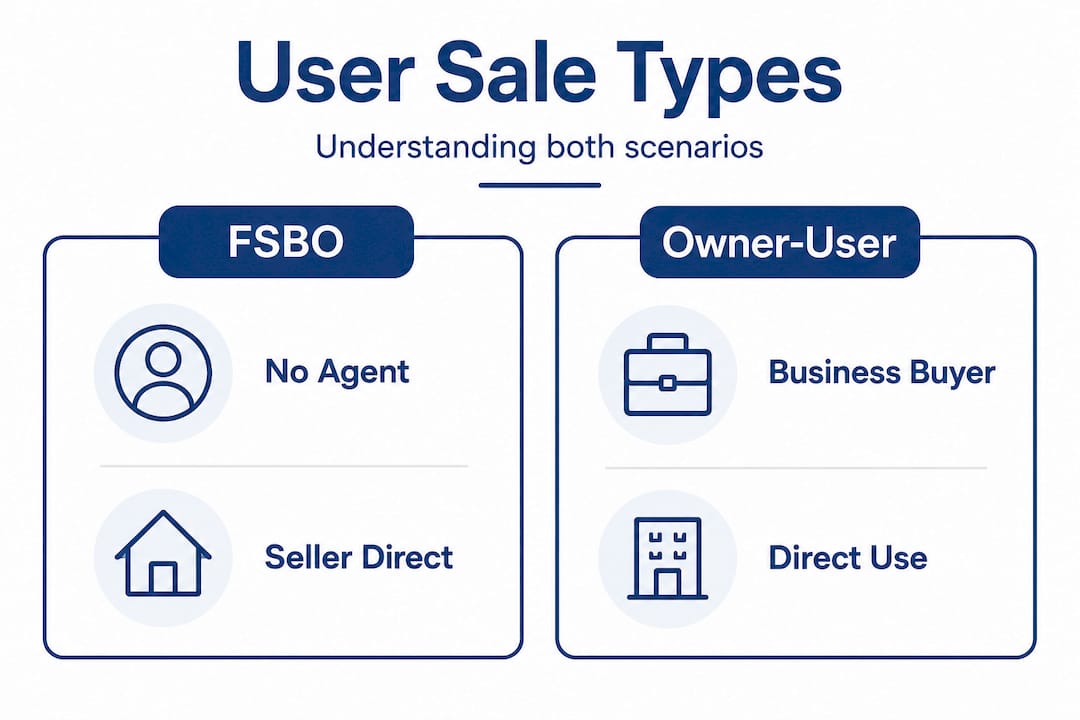
At its core, the phrase typically refers to one of two distinct scenarios. The first is a for sale by owner (FSBO) situation, where the property owner manages the listing and transaction without engaging a real estate agent. The second is an owner-user purchase, where a business acquires property specifically to operate from it rather than to hold as a passive investment. As noted by Rocket Mortgage, "user sale" is not a standard real-estate industry term; it most commonly refers either to an owner-managed listing or to an owner-user/end-user purchase. These two scenarios are fundamentally different, and conflating them creates serious problems in negotiations.
Comparing the two scenarios at a glance
| Scenario | Who drives the process | Primary motivation | Typical GTA context |
|---|---|---|---|
| FSBO (for sale by owner) | The seller manages everything | Reduce selling costs | Owner selling industrial building without a broker |
| Owner-user purchase | The buyer occupies the property | Operational control | Manufacturer buying a facility in Brampton or Milton |
Understanding which scenario applies to your situation shapes every decision that follows, from how you structure your financing to which advisors you engage. Searching for owner-user property listings in the GTA often surfaces both types, which adds to the confusion for companies researching the market independently.
"Precise language is the foundation of a sound transaction. When buyers and sellers mean different things by the same term, it doesn't just slow negotiations—it can derail deals entirely. In the industrial sector, where lease obligations, operational timelines, and capital commitments are substantial, ambiguity is a liability." — Industrial real estate advisory perspective
The broader risk here is that businesses often proceed with assumptions about what a deal structure looks like before confirming those assumptions with the other party or a qualified advisor. In a competitive GTA industrial market where vacancy rates remain tight and prices reflect that pressure, acting on a misunderstanding is an expensive mistake.
For sale by owner (FSBO): the seller-managed process
One of the main contexts for "user sale" is the FSBO path. Here's what you need to know if you're considering this route for your industrial property in the GTA.

For sale by owner in real estate means the property owner lists and handles the transaction without using a real estate agent. For residential properties, this is relatively common. For industrial properties, however, the process is dramatically more involved and the stakes are substantially higher.
When a company decides to sell its warehouse or manufacturing facility as FSBO, it takes on full responsibility for every stage of the transaction. This includes setting an accurate market price, preparing marketing materials, identifying qualified buyers, fielding inquiries, scheduling tours, negotiating deal terms, managing due diligence requests, and coordinating closing. Each of these steps involves specialised knowledge that most business operators simply don't have in-house.
What FSBO sellers must manage
- Market valuation: Industrial properties are priced based on factors like clear height, dock-level loading, column spacing, power supply, zoning classification, and proximity to major transportation corridors. Getting this wrong, even slightly, means leaving money on the table or sitting on the market too long.
- Targeted marketing: Reaching the right buyers for an industrial asset requires access to broker networks, commercial listing platforms, and direct outreach to companies actively seeking space. FSBO sellers often lack these channels.
- Qualifying buyers: Not every interested party has the financing or operational purpose to close a deal. Screening buyers thoroughly upfront prevents wasted time and confidential disclosure to unqualified parties.
- Legal documentation: Agreements of purchase and sale for commercial industrial properties are complex instruments. Errors in representations, warranties, or conditions can expose the seller to liability long after closing.
- Negotiation: Experienced buyers, particularly those backed by advisors, know how to leverage due diligence findings, market data, and deal timing to extract concessions. A seller without equivalent expertise is at a structural disadvantage.
- Compliance and environmental considerations: Industrial properties often carry environmental history. Phase I and Phase II Environmental Site Assessments are standard, and sellers who aren't prepared for these findings can face delays or renegotiated terms at the worst possible moment.
Understanding the industrial FSBO process in the context of the GTA market specifically is essential before committing to this path. Similarly, buyers pursuing a property listed as FSBO should follow the same property acquisition steps they would in any brokered deal, because the absence of a listing agent on the seller's side doesn't reduce the complexity of the transaction.
Pro Tip: If you're a GTA business considering FSBO for your industrial property, get a formal appraisal or broker opinion of value before you list. Industrial properties are uniquely sensitive to operational specifications, and pricing based on comparable residential logic or rough square footage estimates will almost certainly lead to underpricing or extended time on the market.
The FSBO path can save on commission costs in theory, but those savings are often offset by longer sale timelines, lower final sale prices, and legal exposure that arises from process errors. For industrial assets in the $5 million to $25 million range, common in Mississauga, Oakville, and Markham, the margin for error is slim.
Owner-user sale: buying for direct business use
While FSBO focuses on how the property is sold, the other common meaning of "user sale" is when a business acquires a property for their own use. This is the owner-user purchase, and it's a fundamentally different kind of transaction with a distinct set of strategic motivations and practical considerations.
An owner-user sale means the buyer is acquiring the property to house their own business operations rather than to lease it to tenants or hold it as a financial investment. The buyer might be a logistics company seeking a dedicated distribution centre in Ajax, a food manufacturer needing a facility with specific power and refrigeration infrastructure in Hamilton, or a fabrication business outgrowing its leased space in Brampton and ready to own.
As clarified by Rocket Mortgage, an owner-user transaction is specifically one where the buyer is the operating user, which distinguishes it from a standard investment purchase where the buyer's return comes from rental income or capital appreciation.
Why businesses pursue owner-user purchases
The motivations are both financial and operational. On the financial side, owning eliminates rent escalation exposure, builds equity over time, and can provide tax advantages through depreciation and capital cost allowances. On the operational side, owning gives a business the freedom to modify the facility for its specific needs, whether that means adding mezzanine office space, increasing electrical capacity, installing specialised racking systems, or expanding the loading area.
There are also stability benefits that are difficult to quantify but deeply important. A manufacturer operating on a five-year lease in Vaughan has no guarantee of renewal when that term ends. A manufacturer who owns their facility in Vaughan controls their own future. In a GTA industrial market where available supply remains constrained, that kind of certainty has enormous strategic value.
Steps for a successful owner-user transaction in the GTA
- Define your operational requirements precisely. Know your minimum and ideal clear heights, loading dock ratios, power requirements, floor load capacity, yard depth, and parking needs before you begin searching.
- Establish your financing structure early. Conventional commercial mortgages, CMHC-insured financing for owner-occupied commercial properties, and vendor take-back arrangements all carry different implications for your balance sheet.
- Engage a specialist advisor. The benefits for owner-users of working with a broker who specialises in the GTA industrial market include access to off-market opportunities, negotiation expertise, and detailed market intelligence that isn't publicly available.
- Conduct thorough due diligence. This includes environmental assessments, structural inspections, zoning verification, municipal servicing confirmation, and a review of any existing tenancies or encumbrances.
- Plan for operational transition. Purchasing a property and occupying it as an owner-user requires coordination between your legal closing, any tenant vacancies, and your own operational move-in timeline.
- Consider long-term flexibility. Some businesses purchase industrial property and explore a sale-leaseback structure down the line to unlock capital while retaining occupancy. Structuring the purchase with this optionality in mind from the start preserves future flexibility.
Owner-user vs. investor purchase: key differences
| Factor | Owner-user purchase | Investor purchase |
|---|---|---|
| Occupancy intent | Buyer occupies the property | Buyer leases to tenants |
| Return type | Operational savings and equity | Rental income and capital gains |
| Financing approach | Owner-occupied commercial | Investment property mortgage |
| Due diligence focus | Fit for operations | Lease quality, tenancy risk |
| Market sensitivity | Operational need drives timing | Cap rates and yield drive timing |
Understanding which category you fall into matters enormously, because the criteria you use to evaluate a property, and the terms you negotiate, should be entirely different depending on your intent.
Key challenges and best practices in user-driven industrial sales
Understanding what a user sale is covers only half the ground. The real challenge is navigating the process smoothly and avoiding costly mistakes that affect GTA businesses on both the buying and selling sides of these transactions.
Common challenges in user-driven industrial sales
The obstacles in user-driven industrial transactions cluster around a few recurring themes. Valuation disputes are frequent because owner-users often have an emotional or operational attachment to the property that distorts their sense of fair market value. A seller who built their business inside a facility may overvalue it; a buyer who needs the property urgently may undervalue their negotiating position.
Operational fit mismatches are another significant risk. A buyer may fall in love with a facility's location along Highway 401 in Mississauga only to discover after possession that the building's electrical infrastructure can't support their manufacturing processes without a $400,000 upgrade. Proper due diligence prevents this, but many businesses rush through it when they're eager to close.
Compliance and zoning issues frequently surface in GTA industrial transactions. Properties in transitional zones, or those with legacy uses that don't align with current municipal zoning, can delay or even kill a deal. Industrial properties in areas like the Toronto Port Lands, older sections of Etobicoke, or mixed-use corridors in Hamilton require particularly careful zoning analysis.
As FSBO sellers, Zillow notes, they are responsible for the process from start to finish, including pricing, listing, negotiations, paperwork, and closing. Every gap in that process creates risk.
Best practices for both buyers and sellers
- Price realistically and support it with data. Emotion and anecdote are not substitutes for verified comparable sales, broker opinions of value, and current market absorption data for the specific submarket where the property sits.
- Disclose proactively. Sellers who front-load disclosure reduce the risk of renegotiation during due diligence. In the GTA industrial market, a buyer who discovers a surprise after the fact has leverage, and they will use it.
- Document everything clearly. From the heads of agreement to the final agreement of purchase and sale, every negotiated term must be captured in writing. Verbal agreements, even when made in good faith, are not enforceable.
- Build in adequate timelines. Rushing a closing on a $10 million industrial asset to save a few weeks of carrying costs is rarely worth the risk. Due diligence timelines for industrial properties should reflect the complexity of what's being examined.
- Get environmental clarity early. Commission a Phase I Environmental Site Assessment before listing or making an offer, not after. Environmental findings discovered mid-deal create enormous negotiating turbulence.
- Verify zoning and permitted uses independently. Don't rely solely on listing descriptions. Confirm with the relevant municipality that the property is zoned for your intended use and that any required permits are achievable.
Engaging the right value of an advisor becomes especially apparent when you map these challenges against the consequences of getting them wrong. An experienced industrial advisor brings market data, negotiation strategy, and process discipline that protects both sides of the transaction.
Pro Tip: Even if you're pursuing an FSBO deal as a buyer, engage your own advisor. The absence of a listing broker doesn't mean you should navigate the transaction without representation. Your advisor can uncover risks the seller hasn't disclosed and help you structure a deal that serves your operational needs and financial interests simultaneously.
A fresh perspective: why the language of real estate matters for your strategy
Here's something most companies overlook entirely: the words used in a real estate transaction are not just administrative detail. They are strategic signals. When a business uses vague terminology like "user sale" without defining it precisely, they are broadcasting a lack of sophistication that sophisticated counterparties will exploit.
Consider the negotiation dynamics. A seller who doesn't know whether they're running an FSBO or a brokered process sends an uncertain signal to buyers. A buyer who doesn't know whether they're acquiring as an owner-user or as an investor may structure their financing incorrectly, miss tax planning opportunities, or fail to apply the right due diligence framework for their actual intent.
The industrial real estate market in the GTA is one of the most competitive and specialised in Canada. Transactions routinely involve multi-million-dollar assets, complex zoning environments, significant environmental history, and parties with asymmetric information. In that context, vague language is not a minor inconvenience. It is a genuine liability.
There's also a broader strategic point here. Companies that demand precision in how they describe and discuss real estate transactions tend to make better decisions overall. They ask better questions during site selection. They negotiate more effectively. They avoid the traps that catch unprepared buyers and sellers. Consulting detailed industrial market reports regularly builds the kind of market literacy that makes precise language natural rather than effortful.
The uncomfortable truth is that many GTA businesses approach industrial property transactions with the same casual familiarity they'd bring to leasing office furniture. The stakes are incomparably higher, and the complexity is incomparably greater. Demanding that everyone in your transaction uses specific, agreed-upon terminology is not pedantry. It's risk management. It's how serious companies protect serious capital.
Work with industrial real estate experts for clarity and results
If getting clarity on real estate language and process is essential, partnering with an experienced team gives you a measurable edge.
Michael Law Real Estate supports GTA businesses at every stage of owner-user industrial transactions, from initial site selection and market analysis to negotiation strategy and closing coordination. Whether you're selling a facility in Oshawa, acquiring a warehouse in Burlington, or evaluating whether ownership or leasing makes more sense for your business model, the guidance you receive should be grounded in deep local market knowledge and a track record of completed transactions.
The GTA industrial market rewards preparation and penalises guesswork. Working with a specialist means you get access to off-market opportunities, accurate valuations supported by verified comparable data, and negotiation support that accounts for the full complexity of industrial assets. You can browse available GTA industrial properties to see what's currently available across Mississauga, Brampton, Vaughan, Markham, and the broader market. When you're ready to talk strategy, Michael Law Real Estate is ready to help you move with confidence.
Frequently asked questions
Is a 'user sale' in real estate the same as for sale by owner (FSBO)?
Often, yes. A "user sale" typically refers to an owner listing and selling the property without an agent, though it can also mean an owner buying for their own use, as noted by Rocket Mortgage, which clarifies the term is not standard industry language.
What are the main risks of a business handling a user sale themselves?
Businesses face risks like incorrect pricing, legal mistakes, and missed due diligence when managing every aspect solo. As Zillow outlines, FSBO sellers are responsible for the entire process from start to finish, including negotiations, paperwork, and closing.
Can an industrial real estate deal be both FSBO and owner-user?
Yes. The seller can manage the transaction without an agent while the buyer simultaneously acquires the property for their own business operations. The Rocket Mortgage definition confirms these two meanings can coexist in a single transaction.
What professional help is recommended for a user sale in the GTA?
Engaging an industrial broker or real estate advisor with specific GTA market expertise helps businesses avoid common legal, operational, and valuation pitfalls. An advisor brings market data, negotiation strategy, and process discipline that protects the client's interests throughout the transaction.