

TL;DR:
- Industrial real estate in the GTA has demonstrated consistent rent growth and occupancy stability.
- Location, transport access, and modern specifications are key drivers of industrial property value.
- Active management and strategic upgrades can significantly enhance industrial asset worth.
Few property sectors have quietly reshaped investment conversations in the Greater Toronto Area the way industrial real estate has. While many owners still focus heavily on residential or office portfolios, industrial assets have delivered some of the most consistent rent growth and occupancy stability in the Canadian market over the past decade. The confusion lies in understanding why these properties are so valuable and what actually drives that value. This guide breaks down the fundamentals, the key value drivers, the investment performance data, and the practical strategies every GTA industrial property owner and manager needs in 2026.
Table of Contents
- Understanding industrial assets: definitions and types
- Key drivers of industrial asset value in the GTA
- How industrial assets perform as investments
- Ways to unlock and grow the value of your industrial assets
- Challenges and future trends for GTA industrial assets
- Our perspective: what most owners misunderstand about industrial assets
- Unlock your industrial asset's true value with expert support
- Frequently asked questions
Key Takeaways
| Point | Details |
|---|---|
| Location drives value | Industrial assets in prime GTA locations offer consistent demand and reliable returns. |
| Upgrades boost performance | Strategic property improvements and modernisation can significantly increase asset value. |
| Tenant demand is evolving | Logistics, e-commerce, and tech companies fuel industrial property demand in the GTA. |
| Expert guidance matters | Partnering with local advisors and brokers helps uncover hidden value and avoid pitfalls. |
Understanding industrial assets: definitions and types
With the confusion around industrial asset value clearly stated, let's first clarify exactly what these assets encompass and the roles they play in the GTA market.
Industrial assets are income-producing properties used primarily for the production, storage, distribution, and processing of goods. They are fundamentally different from office or retail properties in their physical requirements, their tenant base, and the economic forces that shape their demand. In the GTA, industrial property types span a wide range, and understanding these distinctions matters enormously when assessing value or making acquisition decisions.
The most common categories you will encounter across the GTA include:
- Distribution and logistics warehouses: Large-format, high-clear-height buildings designed for the movement and storage of goods. These are the backbone of the e-commerce economy and are typically found near major highway interchanges in Mississauga, Brampton, and the Durham Region.
- Manufacturing facilities: Properties configured for production processes, often featuring heavy power supply, reinforced floors, and specialised ventilation systems. These facilities are prevalent in older industrial corridors in Toronto's inner suburbs and in Hamilton.
- Flex industrial space: Smaller, multi-use buildings that combine warehouse or light-industrial space with office areas. Flex properties serve a wide variety of tenants, from technology firms to light manufacturers, and are popular in markets like Markham, Vaughan, and Richmond Hill.
- Cold storage and temperature-controlled facilities: Highly specialised assets serving food and pharmaceutical tenants. These command significant premiums due to their infrastructure costs and limited supply.
- Truck terminals and cross-dock facilities: Properties specifically designed for the rapid transfer of freight between vehicles, located near ports of entry and major transport arteries.
Different types of industrial properties create unique value and investment opportunities, and what works for a logistics operator will not necessarily suit a precision manufacturer.
| Property type | Typical clear height | Common tenant | Location preference |
|---|---|---|---|
| Distribution warehouse | 28 ft to 40 ft | E-commerce, 3PL | Highway corridors |
| Manufacturing facility | 18 ft to 28 ft | Food, auto, machinery | Inner suburbs, Hamilton |
| Flex industrial | 16 ft to 22 ft | Tech, light industrial | North GTA, Markham |
| Cold storage | 28 ft to 36 ft | Food, pharma | Mississauga, Brampton |
| Truck terminal | 14 ft to 18 ft | Freight carriers | Airport, port areas |
What sets industrial apart from other commercial categories is the direct link between property function and tenant business operations. A retailer can adapt to a slightly suboptimal space; a logistics operator cannot function without adequate dock doors and truck courts. This operational dependency means tenants are deeply committed to their locations, and lease terms reflect that commitment.
Key drivers of industrial asset value in the GTA
Once we know what industrial assets are, we can examine the market forces that actually drive their appeal and value in the GTA.
Location is the single most powerful determinant of industrial value in this market. Proximity to Highway 400, 401, 407, and 410 corridors, Pearson International Airport, and major urban consumption centres directly affects a property's rental rates and occupancy levels. Tenants pay a meaningful premium for properties that reduce transportation costs, cut delivery times, and support same-day or next-day fulfilment. A warehouse in Brampton with direct 401 access will consistently outperform a comparable building in a secondary location without that connectivity.
The five key factors that drive industrial asset value in the GTA:
- Highway and transport access: Direct access to major freight corridors reduces operating costs for tenants, supporting higher rent tolerance and lower vacancy periods.
- E-commerce and supply chain demand: Online retail growth has structurally increased demand for last-mile distribution space close to population centres. This demand shows no signs of slowing.
- Land scarcity and the Greenbelt: Ontario's urban growth boundaries tightly constrain the supply of industrial land. New development is limited, and infill redevelopment is both expensive and time-consuming. This supply constraint supports long-term value appreciation.
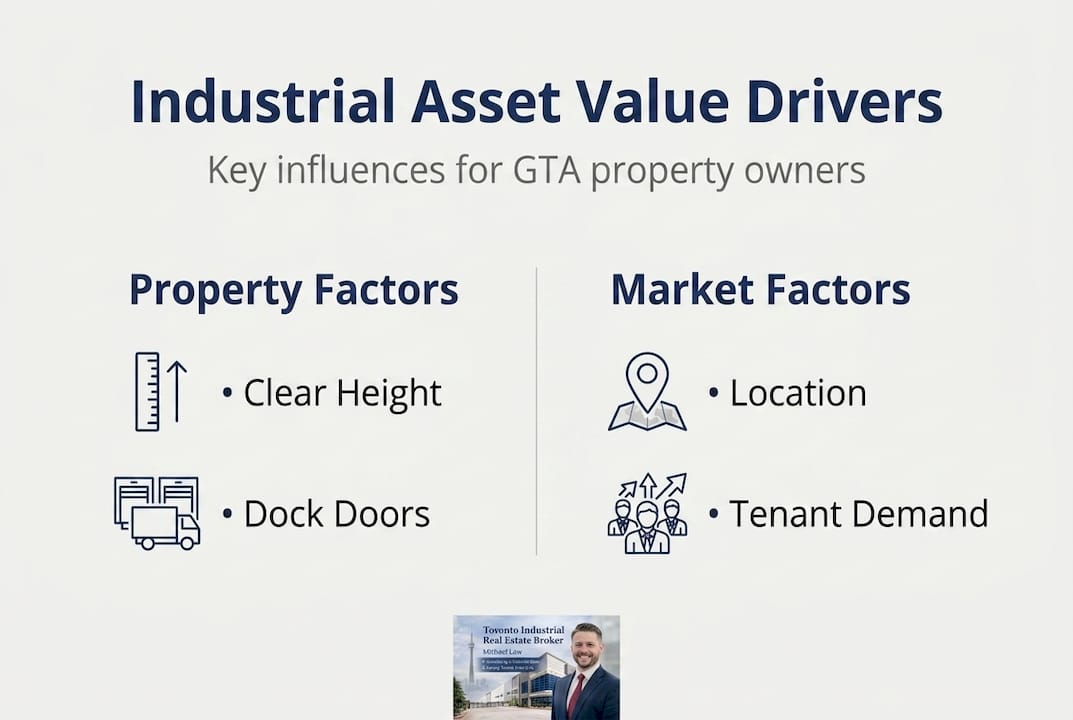
- Modern building specifications: Clear heights above 32 feet, adequate dock-level doors, ample truck court depth, and ESFR sprinkler systems are no longer optional. Buildings that meet these specifications command premium rents and attract institutional-grade tenants.
- Energy efficiency and sustainability: Modern tenants increasingly require buildings that support ESG (environmental, social, and governance) commitments. LED lighting, solar-ready roofs, and energy management systems are becoming standard expectations.
Well-located industrial assets offer resilience during economic fluctuations and are in consistently high demand, which is a pattern that the GTA has demonstrated clearly through multiple economic cycles.
Industrial vs. other commercial asset classes in the GTA
| Factor | Industrial | Office | Retail |
|---|---|---|---|
| Vacancy rate trend (2023-2025) | Rising but still below 5% | Above 15% in many submarkets | Highly variable, 8-14% |
| Average rent growth (5-year) | Strong, 30-50% in prime nodes | Flat to negative | Flat to modest |
| Lease term typical | 5 to 10 years | 3 to 7 years | 5 to 10 years |
| Tenant operational dependency | Very high | Moderate | Moderate |
| Supply constraint | Very high (Greenbelt) | Moderate | Moderate |
Tracking GTA market trends with consistent rigour is essential, because submarkets like Milton, Oakville, and Ajax are evolving at different rates. What holds true in Mississauga today may describe Oshawa or Whitby in three years. Owners who understand these dynamics at the submarket level hold a meaningful advantage.
How industrial assets perform as investments
With a clear understanding of value drivers, let's look at how industrial assets stack up as investments in the real world.

The performance story for GTA industrial real estate over the past decade has been genuinely impressive. Net asking rents across prime GTA industrial nodes increased dramatically between 2018 and 2024, with some Highway 401 corridor properties seeing rent per square foot more than double over that period. Even as the broader market has moderated from its 2022 peak, industrial assets have retained far more of their value than office or retail properties facing structural headwinds.
What makes industrial investments particularly attractive from a risk-adjusted standpoint:
- Longer average lease terms: Industrial tenants typically sign leases ranging from five to ten years, sometimes longer for purpose-built or built-to-suit facilities. This creates predictable cash flow that allows owners to plan maintenance, financing, and capital expenditure with confidence.
- Creditworthy, operationally committed tenants: Major logistics operators, national retailers running their own distribution, and established manufacturers provide a quality of income that many retail or office tenants simply cannot match. These companies cannot easily vacate without disrupting their entire supply chain.
- Lower vacancy rate volatility: Industrial assets historically experience less dramatic vacancy swings than office or retail during downturns, because tenant decisions are driven by operational need rather than discretionary preference. When a manufacturer or third-party logistics firm signs a lease, they are committing their core business to that location.
- Rent review mechanisms: Most GTA industrial leases include periodic rent reviews tied to market rates or fixed escalation clauses. This structural feature means income grows over time rather than stagnating.
- Resilience through economic cycles: The post-pandemic period confirmed what many experienced investors already understood. Industrial real estate outperformed many property classes in risk-adjusted returns and tenancy stability precisely when other sectors were struggling with remote work disruption and reduced foot traffic.
"Industrial property isn't glamorous, but it quietly pays. The tenants need to be there, the leases are long, and the land just keeps getting scarcer. That combination is hard to beat in any market cycle."
Pro Tip: Schedule a formal lease performance review every 24 months at minimum. Comparing your in-place rent against current market rates will reveal whether you are leaving money on the table at renewal, or whether there is an opportunity to renegotiate terms in your favour before the lease expires. Pairing this with guidance on maximising GTA returns gives you a structured framework to act on that data.
Monitoring industrial leasing trends on a quarterly basis is not optional for serious owners. Markets shift, tenant requirements evolve, and the owner who acts on current data consistently outperforms the one who relies on assumptions formed years earlier.
Ways to unlock and grow the value of your industrial assets
Knowing what drives value is only half the battle. Owners can proactively boost their asset's worth with smart, targeted tactics that directly address what today's tenants want and what tomorrow's buyers will pay for.
Here are the most effective strategies for unlocking and growing industrial asset value:
- Dock and clear height upgrades: Adding dock-level doors or increasing clear height through roof raises or facility reconfiguration can shift a building from a secondary grade to a primary grade in the eyes of logistics tenants. The rental premium for an additional 8 to 10 feet of clear height is often 15 to 25% in competitive submarkets.
- Sustainability and energy retrofits: Installing LED lighting, upgrading HVAC systems, and adding electric vehicle charging infrastructure are not just green initiatives. They directly reduce tenant operating costs and align with the ESG reporting requirements that large corporate tenants now impose on their supply chain partners.
- Yard and truck court improvements: Expanding trailer storage capacity, improving pavement condition, and adding adequate security fencing can meaningfully improve a building's appeal to large logistics operators who manage significant truck and trailer fleets.
- Office component modernisation: Many older GTA industrial buildings carry outdated, oversized office components that consume rentable space tenants do not want. Converting excess office space to functional warehouse area, or modernising the existing office to contemporary standards, improves overall utility and tenant satisfaction.
- Digitisation and smart building systems: Automated building management systems, integrated security platforms, and high-speed fibre infrastructure have become baseline expectations for modern industrial tenants. Properties lacking these features face growing leasing resistance from sophisticated users.
Upgrades and active asset management can drive significant value increases, particularly when improvements are strategically timed ahead of a lease expiry or a planned disposition.
| Upgrade type | Estimated cost range | Typical value uplift | Payback period |
|---|---|---|---|
| Clear height increase (roof raise) | $40 to $80 per sq ft | 15 to 25% rent premium | 5 to 8 years |
| LED lighting retrofit | $3 to $6 per sq ft | 5 to 10% operating cost reduction | 2 to 4 years |
| Additional dock door installation | $30,000 to $60,000 per door | Improved leasing velocity | 3 to 5 years |
| EV charging infrastructure | $15,000 to $40,000 per station | ESG compliance, tenant attraction | 5 to 10 years |
| Truck court expansion | Highly variable | Significant for logistics tenants | 4 to 7 years |
Pro Tip: Before committing to any capital improvement programme, benchmark your asset against competing properties using current market data. Working with a knowledgeable real estate advisor ensures that your capital goes toward upgrades tenants will actually pay for, rather than improvements that look good on paper but do not move the needle on rent or occupancy.
The timing of upgrades matters as much as the upgrades themselves. Completing dock improvements six months before a major tenant's lease expiry gives you legitimate grounds to negotiate a rental uplift on renewal. Completing the same improvements two years after renewal locks in the benefit for the tenant at your expense.
Challenges and future trends for GTA industrial assets
Unlocking value also means anticipating the risks and market shifts that could redefine the industrial assets landscape over the next three to five years.
The GTA industrial market, despite its strength, is not without real challenges. Owners who treat their assets as passive, set-and-forget investments will find themselves behind the curve quickly.
Key challenges and risks to monitor closely:
- Zoning and land use pressure: Municipal governments across the GTA are facing intensification pressure to convert industrial land to mixed-use or residential development. While this can create windfall value for some owners, it creates uncertainty for those whose operations depend on the continued industrial designation of their area. Proactive engagement with local planning processes is essential.
- Environmental compliance requirements: Older industrial sites often carry legacy contamination issues, and environmental regulations continue to tighten. Phase I and Phase II environmental site assessments are increasingly standard requirements in both leasing and sale transactions. Owners should stay ahead of compliance obligations rather than discovering them at deal time.
- Construction cost inflation: The cost of building new industrial space has risen significantly, driven by labour shortages, material costs, and extended approval timelines. While this supports the value of existing assets by limiting new supply competition, it also makes capital improvement programmes more expensive to execute.
- Automation and changing space requirements: Tenants investing in robotics and automated storage and retrieval systems (ASRS) need higher clear heights, reinforced floor loading capacity, and specialised power infrastructure. Buildings that cannot accommodate these systems will face increasing obsolescence pressure.
- ESG expectations from large tenants: Corporate sustainability commitments are flowing down through supply chains. Large 3PL operators and national retail tenants are increasingly requiring landlords to demonstrate alignment with environmental targets as a condition of new leases or renewals.
"Savvy owners stay ahead by tracking market data and adopting adaptable strategies. The owners who struggle are those who wait for the market to come to them."
Keeping pace with market trends is essential for competitive value in a market that is evolving as quickly as the GTA's. Owners who invest in regular market monitoring strategies gain the ability to anticipate tenant requirement shifts, spot emerging submarkets before competition intensifies, and time capital decisions more accurately.
The supply pipeline across the GTA is expected to remain constrained relative to demand through 2026 and beyond. New completions are being absorbed, but rising construction costs and financing conditions are pushing development timelines out. For owners of well-located existing assets, this structural constraint is a genuine tailwind on long-term value.
Our perspective: what most owners misunderstand about industrial assets
After years of working through leasing and investment transactions across every major GTA submarket, a pattern becomes clear. The owners who consistently underperform are not those with the worst buildings. They are those who manage their assets passively and underestimate the compounding value of attention, data, and relationships.
The most common misunderstanding is that asset quality is the primary determinant of returns. In reality, alignment with tenant needs matters just as much. A well-maintained 1990s flex building in Markham, repositioned with a smart lease structure and modest targeted upgrades, can outperform a newer building in a less accessible location run by an inattentive owner. The market rewards adaptability and active stewardship.
The second major misunderstanding is the belief that primary markets always deliver the best returns. Emerging nodes like Oshawa, Whitby, Ajax, and parts of Hamilton have shown consistently strong absorption in recent years, precisely because the larger western GTA submarkets have priced out smaller and mid-size tenants. Owners who recognised this migration early and acquired or improved assets in those corridors captured disproportionate value. The opportunity is not always where everyone is already looking.
The third misunderstanding, and arguably the most costly, is undervaluing the role of experienced advisory relationships. Industrial real estate decisions, whether around leasing, valuation, upgrades, or disposition, carry significant capital consequences. Working with advisors who hold GTA broker advantages from genuine specialisation in this asset class consistently produces better outcomes than the transactional, one-time approach. The market intelligence alone, access to off-market opportunities, submarket-level rent data, and advance knowledge of tenant requirements, is worth more than the commission cost on any single transaction.
The industrial market in the GTA is too competitive, too data-driven, and too consequential to navigate without the right information and the right people around you.
Unlock your industrial asset's true value with expert support
The strategies outlined in this article are most powerful when applied with precise, current market data and the kind of submarket expertise that only comes from deep, daily engagement with the GTA industrial landscape.
At Michael Law Real Estate, we work with property owners, private investors, and institutional clients across every major GTA industrial node to deliver exactly that. From Markham industrial real estate advisory to comprehensive GTA properties for sale analysis, our team provides the insights and execution capability you need to make confident decisions. Whether you are planning a capital upgrade, evaluating a lease renewal, or considering a strategic acquisition or disposition, we bring institutional-grade intelligence to every conversation. Explore our full range of property locations in the GTA and connect with our team to start a conversation about your portfolio's potential.
Frequently asked questions
What types of industrial assets are most valuable in the GTA?
Properties with modern specifications such as high clear heights, multiple dock doors, and sufficient truck courts located near major highway interchanges are generally the most valuable, since different property types create unique value depending on tenant needs and location advantages.
How do I increase the value of my industrial property?
Upgrades and active asset management including dock improvements, LED retrofits, and modernised logistics infrastructure are among the most effective strategies, particularly when timed strategically ahead of lease renewals or dispositions.
Why do investors prefer industrial assets over retail?
Industrial real estate outperforms many property classes in risk-adjusted returns and tenancy stability, offering stronger rent growth, longer average lease terms, and significantly lower vacancy risk compared to retail properties facing structural demand shifts.
What major risks should I watch when owning industrial assets?
Zoning changes, environmental compliance obligations, and evolving tenant expectations around automation and ESG are the primary risks, which is why keeping pace with market trends through regular market intelligence review is essential for every serious owner.
Is now a good time to acquire more industrial property in the GTA?
With supply constrained by the Greenbelt and construction cost pressures, and with well-located assets in consistently high demand, strategic acquisitions in undersupplied submarkets remain an attractive opportunity for investors with a medium to long-term horizon.