

TL;DR:
- Many tenants mistakenly believe their base rent is their total occupancy cost, overlooking additional charges like CAM, taxes, and utilities. These supplementary costs can escalate significantly, affecting margins, and should be modeled independently to manage long-term expenses effectively. Regular auditing, negotiated protections, and monitoring occupancy cost ratios are essential strategies for controlling total costs throughout a lease term.
Many industrial tenants in the Greater Toronto Area sign leases believing their base rent figure represents what they will actually pay each month. It does not. Understanding occupancy costs means recognising that base rent is typically only 60 to 75 percent of what a tenant pays over the life of a lease. The remainder comes from Common Area Maintenance charges, property taxes, insurance, utilities, and amortised tenant improvements. Each of these components carries its own escalation risk. Miss them in your budget and you will face shortfalls that compress margins and force reactive decisions at exactly the wrong time.
Table of Contents
- Key takeaways
- Understanding occupancy costs: the full breakdown
- Building an accurate occupancy cost model
- CAM charges: what the lease language actually means
- The occupancy cost ratio as a business health metric
- Strategies to manage and reduce occupancy costs
- My perspective on where tenants go wrong
- Work with Mlawrealestate on your occupancy costs
- FAQ
Key takeaways
| Point | Details |
|---|---|
| Base rent is not total cost | Total occupancy cost includes CAM, taxes, insurance, utilities, and amortised tenant improvements beyond base rent. |
| CAM carries the most variability | CAM charges are the most disputed component and budgets commonly underestimate them by 20 to 40 percent. |
| Model all cost components separately | Forecast base rent, CAM, taxes, and insurance independently to avoid distorted occupancy budgets over the lease term. |
| The occupancy cost ratio flags risk | Dividing total occupancy cost by gross revenue reveals whether your lease is financially sustainable or warrants renegotiation. |
| Negotiate before you sign | CAM caps, base year selection, and gross-up provisions are negotiable and directly affect your long-term cost exposure. |
Understanding occupancy costs: the full breakdown
Before you can manage or reduce what you pay, you need a clear picture of every line item that makes up your total occupancy cost. Total occupancy cost includes base rent, CAM charges, property taxes, property insurance, tenant-borne utilities, and amortised tenant improvements. Each of these components is separate, each escalates at its own rate, and each needs its own line in your budget model.
Base rent and escalation
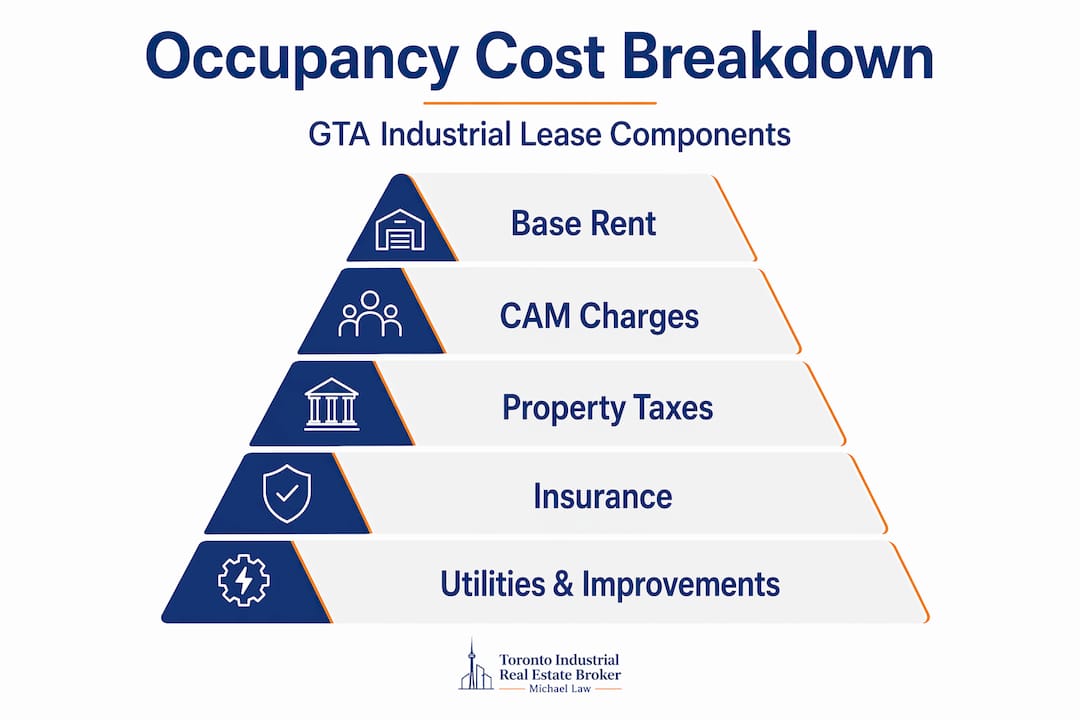
Base rent in a GTA industrial lease is quoted on a per-square-foot, per-year basis. In a triple net structure, this figure is your starting point, not your total cost. Most GTA industrial leases include annual rent escalations of two to four percent, or fixed step-up amounts negotiated at signing. Over a five-year term, a lease starting at $14.00 per square foot can reach $16.50 or higher purely from contractual escalation, before a single additional recovery charge is counted.
CAM charges
Common Area Maintenance charges recover the landlord's operating costs for shared building and property areas. For industrial properties, CAM typically includes parking lot maintenance, landscaping, snow removal, exterior lighting, roof maintenance, and property management fees. What it includes varies considerably by lease, which is precisely why CAM is the component most likely to produce budget surprises. For a detailed look at how these costs are structured in the GTA context, the occupancy cost breakdown guide from Mlawrealestate is worth reviewing.
Property taxes, insurance, and utilities

In a triple net lease, the tenant pays a pro-rata share of property taxes based on their occupied square footage relative to the total building. Property taxes in the GTA have grown meaningfully over recent assessment cycles, making this a non-trivial line item. Property insurance is similarly recovered on a pro-rata basis and covers the building structure, not tenant contents. Tenant-borne utilities, such as gas, hydro, and water, are either separately metered or allocated by formula.
Tenant improvements
Amortised tenant improvements not covered by landlord allowances represent a cost that many tenants forget to include in their occupancy models. If you spend $400,000 fitting out a 30,000 square foot facility and only $250,000 of that is covered by the landlord's tenant improvement allowance, the remaining $150,000 is your cost. Spread over a five-year lease, that adds $1.00 per square foot per year to your true occupancy cost.
| Cost component | Typical share of total cost | Key escalation driver |
|---|---|---|
| Base rent | 60 to 75% | Contractual step-ups |
| CAM charges | 10 to 15% | Operating cost inflation |
| Property taxes | 8 to 14% | MPAC reassessment cycles |
| Property insurance | 2 to 4% | Market insurance rate trends |
| Utilities | 5 to 10% | Consumption and rate changes |
| Amortised TI | Variable | One-time fit-out requirement |
Building an accurate occupancy cost model
Most tenants underestimate CAM, leading to occupancy budgets that are 20 to 40 percent too low before they ever move in. The solution is a structured, component-by-component modelling process that mirrors how landlords actually bill.
Here is a step-by-step approach:
- Start with base rent. Input the contracted rent for each year of the lease, including all scheduled escalations. Do not use the average. Use the actual year-by-year figure.
- Forecast CAM separately. Use the landlord's most recent actual CAM reconciliation as your starting point, then apply an annual growth assumption. In the current GTA environment, three to five percent annual CAM growth is a reasonable working assumption.
- Model property taxes independently. Contact the municipality for recent assessment history on the property. Apply a growth rate that reflects local trends, typically two to four percent annually in the GTA, but this can spike in reassessment years.
- Add insurance costs. Use the landlord's current insurance premium per square foot and apply an annual escalation of five to eight percent, reflecting recent commercial property insurance market conditions in Ontario.
- Include amortised TI costs. Calculate the unamortised tenant improvement gap and divide it by the lease term in years to produce an annual per-square-foot addition.
- Run sensitivity scenarios. Model a base case, a downside case where CAM and taxes grow faster than expected, and an upside case where costs stabilise. Scenario analysis can reveal tens of thousands of dollars in potential cost variation across a five-year lease term.
| Scenario | Year 1 all-in cost/sq ft | Year 5 all-in cost/sq ft | Total lease cost |
|---|---|---|---|
| Base case | $19.50 | $22.80 | $1,053,000 |
| Downside case | $19.50 | $25.40 | $1,147,500 |
| Upside case | $19.50 | $21.20 | $1,017,000 |
Assumes 30,000 sq ft facility, 3% base rent escalation, CAM/tax growth varying by scenario.
Pro Tip: Always request the landlord's last two years of actual CAM reconciliation statements before signing. Comparing them against the estimates billed in each year reveals the true range of reconciliation adjustments you should expect. Landlords who resist sharing this data are telling you something important.
Understanding triple net lease modelling in detail is the foundation of getting this exercise right.
CAM charges: what the lease language actually means
CAM is where the real complexity lives. CAM estimates are billed monthly based on the landlord's annual operating budget, and then reconciled against actual costs at year-end. If actual costs exceeded estimates, you owe the difference. If they were lower, you receive a credit. This cycle repeats every year for the full lease term.
What CAM includes and excludes
Standard CAM inclusions in GTA industrial leases cover exterior maintenance, parking lot repair, landscaping, snow clearing, property management fees typically capped at a percentage of other CAM costs, and common area lighting. Exclusions you should negotiate for include capital expenditures such as roof replacement, management fees above a defined ceiling, costs recoverable from other tenants or insurance proceeds, and costs attributable to landlord negligence.
Controllable vs. non-controllable expenses
CAM caps typically apply only to controllable expenses such as management fees and maintenance contracts. Non-controllable expenses, primarily property taxes and insurance, frequently remain uncapped. This distinction matters enormously over a long lease term because the uncapped categories are often the fastest-growing ones.
| CAM cap type | What it limits | Risk to tenant |
|---|---|---|
| Cumulative cap | Total controllable CAM can grow by X% per year, with unused room carrying forward | Lower long-term risk if growth is modest |
| Non-cumulative cap | Controllable CAM capped at X% above prior year, no carryforward | Landlord can "catch up" after capped years |
| No cap | No limit on controllable CAM growth | Highest tenant exposure |
| Gross-up provision | CAM costs are scaled to 95 or 100% occupancy | Can inflate tenant cost in partially occupied buildings |
Base year selection is a separate but related consideration. A base year set during a low-occupancy or low-cost period gives the landlord room to recover more from tenants as building costs normalise. Tenants should push for a base year that reflects a stabilised, fully occupied building.
Pro Tip: Your lease should include an explicit right to audit CAM reconciliation statements, typically exercisable within 90 to 180 days of receiving the annual reconciliation. If an audit reveals overbilling, the lease should specify that the landlord covers audit costs above a defined threshold. This clause alone has recovered meaningful sums for tenants who exercise it.
The occupancy cost ratio as a business health metric
Once you understand what you pay in total occupancy cost, the next step is relating that figure to what your business actually earns. The occupancy cost ratio is calculated by dividing total annual occupancy cost by gross annual revenue. The result tells you what percentage of every dollar of revenue goes to keeping the lights on at your facility.
For industrial businesses in the GTA, acceptable occupancy cost ratios vary by sector and margin structure:
- Logistics and distribution: typically two to six percent of gross revenue
- Light manufacturing: typically four to eight percent of gross revenue
- E-commerce fulfilment: typically five to nine percent of gross revenue, depending on throughput volumes
- Food processing and cold storage: often higher, reflecting the premium nature of those facilities
When your occupancy cost ratio rises, it signals margin compression. A distribution company generating $12 million in annual revenue and paying $720,000 in total occupancy costs sits at six percent. If CAM, taxes, and insurance escalations push that figure to $900,000 while revenue holds flat, the ratio jumps to 7.5 percent. That 1.5 percentage point shift represents $180,000 in additional cost with zero corresponding revenue benefit.
This is precisely the kind of evidence that supports a renegotiation conversation with a landlord. Total occupancy cost must align with business revenue and margin. When the relationship breaks down, you have a documented, quantifiable basis for seeking relief, whether through a rent reduction, CAM restructuring, or a lease modification. Tracking this ratio annually, not just at renewal time, keeps you ahead of the problem rather than reactive to it.
Strategies to manage and reduce occupancy costs
Knowing your numbers is the starting point. Acting on them is where the savings materialise. Here is a structured approach to taking control of your occupancy costs over the life of an industrial lease.
-
Audit every CAM reconciliation. When the annual statement arrives, compare each line item against your lease's definition of recoverable expenses. Exclusions and caps you negotiated at signing are only effective if you enforce them. Many tenants never review reconciliations and simply pay what is billed.
-
Negotiate CAM protections before signing. Push for explicit exclusions, a cap on controllable expenses, management fee limits, and a base year that reflects stabilised building costs. These provisions are far easier to secure during initial lease negotiations than at renewal.
-
Model cost escalation scenarios annually. Do not update your occupancy budget once per lease term at renewal. Run a fresh model each year using actual reconciliation data as your new baseline. Review the impact of rent escalation on long-term occupancy costs as part of this process.
-
Use the occupancy cost ratio as a trigger. Set a ratio threshold that, if breached, automatically triggers a review of lease terms and a conversation with your adviser. Do not wait for the ratio to reach a crisis level before acting.
-
Appeal property tax assessments where appropriate. In Ontario, tenants paying a pro-rata share of property taxes have an indirect interest in accurate assessments. Work with your landlord or engage a tax consultant to review whether the assessed value reflects current market conditions.
-
Engage an expert adviser before your lease renewal window opens. The leverage you have as a tenant is greatest 18 to 24 months before your lease expires. Waiting until six months before expiry substantially reduces your negotiating position.
Pro Tip: Keep a running log of every CAM reconciliation adjustment, every estimate versus actual variance, and every landlord communication about operating costs. This documentation becomes your evidence base if a dispute arises and your strongest tool when entering renewal negotiations.
For additional guidance on how market conditions affect your position, the lease renewal analysis at Mlawrealestate is a practical resource.
My perspective on where tenants go wrong
I have worked through enough industrial lease transactions across Mississauga, Brampton, Vaughan, and the broader GTA to tell you that the most common and costly mistake tenants make is not with base rent. It is with everything else.
Tenants spend weeks negotiating a $0.25 per square foot reduction on base rent while agreeing to lease language that exposes them to uncapped non-controllable CAM escalations and an unfavourable base year. Over a five-year term, that $0.25 win is irrelevant against the CAM and tax exposure they have accepted.
What I have seen change outcomes is rigorous cost of occupancy analysis before the lease is signed. When a client and I model three scenarios across a full lease term, including a downside where property taxes spike and CAM grows at five percent annually, we have a specific number to point to in landlord negotiations. "Our analysis shows a 15 percent cost variance between your draft lease terms and a structure with standard caps and exclusions" is a far more effective negotiation tool than a general request for better terms.
I have also seen tenants save meaningful sums through CAM audits conducted after occupancy. In one case, a manufacturing tenant in the Airport Corridor had been billed for capital expenditure items that their lease explicitly excluded from CAM recoveries. The audit recovered funds that covered the cost of the adviser several times over.
The broader lesson is this: occupancy cost management is not a one-time exercise at lease signing. It is an ongoing discipline that requires the same rigour you apply to any other significant operating expense in your business.
— Michael
Work with Mlawrealestate on your occupancy costs
Managing occupancy costs in a GTA industrial lease requires more than reading the right articles. It requires applying structured analysis to your specific lease, building, and market position before and during your tenancy.
At Mlawrealestate, we provide industrial tenants across the GTA with detailed lease analysis, CAM audit support, occupancy cost modelling, and strategic renegotiation advisory. Whether you are approaching a renewal, evaluating a new facility, or simply concerned that your current lease is costing you more than it should, we bring the data and transaction experience to act on it. Our work is grounded in deep GTA industrial market knowledge, backed by the resources of Lennard Commercial Realty, one of Canada's most established commercial real estate platforms. If your occupancy costs are rising faster than your revenue, that is the conversation to have now, not at your next renewal.
FAQ
What are occupancy costs in a commercial lease?
Occupancy costs are the sum of base rent, CAM charges, property taxes, property insurance, utilities, and amortised tenant improvements. They represent the full cost of occupying a space, not just the headline rent figure.
How do I calculate my total occupancy cost per square foot?
Add all annual recoverable charges including CAM, property taxes, and insurance to your annual base rent, then divide the total by your occupied square footage. Including amortised tenant improvement costs produces the most accurate all-in figure.
What is a reasonable occupancy cost ratio for an industrial tenant?
For most GTA industrial businesses, an occupancy cost ratio of two to eight percent of gross revenue is considered sustainable, depending on the industry. Ratios above that range signal that lease costs are compressing margins and a renegotiation review is warranted.
Why do CAM reconciliations produce unexpected charges?
CAM is billed monthly based on estimated budgets and then adjusted annually against actual costs. If actual operating expenses exceeded estimates, the tenant owes the difference. Uncapped non-controllable expenses and missing lease exclusions are the most common causes of large year-end reconciliation charges.
When is the best time to negotiate occupancy cost protections?
The most effective time to negotiate CAM caps, exclusions, base year provisions, and audit rights is during initial lease negotiations, before signing. At renewal, your leverage depends heavily on current market vacancy and the landlord's need to retain you as a tenant, so starting the process 18 to 24 months before expiry is advisable.