

TL;DR:
- Selecting an industrial location in Mississauga depends on infrastructure, zoning, and long-term planning that impact operational costs and asset value. The Dixie and Mavis-Erindale areas serve logistics and heavy manufacturing, while Airport Corporate Centre caters to air freight and global supply chains. City strategies aim to protect industrial lands, but redevelopment pressures in areas like Lakeview highlight the need for careful site selection and understanding of planning policies.
Selecting the right industrial location in Mississauga is one of the highest-stakes decisions a logistics operator, manufacturer, or real estate investor can make. The top industrial areas in Mississauga are not interchangeable. Each zone carries distinct zoning designations, infrastructure advantages, labour catchments, and planning trajectories that directly affect your operating costs and long-term asset value. This guide cuts through the complexity by evaluating each major district against the criteria that actually move the needle for warehouse, manufacturing, and logistics businesses operating in one of Canada's most competitive industrial corridors.
Table of Contents
- Key takeaways
- 1. Key criteria for selecting top industrial areas in Mississauga
- 2. Dixie Employment Area: the backbone of Mississauga logistics
- 3. Mavis-Erindale Employment Area: heavy industry's preferred address
- 4. Airport Corporate Centre: Mississauga's global logistics gateway
- 5. Meadowvale Business Park: technology-meets-light-industrial
- 6. Lakeview: redevelopment pressure and the shrinking industrial base
- 7. Downtown Mississauga: commercial hub, not an industrial address
- 8. Comparative overview of Mississauga's top industrial areas
- My perspective on where Mississauga industrial real estate is heading
- Work with Mlawrealestate on your Mississauga industrial site search
- FAQ
Key takeaways
| Point | Details |
|---|---|
| Location type determines asset class | Employment Areas suit heavy logistics; Corporate Centres suit transit-oriented, mixed-use industrial users. |
| Dixie and Mavis-Erindale lead for logistics | These established clusters offer rail access, superior infrastructure, and the widest range of industrial facilities. |
| Airport Corporate Centre is globally connected | Proximity to Pearson Airport and major highways makes this the top choice for air freight and global supply chains. |
| Cybersecurity is now a site selection factor | Manufacturing accounts for 27% of cyber incidents in Mississauga, making operational resilience part of every location decision. |
| City planning supports long-term industrial stability | Mississauga's Path to Prosperity 2030 strategy actively protects and promotes designated industrial lands. |
1. Key criteria for selecting top industrial areas in Mississauga
Before evaluating specific districts, you need a consistent framework. Mississauga's industrial market is sophisticated, and picking a location based on rent alone leaves too much value on the table. Here are the six criteria that matter most.
Transportation infrastructure. Highway access is non-negotiable. Proximity to the 401, 410, 403, and 427 corridors determines your trucking costs and delivery windows. Rail access, where available, opens options for heavy manufacturing and bulk goods movement. Pearson International Airport is a major driver for logistics businesses that depend on air freight, and regional intermodal developments such as the CN Milton hub are already reshaping trucking patterns across the western GTA.
Industrial zoning and land use compatibility. Not all industrial land is the same. Understanding the difference between Employment Areas and Corporate Centres is critical. Employment Areas are reserved for uses like warehousing, manufacturing, and truck terminals. Corporate Centres permit higher-density, mixed-use development. Putting a logistics operation in a Corporate Centre zone can create operational friction from day one.
Real estate availability and type. The GTA industrial market is tight. With GTA vacancy near 4.3%, product choice in any given submarket changes quickly. Know whether you need a bay-door warehouse, a clear-height distribution facility, a manufacturing plant, or an industrial condo before you shortlist locations.
Labour market access. Manufacturing, transportation, and retail trade employ 173,300 people in Mississauga. Locating in or near established employment clusters gives you access to a trained workforce already familiar with shift-based industrial work.
City planning direction. Areas backed by municipal planning policy carry lower redevelopment risk. Investors and long-term occupiers need to know whether the city intends to protect industrial lands or rezone them for residential and mixed-use over the next 10 to 20 years.
Operational resilience, including cybersecurity exposure. This one surprises people. Manufacturing is the most targeted sector for cyberattacks in Mississauga, accounting for 27% of incidents. When evaluating a site, consider the digital infrastructure on offer, redundancy in utilities, and proximity to IT service providers.
Pro Tip: Ask your broker to pull the specific Employment Area designation for any shortlisted site before you negotiate. The designation tells you exactly what uses the city will protect and permit, which directly affects your lease security and resale value.
2. Dixie Employment Area: the backbone of Mississauga logistics
The Dixie Employment Area is arguably the most established industrial district in Mississauga. It sits along the eastern edge of the city, roughly bound by Dixie Road, the QEW, and Dundas Street. City planning recognises Dixie as a major employment cluster with superior infrastructure access, including direct rail connections that most other Mississauga industrial zones cannot offer.
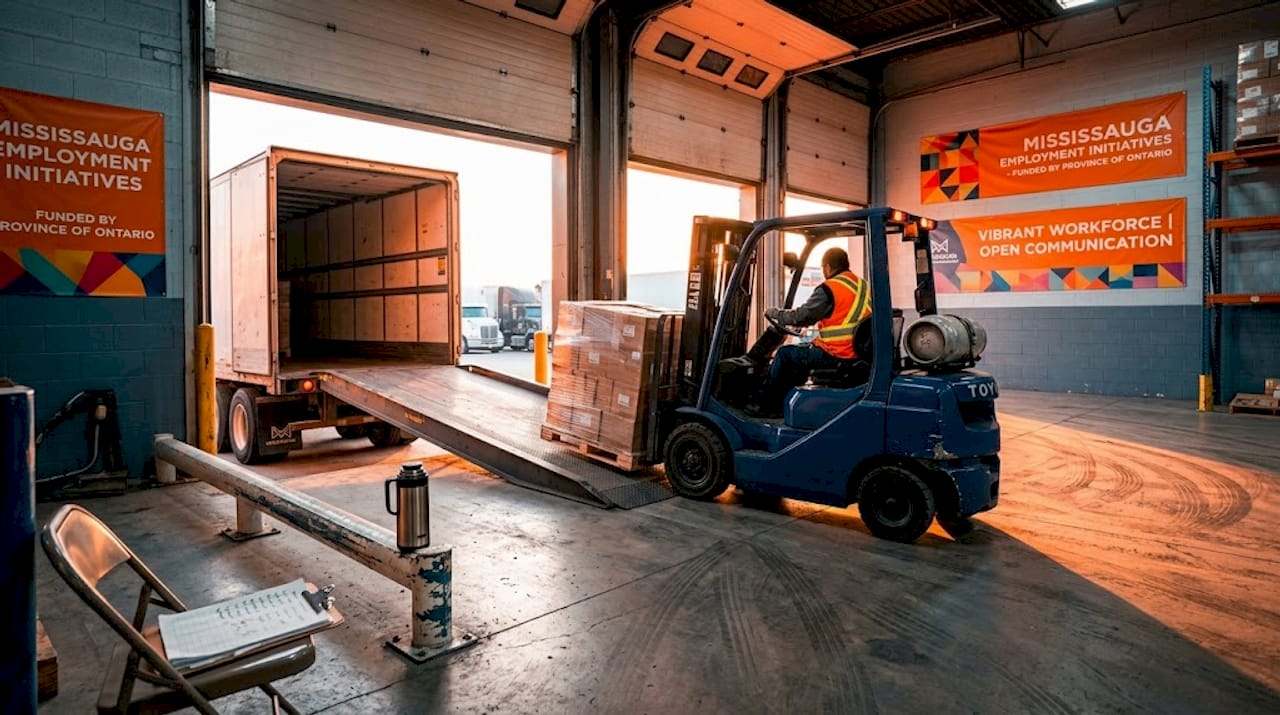
The asset mix here is broad. You will find older multi-tenant industrial buildings, large-bay logistics facilities, and industrial condos serving smaller owner-users. That range makes Dixie attractive to a wide spectrum of occupiers, from third-party logistics providers leasing 50,000 square feet to small manufacturers buying a unit for their own operations.
Key advantages of the Dixie Employment Area:
- Direct rail access for heavy freight users
- QEW and 401 on-ramps within minutes, reducing drayage time
- Established base of logistics and transportation tenants creating a supplier ecosystem
- Strong city planning protection as a designated Employment Area
- Broad range of bay sizes and building types to suit different operational scales
The area does carry older building stock in parts, which means clear heights can be lower than what modern e-commerce distribution requires. If you need 36-foot clear heights and ESFR sprinkler systems, you may need to look at newer facilities in western Mississauga. But for businesses where rail access or established transport networks matter more than ceiling height, Dixie is hard to beat.
3. Mavis-Erindale Employment Area: heavy industry's preferred address
Mavis-Erindale sits in the central-west part of Mississauga and is widely regarded as one of the best manufacturing zones in Mississauga. The area is purpose-built for heavy industrial uses, with land parcels, zoning, and servicing designed to support manufacturing plants, truck terminals, and large-format distribution centres.
Like Dixie, Mavis-Erindale carries a major employment cluster designation, which means the city actively defends it against incursion from residential or light-commercial rezoning pressures. For long-term investors, that designation is a significant risk mitigation factor.
What sets this area apart from Dixie is the concentration of heavier manufacturing activity. You will find automotive suppliers, food processing operations, and industrial services companies that require large lots, outdoor storage rights, and heavy power servicing. Businesses with significant equipment, staging yards, or shift-based production runs tend to gravitate here precisely because the zoning and lot geometry support those uses.
The Mavis-Erindale area also benefits from proximity to the Credit River corridor and connections to Highway 403 and the 401, giving it solid highway access for regional distribution. Transit connectivity for workers is less developed than in the Airport corridor, so businesses here typically assume employees will commute by car. Factor that into your labour attraction strategy.
4. Airport Corporate Centre: Mississauga's global logistics gateway
The Airport Corporate Centre occupies the northeast corner of Mississauga, clustered around Pearson International Airport. It is the city's most recognisable top business district in Mississauga and draws a genuinely different occupier profile from the Employment Area zones.
The city designates this as a high-density employment district with transit-supportive infrastructure, including nodes at Spectrum, Orbitor, and Renforth. Those transit nodes matter because they connect the area to Mississauga's BRT network and, eventually, to regional rapid transit, making it easier to attract employees who do not drive.
For logistics users, the appeal is straightforward. You are minutes from Pearson, which processes billions in air cargo annually. Your supply chain can move from tarmac to warehouse to truck without leaving the immediate geography. Highway 427, the 401, and the 409 all converge in this corridor, making it one of the best-connected industrial real estate locations in Canada.
The Corporate Centre designation does carry trade-offs worth understanding:
- Higher land values and base rents compared to Employment Area zones
- Mix of office, commercial, and industrial uses means some sites carry limitations on outdoor storage and truck court depth
- City planning favours intensification over time, which can affect long-term industrial land availability
- Ideal for businesses running smaller-footprint, high-value logistics rather than bulk warehousing
Pro Tip: If you are a third-party logistics provider or freight forwarder whose clients depend on air freight, the cost premium of the Airport Corporate Centre is almost always justified. The operational savings from proximity to Pearson compound over time in ways that a simple rent-per-square-foot comparison will not capture.
The CN Milton Intermodal Hub development to the west is worth watching from this corridor. As that hub matures, some distribution functions that currently cluster near Pearson may shift westward, adjusting pricing and vacancy dynamics in the Airport area.
5. Meadowvale Business Park: technology-meets-light-industrial
Meadowvale Business Park occupies the northwest corner of Mississauga, adjacent to Brampton and close to Highway 401 and Highway 10. It does not fit the traditional heavy industrial mould. Instead, Meadowvale functions as a business employment park where light manufacturing, technology firms, R&D operations, and corporate office users coexist.
For businesses at the intersection of production and knowledge work, this zone has genuine appeal. The building stock includes flex-industrial and low-rise office-industrial hybrids that suit life sciences companies, electronics manufacturers, and tech-enabled logistics operators. The park has a planned, campus-like character that some businesses find more attractive for employee recruitment than a conventional warehouse district.
Meadowvale's limitations are equally clear. Truck court depth and bay door configurations in older buildings can restrict larger distribution operations. Heavy manufacturing uses are generally not compatible with the area's character and zoning intent. If your business needs significant outside storage, heavy power draws, or 24-hour truck movements, Meadowvale is the wrong address.
As part of the Path to Prosperity 2030 strategy, Meadowvale sits within the city's vision for diversified employment growth. That suggests planning stability for light industrial and business employment uses, which is reassuring for investors considering assets in this corridor.
6. Lakeview: redevelopment pressure and the shrinking industrial base
Lakeview is Mississauga's southeastern waterfront district, and it tells a cautionary tale about industrial land conversion. Historically an industrial area with power generation and manufacturing uses, Lakeview is now in active transformation. The opening of the $60-million Jim Tovey Lakeview Conservation Area is emblematic of the direction the city is taking this corridor: from heavy industrial to green space, residential, and mixed-use.
For investors, that shift carries a direct message. Industrial assets in Lakeview carry meaningful redevelopment risk and, in some cases, redevelopment opportunity depending on your investment horizon. Long-term industrial tenants may find lease renewals complicated by evolving zoning. Developers with an eye toward mixed-use conversions may find value here that pure industrial investors would not.
The remaining industrial businesses in Lakeview tend to be incumbents with long-established leases or owner-users who bought decades ago. New industrial tenants entering this area should proceed with a clear understanding of the city's planning intent and the lease terms that protect their operations.
For logistics, warehousing, or manufacturing businesses seeking certainty, Lakeview is not the first choice. For investors who understand redevelopment cycles and municipal planning, it may be exactly the kind of underappreciated opportunity worth analysing.
7. Downtown Mississauga: commercial hub, not an industrial address
Downtown Mississauga, centred around City Centre Drive and Square One, is Mississauga's premier commercial and retail core. It is not an industrial location and is not positioned as one. But understanding why it is worth mentioning for industrial-focused readers comes down to one point: businesses sometimes conflate "top business districts Mississauga" with industrial real estate, and those are entirely different markets.
Downtown Mississauga is where corporate head offices, retail anchors, and mixed-use residential towers concentrate. If your business has a head office or client-facing function that needs to be proximate to Mississauga's administrative and commercial centre, there may be a case for splitting your operations. Your warehouse or manufacturing function goes to Dixie or Mavis-Erindale. Your sales office or regional headquarters goes downtown.
That kind of operational split is more common than many businesses expect, particularly in the life sciences, food distribution, and professional services sectors. The transit access improvements planned for the downtown corridor over the next decade will make that split increasingly rational from a talent attraction perspective.
8. Comparative overview of Mississauga's top industrial areas
The table below summarises the key distinctions across the major industrial and employment districts covered in this guide.
| Area | Designation | Highway access | Rail access | Best suited for | Planning outlook |
|---|---|---|---|---|---|
| Dixie Employment Area | Employment Area | QEW, 401 | Yes | Logistics, warehousing, transport | Protected, stable |
| Mavis-Erindale | Employment Area | 401, 403 | Yes | Heavy manufacturing, truck terminals | Protected, stable |
| Airport Corporate Centre | Corporate Centre | 401, 427, 409 | No | Air freight, global logistics, flex industrial | Intensification over time |
| Meadowvale Business Park | Business Employment | 401, 10 | No | Light industrial, R&D, flex office-industrial | Diversified growth |
| Lakeview | Transitional / Mixed | QEW | No | Owner-user industrial, redevelopment plays | Active conversion pressure |
| Downtown Mississauga | Commercial Core | 403 | No | Head office, retail, split-operations | Mixed-use intensification |
The distinction between Employment Areas and Corporate Centres is not administrative trivia. It directly shapes what you can build, what uses the city will protect, and what happens to land values over a 10 to 25-year holding period. Investors who differentiate these designations before committing capital consistently make better location decisions than those who treat all industrial zoning as equivalent.
My perspective on where Mississauga industrial real estate is heading
I have worked through enough GTA industrial transactions to say this plainly: most businesses underestimate how much municipal planning policy shapes the value of industrial real estate over time. In Mississauga, the city's Path to Prosperity 2030 strategy is genuinely significant. It signals that the city intends to protect core industrial lands while also pushing intensification in Corporate Centre nodes. For investors, that means the Employment Area assets in Dixie and Mavis-Erindale carry a planning moat that Corporate Centre locations do not.
What I see increasingly in 2026 is businesses making location decisions without fully accounting for their investment horizon. A logistics operator signing a 10-year lease in the Airport Corporate Centre is making a different bet than one signing in Dixie. Both can be right. But they are not the same bet.
The cybersecurity angle also comes up far more often in my conversations with manufacturing clients than it did five years ago. Knowing that manufacturing leads cyber incidents in Mississauga at 27% changes how some clients think about facility redundancy, backup power, and network infrastructure when they are evaluating a new site. It should be part of your due diligence checklist, not an afterthought.
My practical advice: match your location type to your operational profile and your time horizon. Do not let today's rent comparison override tomorrow's planning reality.
— Michael
Work with Mlawrealestate on your Mississauga industrial site search
Whether you are securing your first warehouse in Mississauga or expanding a multi-site logistics network across the GTA, the location decision deserves more than a quick search. Mlawrealestate brings institutional-grade market intelligence and hands-on transaction experience to every mandate, from tenant representation and lease negotiation to investment acquisitions and owner-user sales.
The Mississauga industrial real estate market is one of the most active and competitive in Canada. Getting the right building in the right zone at the right economics requires current data and a broker who knows how municipal planning, vacancy trends, and lease structures interact. Browse current industrial property listings across Mississauga and the GTA, or connect directly with Michael Law through Lennard Commercial Realty for a personalised market briefing tailored to your specific operational and investment requirements.
FAQ
What are the top industrial areas in Mississauga?
The top industrial areas in Mississauga are the Dixie Employment Area, Mavis-Erindale Employment Area, and Airport Corporate Centre. Each serves distinct needs: Dixie and Mavis-Erindale lead for logistics and heavy manufacturing, while Airport Corporate Centre suits air freight and global supply chain operations.
What is the difference between an Employment Area and a Corporate Centre in Mississauga?
Employment Areas are designated for traditional industrial uses like warehousing, manufacturing, and truck terminals. Corporate Centres permit higher-density, transit-supportive mixed-use development and are better suited to office-industrial or airport-linked logistics users.
Which Mississauga industrial area is best for manufacturing?
Mavis-Erindale is widely considered the best manufacturing zone in Mississauga, offering large lots, heavy power servicing, outdoor storage rights, and direct highway access suited to production-intensive operations.
Is Lakeview still a viable industrial location in Mississauga?
Lakeview carries significant redevelopment pressure, with the city actively converting former industrial waterfront lands to green space and mixed-use. It is better suited to developers or owner-users with long tenures than to businesses seeking stable, long-term industrial occupancy.
How does Pearson Airport affect industrial real estate in Mississauga?
Pearson International Airport drives strong demand for logistics and freight-forwarding facilities in the Airport Corporate Centre corridor. Businesses dependent on air cargo benefit from proximity to the airport, though rising land values and evolving city planning toward intensification are factors to weigh carefully.