

TL;DR:
- In the competitive GTA industrial real estate market, independent awards significantly enhance perceived legitimacy and trust. Verifying award credibility through transparent criteria and peer review is essential to avoid reputation risk. Strategic use of recognized awards alongside transaction data strengthens client and investor confidence effectively.
In a market as competitive as GTA industrial real estate, trust is a transactional currency. The role of awards in real estate credibility is one of the most misunderstood topics in the profession. Many practitioners treat awards as vanity trophies or assume clients ignore them entirely. Neither view is accurate. Research published in 2026 shows that independent awards boost perceived legitimacy by 45 points and generate 2.8 times more consumer trust than no recognition at all. For professionals advising logistics operators, manufacturers, and institutional investors in markets like Mississauga, Vaughan, and Brampton, understanding which awards carry genuine weight and which are hollow marketing tools is not optional. It is due diligence.
Table of Contents
- Key takeaways
- How awards influence real estate credibility and trust
- Recognising legitimate versus questionable awards
- Types of real estate awards and what each one signals
- Practical strategies for using awards in your GTA real estate brand
- My perspective on awards in the GTA market
- How Mlawrealestate builds credibility in GTA industrial real estate
- Common questions
Key takeaways
| Point | Details |
|---|---|
| Awards move trust metrics | Independent recognition increases perceived legitimacy by 45 points compared to unrecognised firms. |
| Selectivity is the credibility signal | Awards with acceptance rates under 5% carry significantly more weight than broadly distributed recognition. |
| Verification is non-negotiable | Check published criteria, judging panel independence, and acceptance rates before citing any award in marketing. |
| Award types serve different purposes | Consumer-voted, industry-judged, and membership-based awards each influence different stakeholder groups. |
| Awards complement, not replace, performance | Use recognition to reduce initial scepticism, then back it with data, track record, and local market expertise. |
How awards influence real estate credibility and trust
The formal concept at play here is third-party validation, the mechanism by which an external body confirms what a firm claims about itself. In real estate, where clients routinely commit to multi-million dollar decisions, the need for independent validation is acute. Awards represent one of the most scalable forms of that validation.
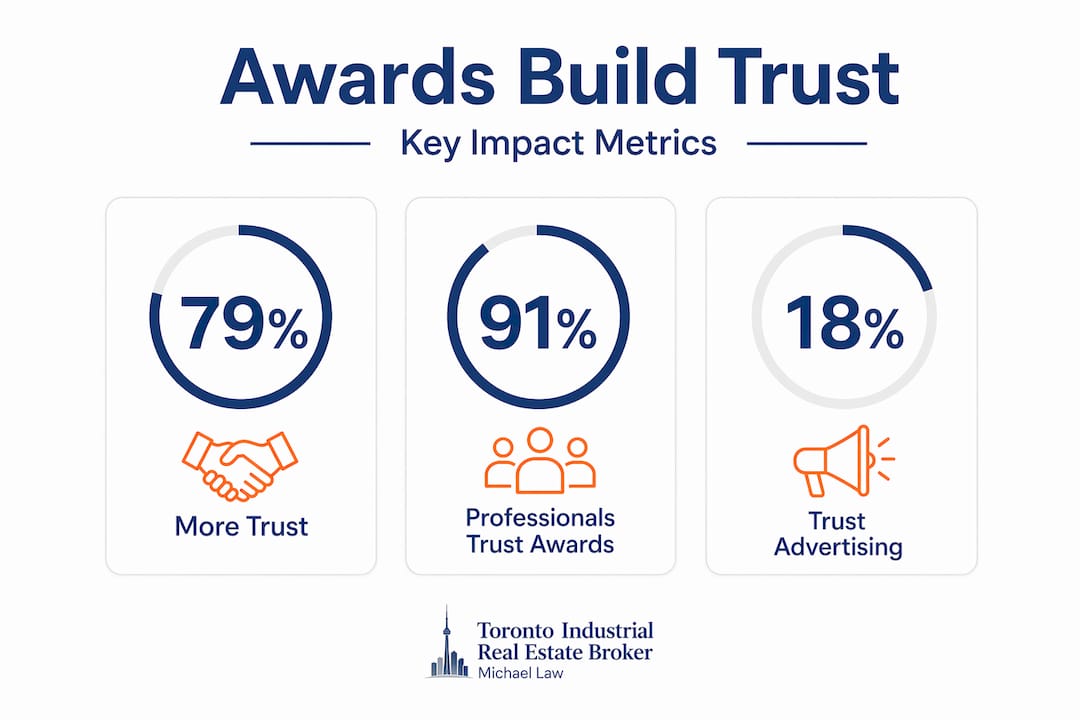
The data is striking. According to a 2026 study by Global Recognition Awards, 79% of consumers perceived a company as more legitimate after seeing an award. More relevant to commercial real estate professionals: 91% use award credentials when vetting business partners, and 89% factor them into investment consideration. For a GTA industrial broker working with institutional investors or REITs, those are not abstract percentages. They describe how your next client is evaluating you before the first phone call.
Why awards outperform paid advertising for trust
The reason awards carry more weight than advertising is not intuitive, but it is well-documented. Only 18% of respondents in the same study assumed award credentials were paid for. Compare that to 82% for paid advertising and 61% for press releases. This gap, sometimes called the authenticity scepticism gap, explains why a credible award on a company profile produces more trust lift than a six-figure marketing campaign. Buyers assume ads are self-serving. They assume an award from a third party involves at least some independent scrutiny.
This matters especially in commercial real estate, where scepticism about broker incentives runs high. A tenant looking for 50,000 square feet of warehouse space in Brampton is already filtering for credibility signals before they engage. An award from a recognised industry body reduces that friction in a way that no testimonial or marketing copy can replicate.
The investor dimension
The credibility effect is not limited to consumer-facing interactions. Research shows the trust lift from awards strengthens with seniority of decision makers and persists longer than advertising impressions. For investment sales professionals in the GTA, this is a meaningful insight. When a private investor or asset manager is vetting a broker for an industrial acquisition in Milton or Pickering, award recognition signals a baseline of peer-confirmed competence that marketing materials alone cannot establish.
Understanding how investor confidence builds is part of what separates advisors who close deals from those who stay in the pitch phase indefinitely.
Pro Tip: When presenting to institutional investors, list your awards alongside transaction volume and market coverage data. The combination of third-party recognition and proprietary performance metrics creates a credibility stack that is significantly harder to dismiss than either element alone.
Recognising legitimate versus questionable awards
Not all awards carry equal weight. In fact, some awards actively damage credibility when clients or investors look more closely. Understanding the difference between genuine recognition and pay-to-play marketing is one of the most practically useful skills a real estate professional can develop.

Indicators of genuine recognition
Legitimate awards share several characteristics that distinguish them from promotional products dressed up as industry honours.
- Published selection criteria. Credible awards specify exactly what they measure. Judging rubrics are public, not proprietary.
- Independent judging panels. The REB Awards in Australia, widely cited as a benchmark for rigour, attracted roughly 900 entries in 2026 and accepted approximately 3 to 4% as winners. That selectivity is itself the credibility signal.
- Multi-market peer review. The CoStar Impact Awards are judged by 570 industry professionals across 129 global markets. Multi-market peer panels reduce local bias and carry significantly more weight with institutional investors.
- Non-guaranteed outcomes. Legitimate award programmes charge administrative fees in the range of $100 to $500 but winning is never guaranteed by payment.
Red flags to watch for
| Warning sign | What it signals |
|---|---|
| Fee guarantees a win | Pay-to-play programme with no genuine selection |
| No published judging criteria | Criteria are subjective or non-existent |
| Acceptance rate above 50% | Recognition is broadly distributed, not selective |
| No named judges or panel | Cannot verify independence of the process |
| No searchable past winners | Programme lacks transparency or history |
The FTC has cited legal cases where awards created false credibility impressions without integrity guarantees. In the GTA industrial market, where institutional buyers perform serious due diligence, citing a questionable award can undermine your credibility faster than having no award at all.
Verification steps
A practical approach to verifying an award's legitimacy follows what industry practitioners call a verification ladder: check the issuer's published archives, seek independent third-party confirmation, and run a public records check on the organiser. For GTA professionals handling acquisitions in Vaughan or development advisory in Caledon, this verification process should take no longer than 30 minutes and can save significant reputational risk.
Pro Tip: Before including any award in a client pitch or marketing material, call the organiser directly and ask for the acceptance rate and a list of past winners. Organisations running legitimate programmes will answer those questions without hesitation.
Types of real estate awards and what each one signals
Not all recognition serves the same purpose. Understanding the different categories of real estate awards and their specific credibility functions lets you use them more strategically in client-facing and investor-facing contexts.
The four main categories are consumer-voted awards, industry-judged awards, membership-linked awards, and project impact awards. Each reaches a different audience and carries a different signal.
-
Consumer-voted awards. Programmes like the BrandSpark Most Trusted Awards use national surveys with strict thresholds. The 2026 edition drew from 35,215 shoppers evaluating 182,000 brand reviews across 359 categories. For real estate brands serving retail or residential clients, consumer-voted recognition translates directly to brand trust metrics.
-
Industry-judged awards. The CoStar Impact Awards, with 353 winners in 2026 across categories including lease, commercial development, and sale/acquisition, represent peer recognition within the professional community. This type of award carries the most weight with institutional investors and sophisticated commercial tenants.
-
Membership-linked awards. Programmes like the Navy Federal RealtyPlus Spirit Bell Awards tie recognition to tangible consumer benefits such as cash-back commissions. When an award is connected to a real client benefit, its perceived trustworthiness increases significantly because the recognising organisation has financial accountability in the outcome.
-
Project impact awards. These recognise specific transactions or developments based on market impact, community contribution, or financial outcomes. For GTA industrial professionals who have completed notable sale/leaseback transactions, redevelopments, or large-scale logistics acquisitions, this category offers the most credible form of third-party recognition because the evidence is transaction-specific.
| Award type | Primary audience | Credibility signal |
|---|---|---|
| Consumer-voted | Residential buyers, retail clients | Brand trust and name recognition |
| Industry-judged | Commercial tenants, investors, institutions | Peer-confirmed professional competence |
| Membership-linked | Service-dependent clients | Trust backed by financial accountability |
| Project impact | Institutional investors, developers | Evidence-based, transaction-specific recognition |
For GTA industrial professionals, industry-judged and project impact awards are the most relevant categories. They signal to the operators, investors, and developers who make decisions in markets like Mississauga industrial corridors that your work has been reviewed and validated by peers who understand the asset class.
Practical strategies for using awards in your GTA real estate brand
Knowing which awards matter is only half the equation. How you present and position them in client communications, pitch materials, and investor relations determines whether they actually move the needle on trust.
The most common error is overclaiming. An award does not prove superior outcomes. It signals reduced risk. Frame it that way. Telling a potential tenant in Brampton that you are an "award-winning broker" without context is noise. Telling them that your firm was selected from over 900 submissions in a peer-reviewed competition, with a 3% acceptance rate, based on measurable transaction outcomes, is credible and specific.
Here are the strategies that work in practice:
- Integrate awards into the due diligence layer, not the marketing layer. Include award credentials in your proposals alongside transaction data, vacancy trend analysis, and client references. This positions recognition as evidence, not decoration.
- Pair awards with local market intelligence. In the GTA, where market intelligence drives decisions, awards carry more weight when backed by proprietary data on absorption rates, rental trends, and submarket activity. One without the other is weaker.
- Be specific in investor materials. When presenting to private investors or REITs evaluating industrial acquisitions in Hamilton or Oshawa, name the award, the organiser, the year, the selection criteria, and the acceptance rate. Vague references to "industry recognition" are dismissed by sophisticated buyers.
- Use awards to open doors, not close deals. Recognition reduces scepticism at the top of the funnel. The actual decision to engage you depends on your knowledge, your network, and your track record. Awards create the room; you still have to fill it.
- Audit your award portfolio annually. Award programmes change. Some that were credible five years ago are now pay-to-play. Review each one for current judging practices and acceptance rates before renewing your marketing materials.
Pro Tip: Create a one-page award verification sheet for each recognition you cite in client materials. Include the issuer, judging process, acceptance rate, and year. This signals professionalism and makes due diligence easy for the institutional clients who will ask for it.
The advantages of a GTA industrial broker with verified, selective recognition extend well beyond optics. They simplify the trust-building phase with clients who are evaluating multiple advisors simultaneously.
My perspective on awards in the GTA market
I have watched the awards conversation evolve considerably over the years in commercial real estate. My honest view is that most practitioners get this backwards. They either dismiss awards as irrelevant marketing fluff, or they treat any recognition as proof of competence. Both positions are wrong in ways that cost clients.
What I have come to understand is that awards are uncertainty reducers, not performance guarantees. When an institutional investor in Toronto is evaluating two industrial brokers for an acquisition in Vaughan, they are not certain either one is the right fit. A credible, independently judged award narrows that uncertainty. It does not eliminate it, but it changes the conversation from "who is this person" to "what can they do for me specifically."
The GTA industrial market is one of the most competitive in Canada. Vacancy rates have tightened, rents have moved significantly, and the quality of advisory work required to execute well has increased accordingly. In that environment, award recognition from a rigorous programme signals that your work has been scrutinised. That matters to the people writing seven-figure cheques.
What I have also seen is that unverified or pay-to-play awards backfire. I have seen brokers list awards on their profiles that clients discovered were essentially purchased. That discovery does not just neutralise the credibility gain. It creates an active credibility deficit. The lesson is straightforward: vet your awards with the same rigour you apply to market analysis.
My advice is simple. Pursue recognition selectively, verify rigorously, present specifically, and let your transaction record do the heavy lifting. Awards should reinforce your credibility. Your work should establish it.
— Michael
How Mlawrealestate builds credibility in GTA industrial real estate
At Mlawrealestate, credibility is built on something more durable than any single award. It comes from a proven transaction record across leasing, investment sales, and owner/user acquisitions throughout the GTA, covering every major industrial corridor from Toronto West through Vaughan and Markham to the Durham Region.

Michael Law operates through Lennard Commercial Realty, one of Canada's most recognised commercial real estate firms, which provides the institutional infrastructure, market data, and professional standards that underpin every advisory engagement. The combination of deep local specialisation and a reputable brokerage affiliation is a credibility signal in its own right, one that sophisticated investors and occupiers recognise quickly.
Whether you are a logistics operator negotiating a renewal in Mississauga, a private investor evaluating an industrial acquisition in Caledon, or an institution assessing development land in Hamilton, you can explore current opportunities and advisory services across the GTA at Mlawrealestate properties. The goal at every engagement is the same: reduce uncertainty, improve your position, and execute with precision.
Common questions
Do awards genuinely improve a real estate professional's credibility?
Yes. Research shows that independent awards increase legitimacy perception by 45 points and are trusted by 91% of professionals when vetting business partners. The effect is strongest when the award is from an independently judged programme with a low acceptance rate.
How can I tell if a real estate award is legitimate?
Check for published selection criteria, a named independent judging panel, a verifiable acceptance rate, and a history of publicly listed past winners. Programmes where paying a fee guarantees a win are not legitimate industry recognition.
Which types of awards matter most to commercial real estate investors?
Industry-judged and project impact awards carry the most weight with institutional investors and commercial tenants. Programmes like the CoStar Impact Awards, judged by 570 real estate professionals across 129 markets, are regarded as credible peer validation in the commercial sector.
Should I mention awards in investor pitch materials?
Yes, but with specificity. Name the award, the organiser, the selection process, and the acceptance rate. Vague references to "industry recognition" are ignored by sophisticated investors. Specific, verifiable credentials reduce scepticism and support due diligence.
Can a questionable award hurt my reputation?
It can. If a client or investor discovers an award was pay-to-play, it creates an active credibility deficit. The risk of false credibility signals is well-documented. Audit your award portfolio regularly and remove any recognition you cannot verify with transparency.