

TL;DR:
- Ignoring market trends in GTA industrial real estate can lead to overpaying by 20% or more and erodes investor returns. Monitoring submarket vacancy, net absorption, leasing velocity, and development pipelines provides a strategic advantage in 2026’s shifting landscape. Consistent trend tracking helps investors make timely, data-driven decisions and avoid valuation discounts of up to 30%.
Overlooking market trends in industrial real estate is not a neutral decision. It is a costly one. For investors and business owners operating across Toronto and the Greater Toronto Area, understanding why track market trends in 2026 is the difference between locking in a well-priced lease and overpaying by 20% or more. The GTA industrial market is shaped by forces that move fast: vacancy rate shifts, supply chain restructuring, geopolitical fragmentation, and AI-driven analytics that surface opportunities weeks before they appear in mainstream reporting. This article lays out exactly what to monitor, what to act on, and what to ignore.
Table of Contents
- Key takeaways
- Why 2026 is a pivotal year for GTA industrial real estate
- How market indicators create a competitive edge
- The cost of not tracking industrial property trends
- Practical ways to build trend monitoring into your process
- A framework for applying trend insights in 2026
- My take on what most investors get wrong
- Work with Mlawrealestate for expert GTA market intelligence
- FAQ
Key takeaways
| Point | Details |
|---|---|
| 2026 is a pivotal year for GTA industrial markets | Supply chain shifts, rising vacancy, and new supply are reshaping pricing across every major corridor. |
| Ignoring trends creates real financial risk | Misaligned valuations can lead to 15% to 30% discounts that directly erode investor returns. |
| Distinguish trends from fads | Sustained directional change across multiple indicators signals a real trend worth acting on. |
| Tracking acceleration beats tracking volume | Monitoring how fast a signal is growing reveals market shifts weeks ahead of peak attention. |
| Expert advisory multiplies trend intelligence | Local advisors with proprietary data convert raw market signals into deal-specific decisions. |
Why 2026 is a pivotal year for GTA industrial real estate
The GTA industrial market entered 2026 in a state of recalibration. After several years of historically tight vacancy and record-setting net rents, conditions have shifted materially. New supply that was committed during the 2021 to 2023 construction boom has now been delivered. Vacancy rates across the GTA have risen from their sub-1% lows to levels that give tenants more options and put downward pressure on headline rents. For investors and business owners, that context alone makes market trend analysis 2026 a non-negotiable priority rather than a nice-to-have.
Beyond local supply fundamentals, the macro backdrop is genuinely complex. Global markets in 2026 are shaped by geopolitical bloc formation, currency volatility, and accelerating AI adoption across logistics and manufacturing. These forces are not abstract. They translate directly into which industrial submarkets attract tenants, which asset types command rent premiums, and which corridors face prolonged absorption challenges. Brampton and Mississauga continue to attract large-format logistics users tied to the 400-series highway network, while Vaughan and Markham absorb mid-bay manufacturing demand driven by nearshoring activity.
On the economic side, the picture is constructive but requires nuance. S&P 500 companies reported 9.2% revenue growth and 13.4% earnings growth in Q4 2025, and Q1 2026 results confirmed continued momentum. That signals that corporate occupiers are not pulling back on space commitments across the board, but individual sector performance varies widely.
- Logistics and e-commerce: moderating growth after the pandemic surge, but still net space-positive
- Advanced manufacturing: growing steadily as nearshoring accelerates across southern Ontario
- Cold storage and food distribution: structurally undersupplied in the GTA with strong absorption
- Flex and light industrial: competitive, with tenants using vacancy uptick to renegotiate aggressively
Pro Tip: Do not confuse overall market softening with uniform weakness. Submarkets and asset classes within the GTA are diverging sharply in 2026. A Brampton big-box asset and a Markham flex unit are different investment decisions.
How market indicators create a competitive edge
The investors who outperform in the GTA industrial market are not necessarily the ones with the most capital. They are the ones who read signals earlier and act with more precision. Understanding the importance of market trends 2026 starts with knowing which indicators actually matter and in what order to weight them.
Here is the framework that genuinely experienced industrial investors use when evaluating GTA opportunities:
-
Vacancy rate by submarket. Headline GTA vacancy obscures meaningful variation. An investor watching Oshawa versus Milton vacancy rates separately will spot demand shifts in the Durham corridor before they show up in aggregate data. Submarket vacancy is the single highest-signal indicator available.
-
Net absorption trends. Positive absorption in a submarket means tenants are taking space faster than it is being vacated. Tracking absorption on a rolling four-quarter basis eliminates single-quarter noise and reveals genuine directional movement.
-
Leasing velocity and deal structure. How quickly available units lease, and whether landlords are offering incentives such as free rent periods or tenant improvement allowances, signals real-time bargaining dynamics. A shift from zero incentives to three months of free rent tells you more than any rent index.
-
Investment sales activity and cap rate movement. When institutional buyers reduce acquisition activity in a submarket, cap rates adjust. Tracking this early allows private investors to either exit at peak pricing or acquire assets as institutional capital retreats.
-
Earnings and revenue signals from key tenant sectors. Revenue growth of 9.2% to 9.6% across S&P 500 companies confirms that corporate tenants in growth sectors still have the financial capacity to commit to space. Tracking sector earnings is not just for equity investors.
Most people monitor volume: how many listings, how many deals. What separates skilled analysts is tracking acceleration. As research on Social Velocity tracking demonstrates, measuring how quickly a signal is growing reveals market shifts four to six weeks before they register in conventional reporting. Applied to GTA industrial, this means tracking how fast leasing activity is increasing in a submarket, not just that it increased.
Pro Tip: Set up a simple quarterly scorecard with five to seven submarket indicators. Review it on a fixed schedule, not just when a deal is in front of you. Consistent monitoring beats reactive research every time.
The competitive intelligence tools market is growing at 12.90% CAGR from 2025 to 2035, reflecting that serious market participants across every sector are investing in better data infrastructure. For GTA industrial investors, that means the information gap between well-equipped operators and those relying on anecdotal market reads is widening rapidly. Closing that gap is not optional in 2026.
The cost of not tracking industrial property trends
There is a version of this conversation that sounds hypothetical. It is not. Investors who entered the GTA industrial market in 2022 without tracking development pipeline data paid peak rents for long-term leases on assets that have since seen market rents soften as new supply arrived. The benefits of tracking market trends are concrete, but so are the costs of ignoring them.

The valuation dimension is significant. Research shows that misaligned valuation forecasts reduce investor confidence and create discounts of 15% to 30% for assets where the business case is unclear relative to market direction. In industrial real estate, this plays out when a property is positioned around a tenant sector that is contracting while the owner expected growth. The asset trades at a discount not because the building is flawed, but because the market read was wrong.
The following comparison illustrates the difference in outcomes between trend-aware and trend-blind decision-making at the lease negotiation stage:
| Scenario | Trend-aware investor | Trend-blind investor |
|---|---|---|
| Market context | Identified rising vacancy in submarket six months prior | Relied on asking rents from 12 months ago |
| Negotiation outcome | Secured 18-month lease with three months free rent | Signed at gross face rate with no incentives |
| Effective rent difference | 16.7% lower annual occupancy cost | Paid market high without protection |
| Lease flexibility | Secured break clause at month 12 | No break options; locked in for full term |
| Outcome at renewal | Renegotiated from position of knowledge | Surprised by landlord's renewal terms |
Geopolitical volatility adds another layer of risk for those not monitoring market changes. Currency fluctuation affects the landed cost of goods for tenants in import-dependent sectors, which flows through to their ability to carry occupancy costs. An investor or business owner who understands the impact of fragmented global markets on tenant financial health will structure leases with appropriate safeguards. One who does not may find a tenant exercising a force majeure clause or requesting rent relief without warning.
The other underappreciated risk is misclassifying fads as trends. During the pandemic period, micro-fulfilment demand looked like a structural shift in GTA industrial. Some investors paid premium prices for small-bay urban assets positioned for last-mile delivery. Many of those facilities have since struggled with absorption as operators consolidated to larger regional hubs. Sustained directional change across multiple indicators is what validates a trend. A single data point and media attention is not enough.
Practical ways to build trend monitoring into your process
Tracking economic trends does not require a dedicated research department. It requires a structured habit and the right data sources. For most GTA industrial investors and business owners, the following approach is both realistic and sufficient.
-
Subscribe to submarket-level vacancy and absorption reports. Several commercial real estate data providers publish quarterly GTA industrial reports with submarket breakdowns. These are often available free through advisory relationships. Reading them consistently is more valuable than reading them occasionally in depth.
-
Monitor planning and development pipeline data. New supply registrations in the GTA give three to five quarters of lead time before delivery. Tracking what is under construction in Brampton versus what is delivering in Ajax allows you to anticipate where vacancy will rise before it registers in the market.
-
Set up Google Alerts for relevant tenant sector news. If your portfolio includes tenants in logistics, automotive parts, or food manufacturing, tracking sector-level headlines gives early warning of space requirement changes. A major contract win or loss at a key tenant triggers space decisions well before a formal notice lands on your desk.
-
Use AI-driven analytics platforms for real-time signal detection. As trend forecasting frameworks show, separating observation from interpretation requires structured tools. AI platforms that scan leasing activity, investment sales, and planning approvals simultaneously surface inflection points faster than manual review.
-
Maintain an active advisory relationship with a local market specialist. Data without local interpretation has limited value. A broker who completes twenty industrial transactions per year in Vaughan or Mississauga holds pattern recognition that no public database captures. That relationship converts raw data into decision-relevant intelligence.
Reviewing data-driven GTA investment approaches alongside your own portfolio review cadence creates a feedback loop that improves every subsequent decision.
A framework for applying trend insights in 2026
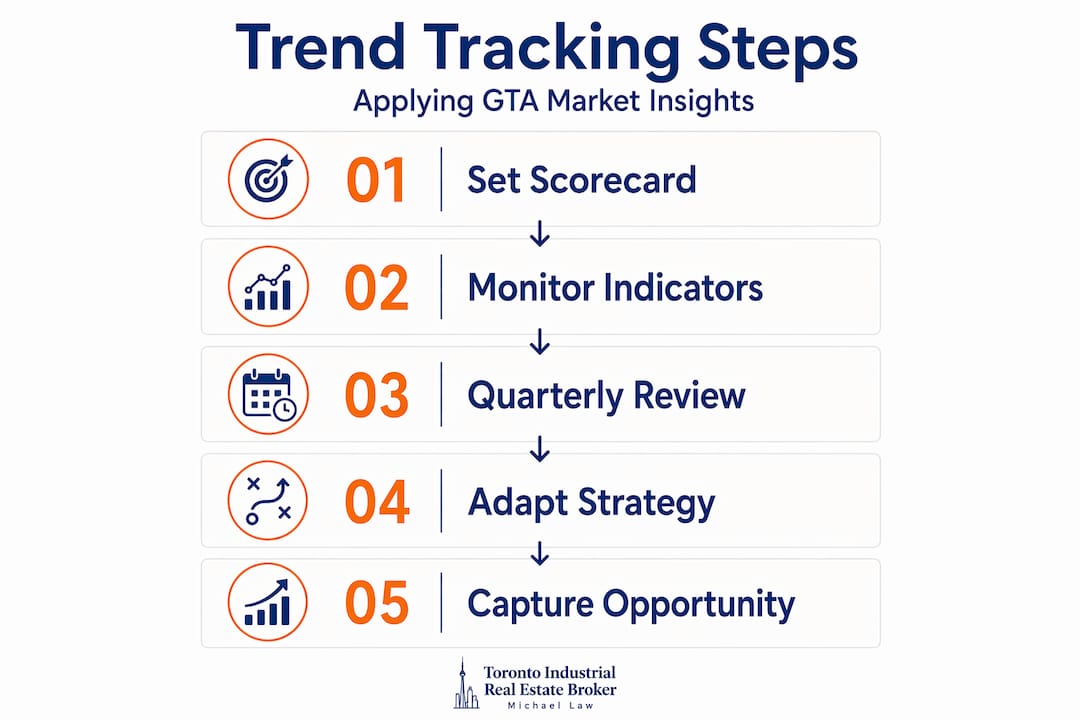
The goal of tracking market trends is not awareness for its own sake. It is better decisions on specific properties at specific moments. The following framework summarises how to apply trend intelligence directly to GTA industrial real estate decisions.
| Decision type | Key trend input | Application |
|---|---|---|
| Acquisition timing | Submarket vacancy trajectory and absorption pace | Buy ahead of demand recovery, not after it peaks |
| Lease negotiation | Incentive availability and leasing velocity | Use rising vacancy data to justify free rent and break clauses |
| Lease renewal | Comparable net rents and landlord concession patterns | Renegotiate from a position of current market data |
| Disposition timing | Cap rate compression and investment sales volume | Sell into institutional demand cycles, not during retreat |
| Site selection | Infrastructure investment and development pipeline | Prioritise corridors with confirmed capital investment |
Trend awareness reduces uncertainty and strengthens decision-making across every stage of the investment and occupancy lifecycle. It also compounds over time. Investors who monitor consistently build pattern recognition that accelerates future decisions. The first year of structured trend monitoring is the hardest. By year three, market reads that previously took weeks of research take hours.
The benefits of tracking trends also extend beyond individual deals. Investors who understand market direction position their portfolios strategically, concentrating assets in corridors with structural tailwinds and reducing exposure to submarkets with challenged fundamentals. That is not market timing in a speculative sense. It is disciplined capital allocation informed by evidence.
My take on what most investors get wrong
I have spent years working through GTA industrial transactions across every submarket from Hamilton to Oshawa, and the single most common mistake I see is confusing confidence with knowledge. Investors who feel they understand the market because they have been active in it for a long time are the most vulnerable to surprise.
The 2026 market environment does not reward experience alone. It rewards precision, speed, and adaptability, and those qualities only come from structured, ongoing trend monitoring. I have seen experienced investors overpay by double digits on assets where the development pipeline data told a clear story about incoming supply. The data was available. They simply were not looking at it systematically.
What I have learned about timing in this market is that the best decisions rarely feel obvious. They feel slightly early and slightly uncomfortable, because you are acting on trend acceleration before the mainstream catches up. That is exactly where the advantage lives. By the time a trend is obvious, the pricing has already moved to reflect it.
My advice to investors new to structured trend analysis is to start with one submarket, one set of indicators, and one quarterly review cadence. Build the habit before expanding the scope. The worst version of trend monitoring is an elaborate system that nobody actually maintains. A simple, consistent process beats a sophisticated one that gets abandoned after two quarters.
— Michael
Work with Mlawrealestate for expert GTA market intelligence

Mlawrealestate provides institutional-grade market intelligence and advisory services across every major GTA industrial corridor, from Mississauga and Brampton in the west to Ajax, Whitby, and Oshawa in the east. If you are an investor, business owner, or tenant trying to make sense of shifting vacancy rates, lease structures, or acquisition timing, the team at mlawrealestate.com brings the local expertise and data infrastructure to convert market signals into sound decisions.
Michael Law operates through Lennard Commercial Realty, with a track record spanning investment sales, tenant representation, lease renewals, and land advisory across the GTA. Every client engagement is grounded in current market data, submarket-level analysis, and direct transactional experience. Whether you are evaluating a Vaughan distribution centre, renegotiating a Brampton warehouse lease, or assessing a Hamilton land opportunity, the right market intelligence changes the outcome.
Explore available GTA industrial properties and connect with Michael directly to discuss your 2026 industrial real estate objectives. You can also review Michael's full profile and transaction background at Lennard Commercial Realty.
FAQ
Why does tracking market trends matter for GTA industrial investors?
Tracking market trends allows GTA industrial investors to time acquisitions, negotiate leases from a position of current data, and avoid overpaying in markets where conditions have shifted. Investors without trend awareness risk valuation discounts of 15% to 30% on mispositioned assets.
What are the most useful indicators for GTA industrial market analysis in 2026?
Submarket vacancy rates, net absorption trends, leasing velocity, development pipeline volume, and investment sales activity are the five indicators that provide the clearest picture of GTA industrial market direction in 2026.
How do you distinguish a real trend from a short-term fad in industrial real estate?
A real trend shows sustained directional change across multiple indicators over multiple quarters. A fad produces a short burst of activity in a single data source without broader confirmation. Requiring cross-indicator validation before acting is the most reliable way to avoid capital misallocation.
How often should investors review market trend data for GTA industrial properties?
A quarterly review cadence, aligned with the commercial real estate reporting cycle, is sufficient for most investors. During periods of rapid market change such as sharp vacancy movements or major supply deliveries, a monthly review of key submarket indicators is worth the additional time.
What is the impact of global economic conditions on GTA industrial real estate trends in 2026?
Geopolitical fragmentation, currency volatility, and nearshoring activity are directly influencing tenant demand in GTA industrial submarkets. Global market complexity in 2026 means that tracking economic trends at the macro level is now part of sound local investment analysis, not a separate exercise.